Where it forms, where it's found
- Geological setting
Secondary mineral formed by alkteration of uraninite in alkaline carbonate solutions.
- Type locality
- Edirne
- Edirne Province
- Turkey
41.6667°, 26.5667°
80recorded occurrences
Radioactivity
Physical
Optical
- Optical type
- Biaxial (+) · 2V measured = 37 – 42°
- Refractive index
- 1.494 – 1.542
- Surface relief
- Moderate
- Principal indices
- nα 1.494 – 1.501 · nβ 1.498 – 1.505 · nγ 1.535 – 1.542
- Pleochroism
- Visible
X = Nearly colourless Y = Light yellowish green Z = Light yellowish green
- Dispersion
- moderate r > v
- UV response
- Green to blue green fluorescence (LW & SWUV).
Δ = 0Δmax
PPLpleochroism per grain
XPLindependent extinctions · rotate the stage
PPLpleochroism only · colour blends on rotation
XPLinterference colour · extinct every 90°
Retardation410 nm
Order1st order
XPL colour
Crystallography
- Cell parameters
- a = 16.699(3) Å · b = 17.557(3) Å · c = 13.697(2) Å
- Ratio a:b:c
- 1 : 1.051 : 0.820
- Z
- 8
- Morphology
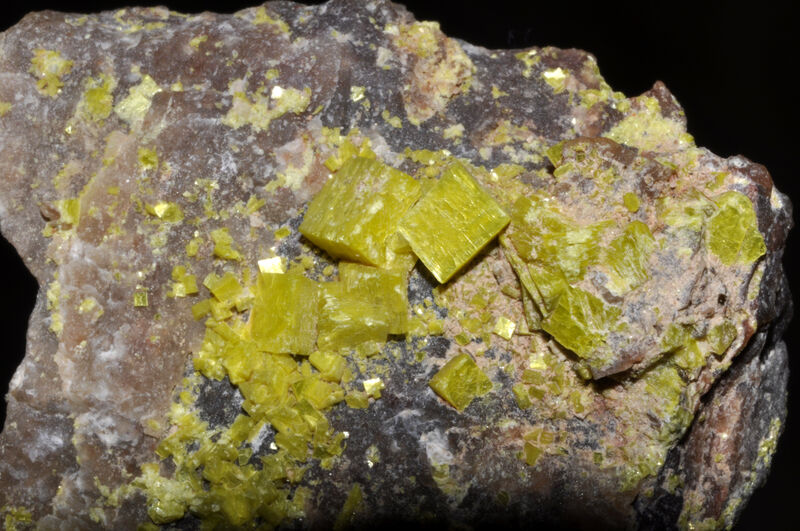
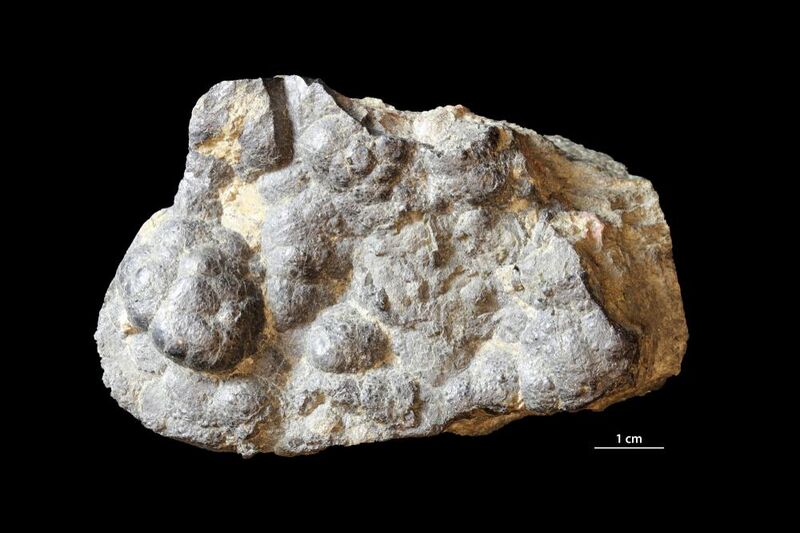
Crystals equant or short prismatic [001], normally indistinct with rounded edges and convex or vicinal faces. Commonly granular or scaly aggregates and thin crusts; botryoidal.
- Type-locality form
Mammillary concretion.
- Comment
Space Group: Bba2.
Crystal structure
Chemical composition
Synonyms
- Flutherit
- Flutherita
- Flutherite
- Hebergit
- Hebergita
- Hebergite
- Kalk-Uran-carbonate
- Liebigiet
- Medjidite
- Uranotalita
- Uranothallit
- Uranothallite
In other languages
- French
- Liebigite
- German
- Flutherit · Hebergit · Kalkurancarbonat · Liebigit · Uranothallit
- Spanish
- Liebigita
- Italian
- liebigite
Classification
Strunz
10th ed.5.ED.20
- 5CarbonatesClass
- 5.EUranyl CarbonatesDivision
- 5.EDUO2:CO3 = 1:3Group
- 5.ED.20LiebigiteSpecies
Dana
8th ed.15.03.02.01
- 15Hydrated Normal CarbonatesClass
- 15.03AmBn(XO3)p·xH2O, with (m+n):p = 1:1Type
- 15.03.02— unnamed intermediate level —Group
- 15.03.02.01LiebigiteSpecies
Group, growth & confusion
Literature, links & citation
Citations
- 1848Smith, J.L. (1848) Two new minerals, - medjidite (sulphate of uranium and lime) - liebigite (carbonate of uranium and lime). American Journal of Science and Arts: 5: 336-338.
- 1851Smith, J.L. (1851) American Journal of Science: 11: 259.
- 1853Vogl (1853) Jahrbuch Geol. Reichsanst., Vienna: 4: 221 (as Kalk-Uran-carbonate).
- 1856Lindacker analysis in: Vogl (1856) Gangverh. Mineralreich. Joachimsthal, Teplitz.
- 1875Weisbach, Albin (1875) Synopsis mineralogical, systematische Übersicht des Mineralreiches. 78 pp., Freiberg: 48 (as Flutherite).
Cite this entry
Entry last updated
@misc{mineral2025,
  author    = {Mineral Index editorial board},
  title     = {Liebigite — Mineral Index},
  year      = {2025},
  url       = {https://mineralindex.org/minerals/liebigite-2398}
}