History
Berzelius had glimpsed the mineral in 1819. He listed it tentatively under the uranite entry of his system. The description called it a "salt of calcium in which uranium oxide plays the role of acid".
Autunite got its own name in 1852, when Henry James Brooke and William Hallowes Miller described it. The type locality is at Saint Symphorien, near Autun in Saône-et-Loire, France. The town gave the mineral its name.
Industrial & practical applications
At 48 percent uranium by mass, autunite is a viable but minor ore of the metal — mined commercially where deposits are rich enough. At Mount Kit Carson in Washington State, nine properties together yielded about 90,000 pounds of uranium oxide. Other workable deposits lie in Cornwall, Katanga in the Democratic Republic of the Congo, and the northwestern United States.
Beyond uranium extraction, autunite has a small ornamental market. Its crystals fluoresce bright green to lime green under ultraviolet light, which makes them a collector favourite.
Where it forms, where it's found
- Geological setting
Granite pegmatite
In the oxidation zone of uranium-bearing rocks, including sandstones, hydrothermal veins, and granitic pegmatites.
- Type locality
- Saint-Symphorien-de-Marmagne uranium deposit
- Saint-Symphorien-de-Marmagne
- Autun
- Saône-et-Loire
- Bourgogne-Franche-Comté
- France
46.8287°, 4.2965°
Radioactivity
Physical
- Hardness
- 1Talc
- 2Gypsum
- 3Calcite
- 4Fluorite
- 5Apatite
- 6Orthoclase
- 7Quartz
- 8Topaz
- 9Corundum
- 10Diamond
- Transparency
- Transparent · Translucent
- Colour
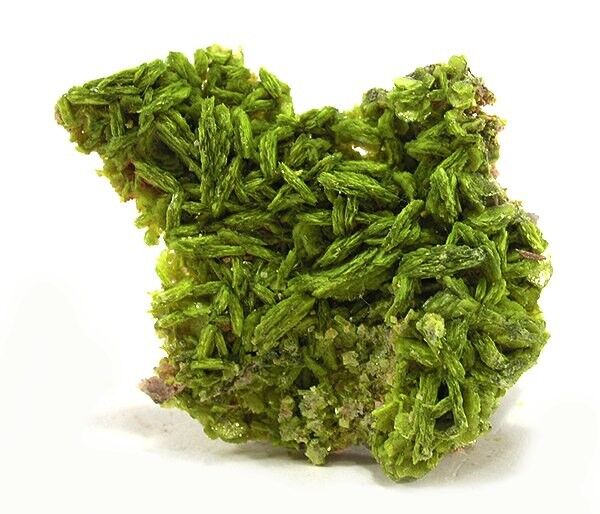
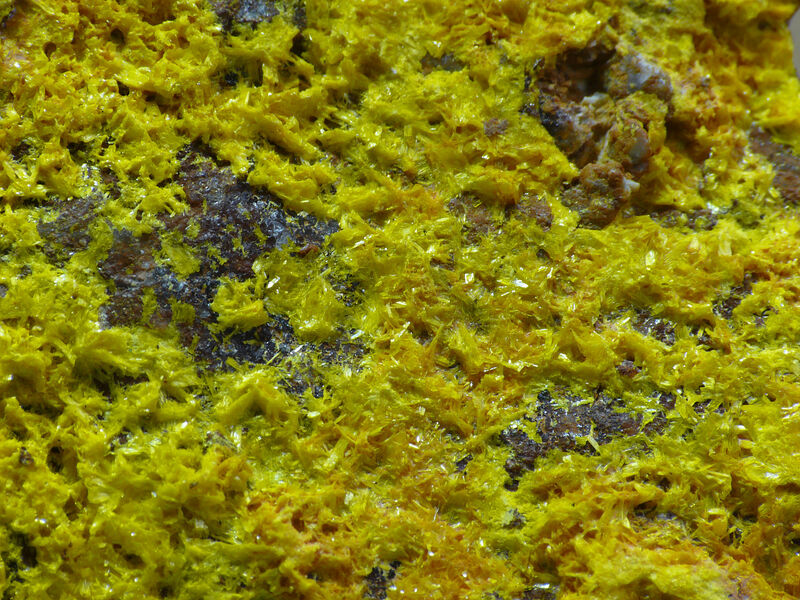
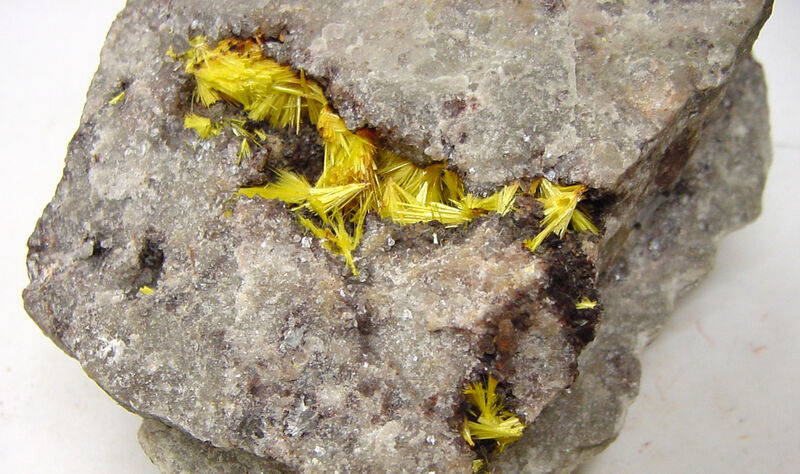
- Yellow · greenish-yellow · pale green · dark green · greenish black.
Color may become yellower and less greenish with even slight dehydration
- Streak
- Pale yellow
- Tenacity
- sectile
- Cleavage
- Perfect
Perfect on (001), indistinct on (100)
Autunite is fragile and may easily split with low pressure. On cutting, the mineral may appear sectile, waxy, or slightly elastic.
- Fracture
- Micaceous
- Density
- 3.05 g/cm³
Optical
- Optical type
- Biaxial (-) · 2V measured = 10 – 53°
- Refractive index
- 1.553 – 1.578
- Surface relief
- Moderate
- Principal indices
- nα 1.553 – 1.555 · nβ 1.575 · nγ 1.577 – 1.578 · nω 1.575 · nε 1.572
- Birefringence
- 0.024 (if biaxial)
- Pleochroism
- Visible
X = Colourless to pale yellow Y = Z = Yellow to dark yellow
- Dispersion
- r > v strong
- Extinction
- Z=c, Y={110}
- UV response
- Strong yellow-green (LW & SW UV).
- Notes
Uniaxial - but commonly anomalously biaxial - dependent on the H2O content of the crystals. 2V decreases with decreasing water content.
Crystallography
- Space group
- #71
- Cell parameters
- a = 14.0135(6) Å · b = 20.7121(8) Å · c = 6.9959(3) Å
- Ratio a:b:c
- 1 : 1.478 : 0.499
- Z
- 4
- Morphology
Crystals thin to thick tabular (001), and with a rectangular or octagonal outline. Subparallel growths common; foliated or scaly aggregates, crusts.
- Twinning
Rare interpenetrant twinning on (110).
- Epitaxy
Oriented growths on prism. Crystals look concentrically zoned.
- Comment
For synthetic material. Pseudotetragonal metrics. Often shown to be holosymmetrical tetragonal. Natural samples may show space-group symmetry I4/mmm, with a = 6.989, c = 20.63 Å.
Chemical composition
- Impurities
- Ba
- Mg
Synonyms
- Calcium-Autunite
- Calciumphosphoruranit
- Calcouranit
- Calcouranita
- Calcouranite
- Kalk-Uranglimmer
- Kalk-Uranit
- Lime-Uranite
- Ótainít
- Sel à base de chaux, où l'oxide d'urane joue le rôle d'acide
In other languages
- French
- autunite · Calcium-Autunite · Calcouranite · Lime-Uranite
- German
- Autunit · Kalkuranglimmer
- Spanish
- autunita
- Italian
- autunite
- Portuguese
- Autunita · autunite
- Japanese
- 燐灰ウラン石
- Chinese
- 钙铀云母
- Russian
- отенит
- Arabic
- أوتونايت · أوتونيت
Classification
8.EB.05
- 8Phosphates, Arsenates, VanadatesClass
- 8.EUranyl phosphates and arsenatesDivision
- 8.EBUO2:RO4 = 1:1Group
- 8.EB.05AutuniteSpecies
40.2a.01.01
- 40Hydrated Normal Phosphates, Arsenates and VanadatesClass
- 40.2aAB2(XO4)2·xH2O, containing (UO2)2+Type
- 40.2a.01— unnamed intermediate level —Group
- 40.2a.01.01AutuniteSpecies
19.11.15
- 19PhosphatesClass
- 19.11Phosphates of UGroup
- 19.11.15AutuniteSpecies
Group, growth & confusion
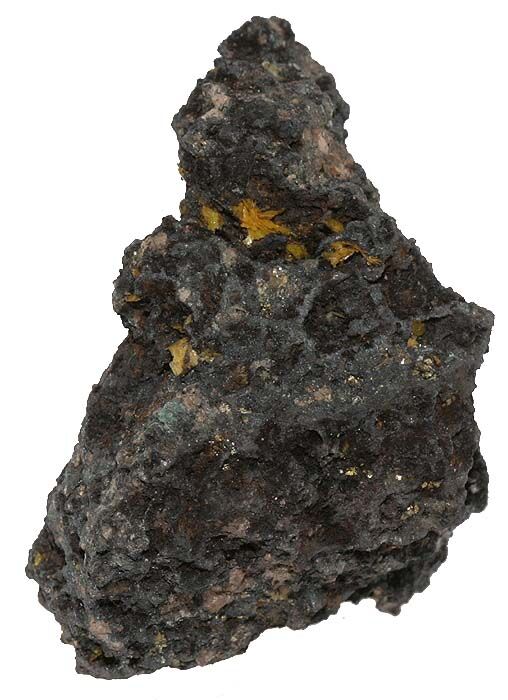 BassetiteFe2+(UO2)2(PO4)2(H2O)10Mineral—
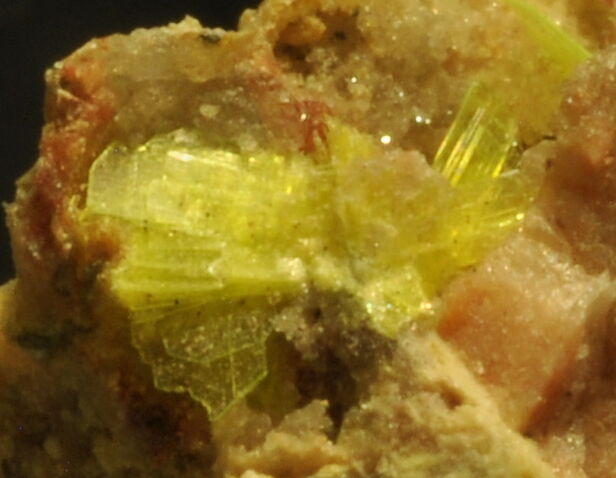 HeinrichiteBa(UO2)2(AsO4)2 · 10H2OMineral—
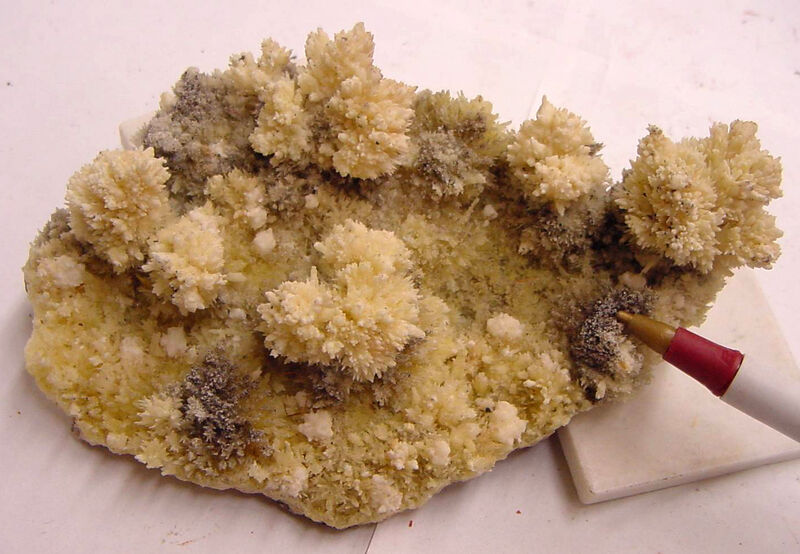 HydronováčekiteMg(UO2)2(AsO4)2 · 12H2OMineral—
- KahleriteFe2+(UO2)2(AsO4)2 · 12H2OMineral—
- NováčekiteMg(UO2)2(AsO4)2 · 10H2OMineral—
- RauchiteNi(UO2)2(AsO4)2 · 10H2OMineral—
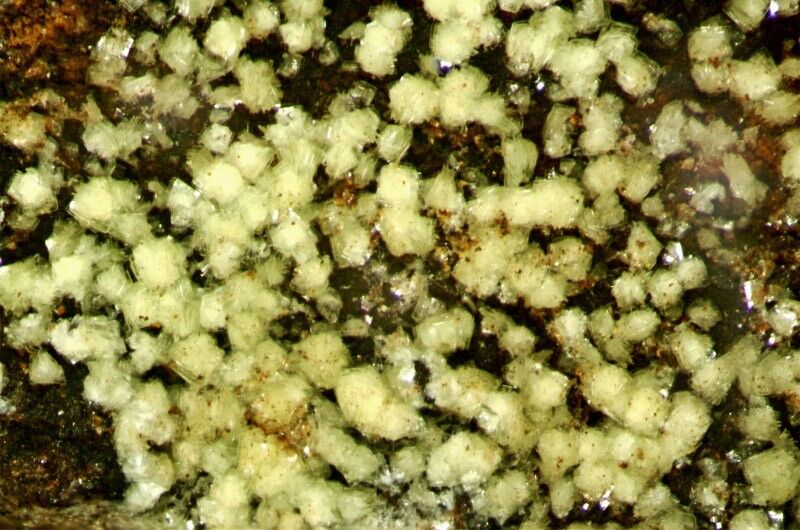 SabugaliteHAl(UO2)4(PO4)4 · 16H2OMineral—
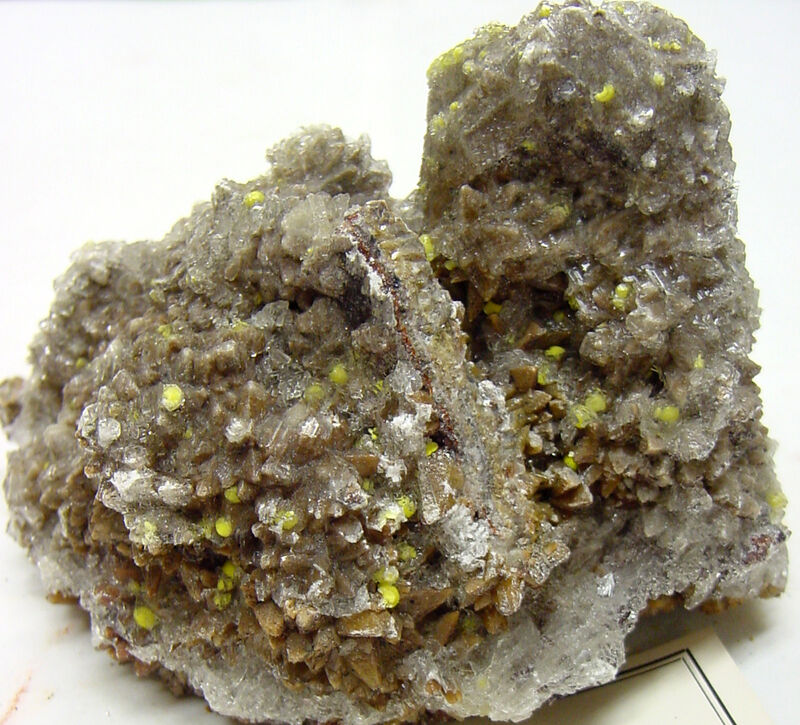 SaléeiteMg(UO2)2(PO4)2(H2O)10Mineral—
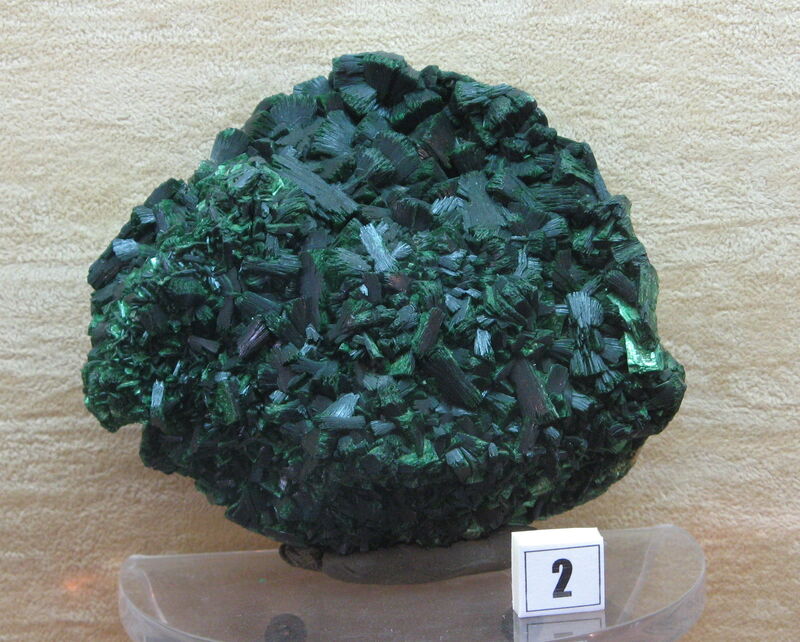 TorberniteCu(UO2)2(PO4)2 · 12H2OMineral—
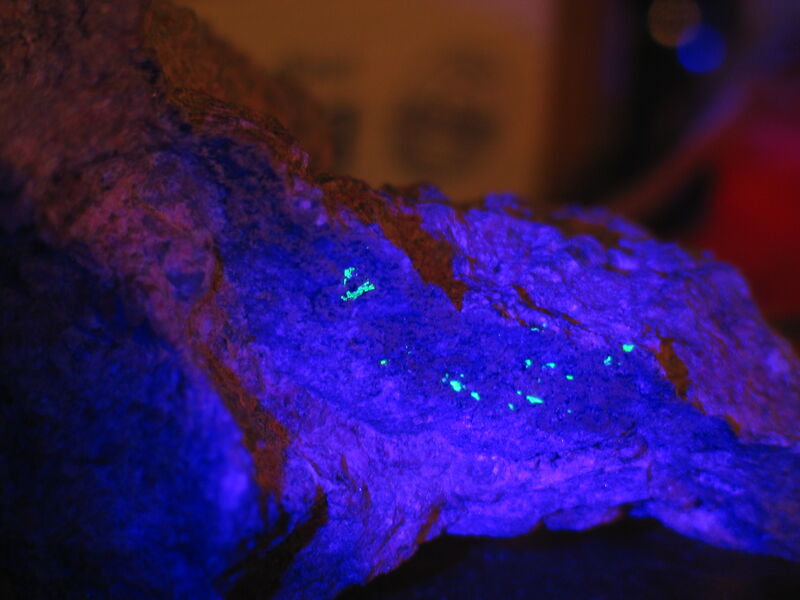 UranocirciteBa(UO2)2(PO4)2 · 10H2OMineral—
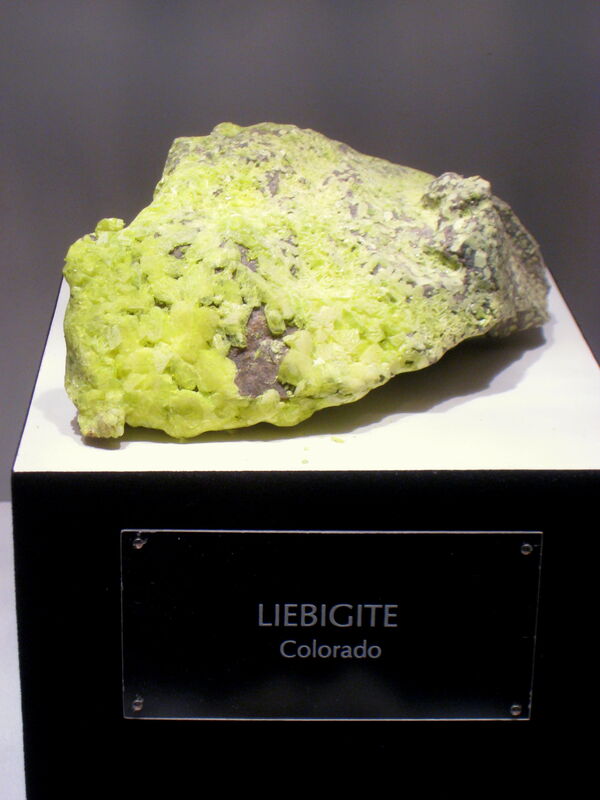
Literature, links & citation
- 1819Berzelius, J. J. (1819) Nouveau Système de minéralogie. Méquignon-Marvis.
- 1844Berzelius (1844) Annalen der Physik, Halle, Leipzig: 1: 379.
- 1852Brooke, Henry J., Phillips, William (1852) An Elementary Introduction to Mineralogy (6th ed.)
- 1865Breithaupt (1865) Berg.- und hüttenmännisches Zeitung, Freiberg, Leipzig (merged into Glückauf): 24: 302 (as Calcouranit).
- 1875Church, A.H. (1875) On the composition of autunite. Journal of the Chemical Society, London: 28: 109-112.
Entry last updated
@misc{mineral2026,
  author    = {Mineral Index editorial board},
  title     = {Autunite — Mineral Index},
  year      = {2026},
  url       = {https://mineralindex.org/minerals/autunite-433}
}