History
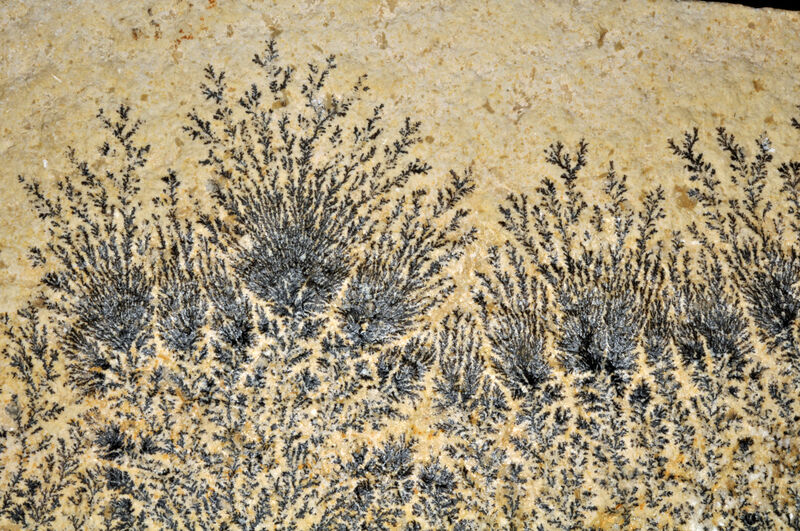
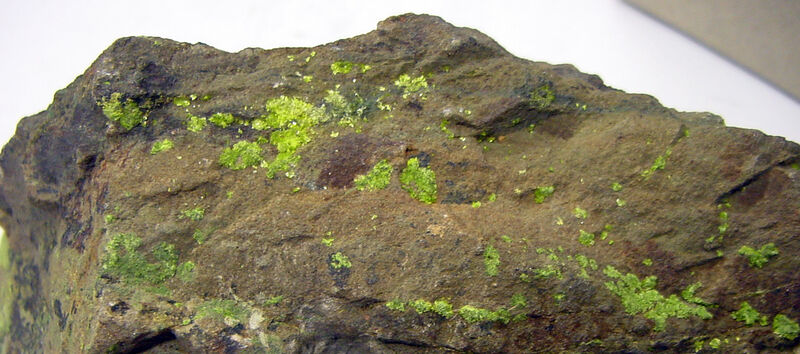
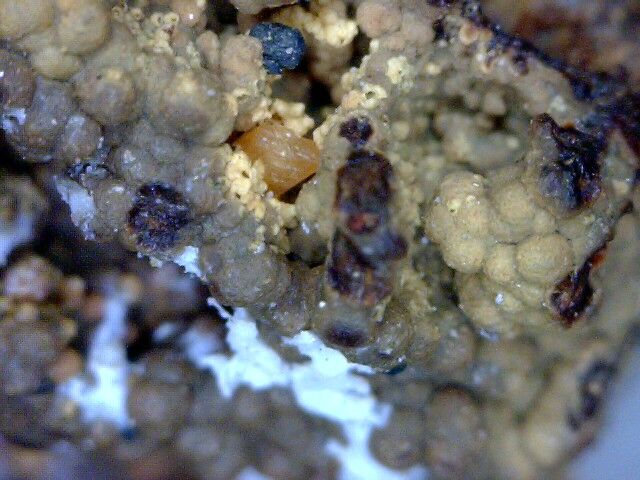
Manganese Oxides is not a single mineral. It is a collective field name for fine-grained mixtures of manganese oxide and hydroxide minerals. Pyrolusite, romanèchite, manganite and cryptomelane all hide in such a sample, too intergrown to tell apart by eye. Miners long had a blunter word for the same dark, earthy material: wad. It is an old mining term for any black manganese oxide or hydroxide mineral-rich rock, found where an ore body has weathered.
The black powders these rocks yield are among the oldest pigments people used. At the Gargas caves in France, paintings 30,000 to 24,000 years old were made with the mineral form of manganese dioxide. Blocks of the species pyrolusite turn up often at Neanderthal sites, kept as pigment — and perhaps powdered and mixed with tinder fungus to help light fires.
A second ancient use was subtler. Egyptian and Roman glassmakers added a pinch of manganese mineral to molten glass to cancel the green and brown tints that iron impurities leave behind. The trick earned the material the name glassmaker's soap, and it kept the colour out of glass through the Middle Ages and beyond.
The metal hiding inside these ores was not isolated until 1774. That year the Swedish chemist Carl Wilhelm Scheele reacted manganese dioxide with acid and first described the gas we now call chlorine. He recognised the dark mineral held an unknown element. His countryman Johan Gottlieb Gahn pulled the metal out the same year, reducing the dioxide with carbon to win an impure sample of manganese.
Industrial & practical applications
Taken together, the manganese oxide ores are the world's source of manganese — and most of that manganese goes into steel. Around 85 percent of the manganese ore mined in the United States feeds iron and steel production. The ores are first smelted into ferromanganese, an iron-manganese alloy. Heating the oxide with coke — carbon-rich coal residue — strips away the oxygen and leaves the metal. Mixed into molten steel, the manganese mops up sulfur and oxygen and toughens the finished metal.
The second great use is the battery. Manganese dioxide is the positive electrode material in ordinary dry cells, both the alkaline batteries and the older zinc-carbon (Leclanché) type. There it soaks up electrons as the cell discharges. Roughly 500,000 tonnes are consumed for this application each year. The grade that matters most here is electrolytic manganese dioxide, a purified form grown on an electrode from a manganese-sulfuric-acid bath. Natural ore is rarely clean enough for a good battery.
The rest of the demand is chemical and decorative. Glassmakers still add a little manganese to cancel the green tint that iron leaves in glass. The same oxides serve as inorganic pigments in ceramics and glass. Manganese dioxide is also a strong oxidising agent — a substance that pulls electrons from others. That makes it the starting point for chlorine gas and for potassium permanganate, a deep-purple disinfectant and laboratory reagent.
Where it forms, where it's found
Varieties
Synonyms
- Manganmulm
- Manganoxide
Group, growth & confusion
Literature, links & citation
- 1924Thiel, George A. (1924) The manganese minerals: their identification and paragenesis. Economic Geology, 19 (2). 107-145 doi:10.2113/gsecongeo.19.2.107DOI: 10.2113/gsecongeo.19.2.107
- 1924Fairbanks, Ernest E. (1924) The identification of manganese minerals. Economic Geology, 19 (8) 769-770 doi:10.2113/gsecongeo.19.8.769DOI: 10.2113/gsecongeo.19.8.769
- 1962Crittenden, M. D., Cuttitta, Frank, Rose, H. J., Fleischer, Michael (1962) Studies on manganese oxide minerals. VI. Thallium in some manganese oxides. American Mineralogist, 47 (11-12). 1461-1466
- 1987Chukhrov, F. V., Gorshkov, A. I., Drits, V. A. (1987) Advances in the crystal chemistry of manganese oxides. International Geology Review, 29 (4). 435-444 doi:10.1080/00206818709466161DOI: 10.1080/00206818709466161
- 1989Bish, David L., Post, Jeffrey E. (1989) Thermal behavior of complex, tunnel-structure manganese oxides. American Mineralogist, 74 (1-2) 177-186
Entry last updated
@misc{mineral2026,
  author    = {Mineral Index editorial board},
  title     = {Manganese Oxides — Mineral Index},
  year      = {2026},
  url       = {https://mineralindex.org/minerals/manganese-oxides-26664}
}