Where it forms, where it's found
- Geological setting
Lead slag
Lead-rich slags, also found in the oxide zone of some lead deposits in arid areas.
- Type locality
- Lavrion Slag Localities
- Lavreotiki
- East Attica
- Attica
- Greece
Safety & handling
Physical
Optical
- Optical type
- Biaxial (-)
- Refractive index
- 2.05 – 2.2
- Surface relief
- Very high
- Principal indices
- nα 2.05 · nβ 2.15 · nγ 2.2
- Pleochroism
- Visible
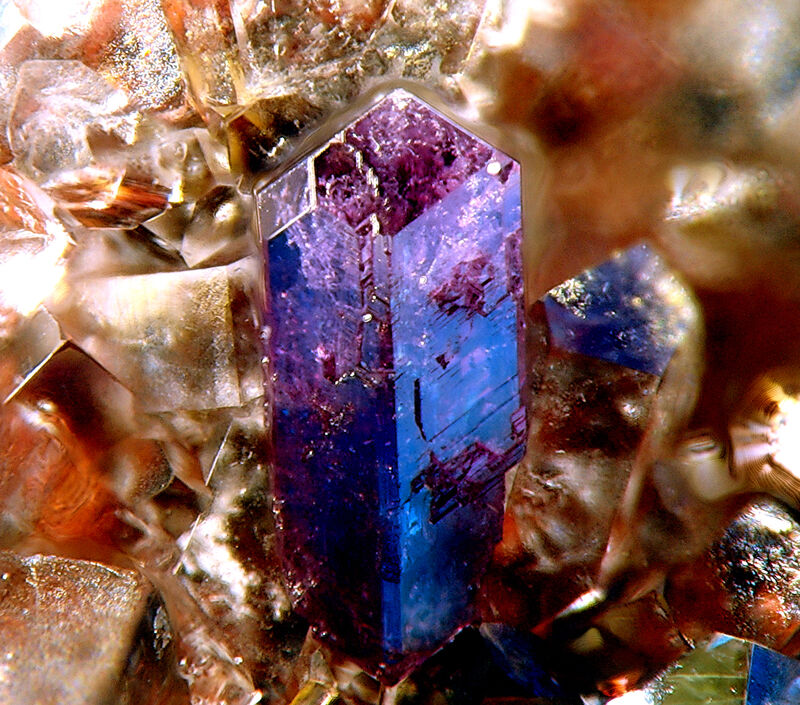
Violet-tinted crystals are pleochroic with absorption Y is greater than X, Z.
- Dispersion
- r < v strong
- Notes
Plates on (100) exhibit abnormal interference figures due to twinning.
Crystallography
- Space group
- C2/m
- Cell parameters
- a = 10.865(4) Å · b = 4.006(2) Å · c = 7.233(3) Å
- Cell angles
- β = 117.24(4) °
- Ratio a:b:c
- 1 : 0.369 : 0.666
- Morphology
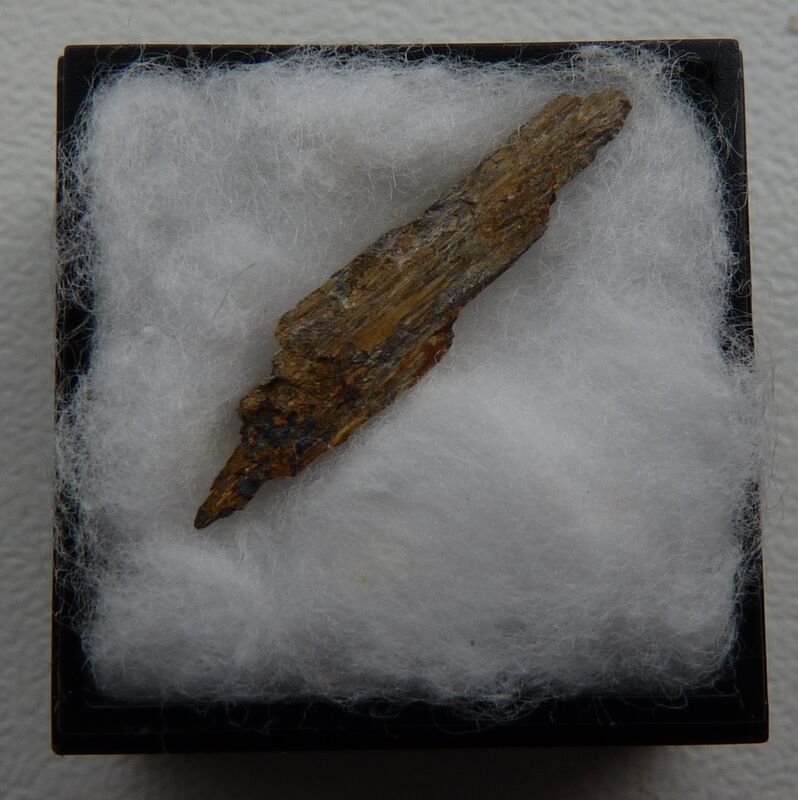
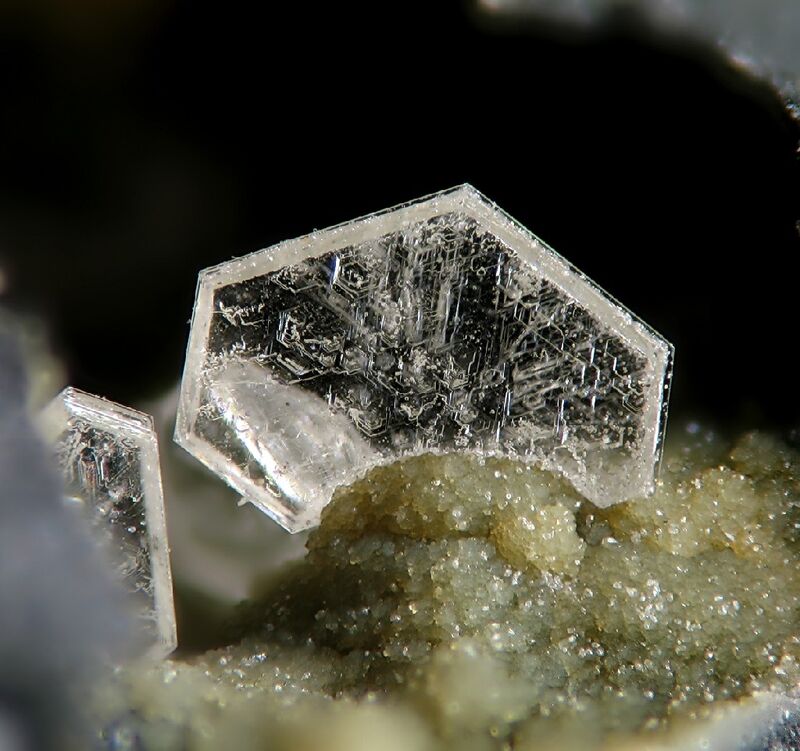
Crystals thin tabular (100) or lath-like by elongation [001]. The terminations of the plates or laths are rectangular or wedge-shaped as a result of development of pyramidal faces at the corners. Forms on type material: (100) large, (001) small, {10_1) minute, (20) small, (40) small, (60) small, (111) large, (110) large.
- Twinning
Twin plane (100), very common, as symmetrical contact twins with composition face (100), simulating orthorhombic holohedry.
- Type-locality form
Pseudo-rhombic tabular (to 10x15 mm) to prismatic (to 5 mm length). Similar to laurionite or fiedlerite.
- Comment
OD structure. I-centred setting has a ~ 9.92 A, β ~ 103°.
Chemical composition
Synonyms
- Laurionite-2M
- Paralaurioniet
- Rafaëlit (of Arzruni and Thaddéeff)
- Rafaelite (of Arzruni and Thaddéeff)
- Rafaelite (of Arzruni)
In other languages
- French
- Paralaurionite · Rafaelite
- German
- Paralaurionit
- Spanish
- Paralaurionita
- Italian
- Paralaurionite
Classification
3.DC.05
- 3HalidesClass
- 3.DOxyhalides, hydroxyhalides and related double halidesDivision
- 3.DCWith Pb (As,Sb,Bi), without CuGroup
- 3.DC.05ParalaurioniteSpecies
10.02.03.01
- 10Oxyhalides and HydroxyhalidesClass
- 10.02A(O,OH)XqType
- 10.02.03— unnamed intermediate level —Group
- 10.02.03.01ParalaurioniteSpecies
8.8.8
- 8Halides - Fluorides, Chlorides, Bromides and Iodides; also Fluoborates and FluosilicatesClass
- 8.8Halides of PbGroup
- 8.8.8ParalaurioniteSpecies
Group, growth & confusion
Literature, links & citation
- 1899Herbert Smith, G. F., Prior, G. T. (1899) On some lead minerals from Laurium, namely, Laurionite, Phosgenite, Fiedlerite, and (new species) Paralaurionite. Mineralogical Magazine and Journal of the Mineralogical Society, 12 (55) 102-110 doi:10.1180/minmag.1899.012.55.06 DOI: 10.1180/minmag.1899.012.55.06
- 1899Herbert Smith, G. F. (1899) Note on the Identity of Paralaurionite and Rafaelite. Mineralogical Magazine and Journal of the Mineralogical Society, 12 (56) 183 doi:10.1180/minmag.1899.012.56.08 DOI: 10.1180/minmag.1899.012.56.08
- 1899Arzruni, A.; Thaddéeff, K. (1899) Neue Minerale aus Chile, ein neues Vorkommen von Utahit und ein neues Wismuthcarbonat von Schneeberg. Zeitschrift für Kristallographie, Mineralogie und Petrographie, 31 (1-6). 229-247 doi:10.1524/zkri.1899.31.1.229 DOI: 10.1524/zkri.1899.31.1.229
- 1900Smith, G. F. Herbert (1900) Ueber die Identität von Rafaelit und Paralaurionit. Zeitschrift für Kristallographie, 32 (1-6). 217-219 doi:10.1524/zkri.1900.32.1.217DOI: 10.1524/zkri.1900.32.1.217
- 1910Ktenas, Const.-A. (1910) Sur les relations cristallographiques entre la laurionite et la paralaurionite. Bulletin de Minéralogie, 33 (3). 173-188 doi:10.3406/bulmi.1910.3422DOI: 10.3406/bulmi.1910.3422
Entry last updated
@misc{mineral2026,
  author    = {Mineral Index editorial board},
  title     = {Paralaurionite — Mineral Index},
  year      = {2026},
  url       = {https://mineralindex.org/minerals/paralaurionite-3096}
}