Where it forms, where it's found
- Geological setting
Intensely folded, carbonaceous shale beds.
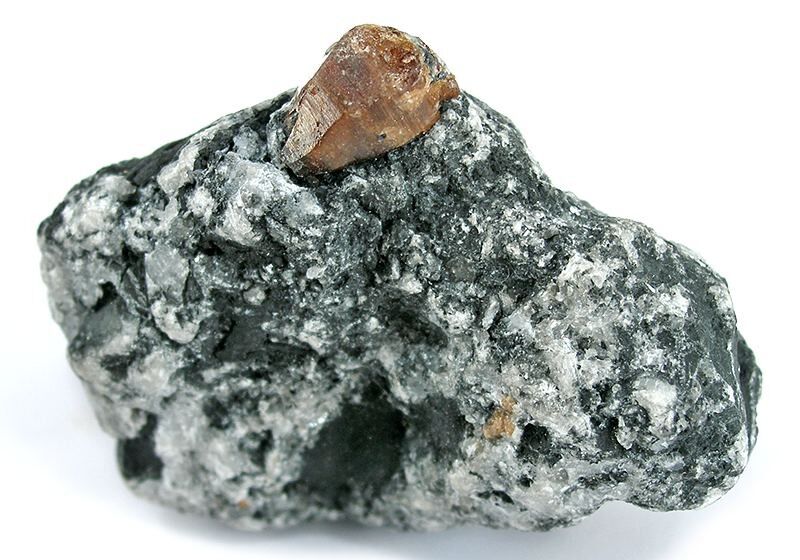
It occurs as an accessory mineral in differentiated alkalic massifs, granite pegmatites, and REE-rich carbonatites. It distributes in many localities, for example the carbonatite orebody of Mountain Pass, California, the carbonatite complex Amba Dongar, India, the alkaline granite-syenite pegmatites of the Mount Malosa pluton in Malawi the ultramafic lamprophyre–carbonatite complex near Delitzsch, Germany, the Bayan Obo Fe–Nb–RE deposit, Inner Mongolia, China.
- Type locality
- Muzo Municipality
- Western Boyacá Province
- Boyacá Department
- Colombia
5.5314°, -74.1072°
Physical
- Hardness
- 1Talc
- 2Gypsum
- 3Calcite
- 4Fluorite
- 5Apatite
- 6Orthoclase
- 7Quartz
- 8Topaz
- 9Corundum
- 10Diamond
- Lustre
- Vitreous
- Transparency
- Transparent · Translucent
- Colour
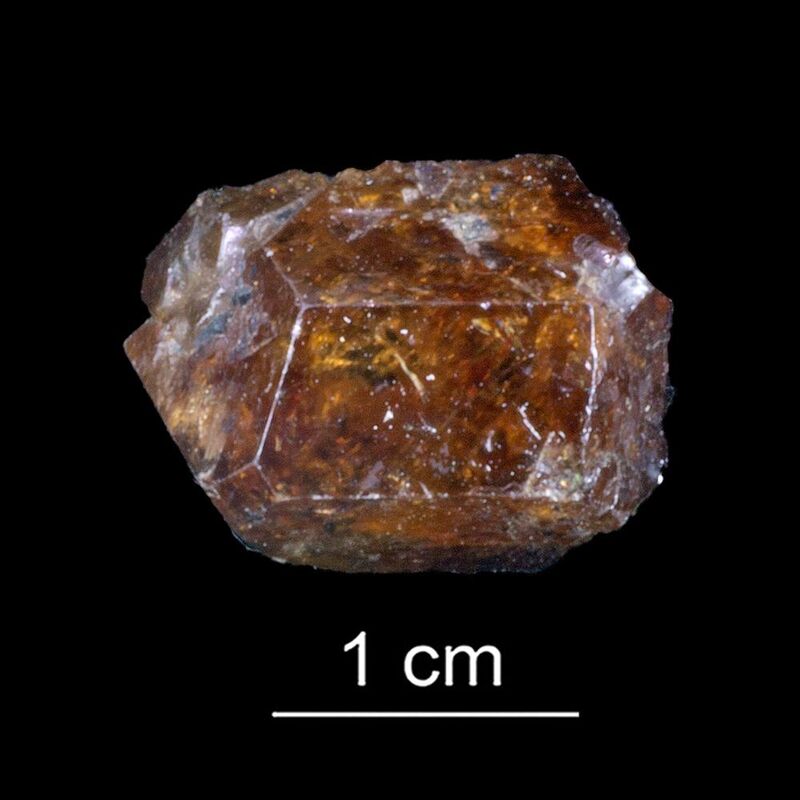
- Brown · brownish-yellow · waxy yellow · gray-yellow · colourless to yellow in transmitted light.
- Tenacity
- brittle
- Cleavage
- Distinct/Good
On (0001) (or parting) present at times apparently due to alteration.
- Fracture
- Splintery · Sub-Conchoidal
- Density
- 4.33 g/cm³
Optical
- Optical type
- Uniaxial (+)
- Refractive index
- 1.676 – 1.757
- Surface relief
- High
- Principal indices
- nω 1.676 · nε 1.757
- Pleochroism
- Weak
O = Light yellow E = Golden yellow Absorption E > O.
Crystallography
- Cell parameters
- a = 12.305 Å · b = 7.1056 Å · c = 28.2478 Å
- Cell angles
- β = 98.246 °
- Ratio a:b:c
- 1 : 0.577 : 2.296
- Z
- 12
- Morphology
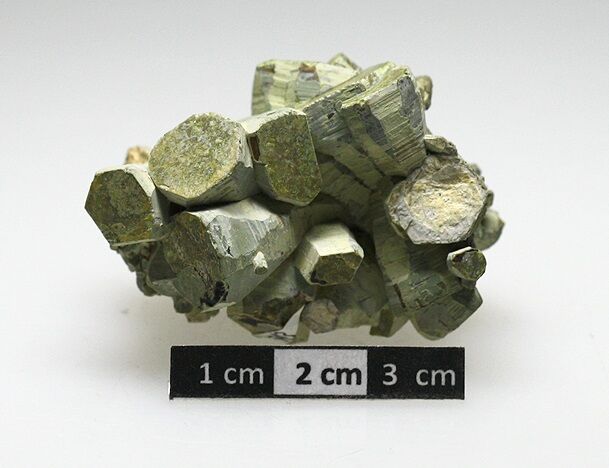
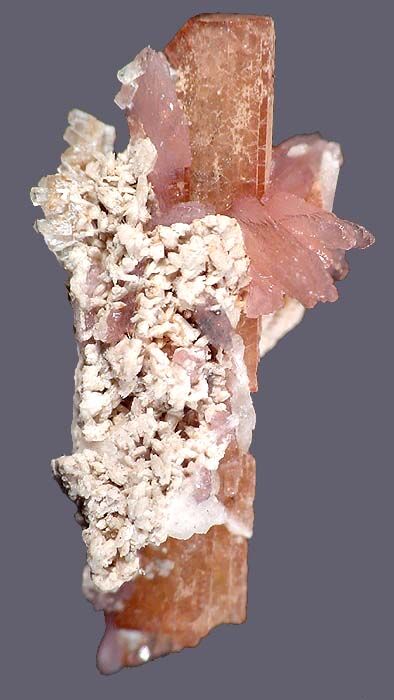
Crystals commonly acute double hexagonal pyramids; prismatic in appearance at times due to oscillatory combination of steep pyramids. True prism faces are either lacking or are very small. Also trigonal (or possibly rhombohedral in development). Elongated crystals have locally enlarged portions at times, or have sceptre-like terminations. Lateral faces are striated or deeply grooved. (0001) very commonly present as small faces, large at times.
- Comment
Space group Cc. Pseudohexagonal.
Chemical composition
- Impurities
- Y
- Sr
In other languages
- German
- Parisit-(Ce)
- Spanish
- Parisita- · Parisita-(Ce)
- Italian
- Parisite- · Parisite-(Ce)
- Chinese
- 氟碳鈰鈣石
Classification
5.BD.20b
- 5CarbonatesClass
- 5.BCarbonates with additional anions, without H2ODivision
- 5.BDWith rare earth elements (REE)Group
- 5.BD.20bParisite-(Ce)Species
16a.01.05.01
- 16aAnhydrous Carbonates Containing Hydroxyl or HalogenClass
- 16a.01(AB)(XO3)ZqType
- 16a.01.05Parisite SubgroupGroup
- 16a.01.05.01Parisite-(Ce)Species
12.1.11
- 12Carbonates with other anionsClass
- 12.1Carbonates with halidesGroup
- 12.1.11Parisite-(Ce)Species
Group, growth & confusion
Literature, links & citation
- 1835Medici-Spada (1835) (as Musite).
- 1845Medici-Spada in Bunsen, R.W.E. (1845) Ueber den Parisit, ein deues Cerfossil. Annalen der Chemie, Leipzig (Justus Liebig’s): 53: 147-156 (as Parisite).
- 1899Penfield, S.L., Warren, C.H. (1899) On the chemical composition of parisite and a new occurrence of it in Ravalli Co., Montana. American Journal of Science: 8: 21-24.
- 1900Penfield, S. L.; Warren, C. H. (1900) Ueber die chemische Zusammensetzung des Parisits und über ein neues Vorkommen desselben im Ravalli County, Montana. Zeitschrift für Kristallographie, 32 (1-6). 4-8 doi:10.1524/zkri.1900.32.1.4DOI: 10.1524/zkri.1900.32.1.4
- 1906Tschernik, G. (1906) Verh. Russ. Min. Ges.: 44: 507.
Entry last updated
@misc{mineral2026,
  author    = {Mineral Index editorial board},
  title     = {Parisite-(Ce) — Mineral Index},
  year      = {2026},
  url       = {https://mineralindex.org/minerals/parisite-ce-3120}
}