Where it forms, where it's found
- Geological setting
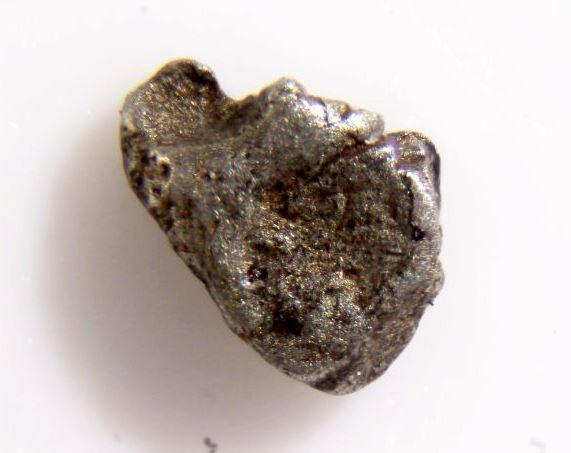
The clinopyroxenite mass has a depression near the center, and a small river, approximately 2-3 m wide and 2 km long, passes through this area and joins the Shakain River. PGM can be collected as a placer in this small river. Most of the PGM placer collected was composed of isoferroplatinum-based grains that are irregularly shaped with an average size of less than 1 mm, although grains up to 4 mm were also obtained.
- Type locality
- Haraigawa
- Misato
- Shimomashiki District
- Kumamoto Prefecture
- Japan
32.5726°, 130.7905°
Physical
- Hardness
- 1Talc
- 2Gypsum
- 3Calcite
- 4Fluorite
- 5Apatite
- 6Orthoclase
- 7Quartz
- 8Topaz
- 9Corundum
- 10Diamond
- Transparency
- Opaque
- Tenacity
- brittle
- Cleavage
- Poor/Indistinct
estimated to be along the (111) planes according to the isotypic malanite
- Density
- 5.78 g/cm³
Optical
- Optical colour
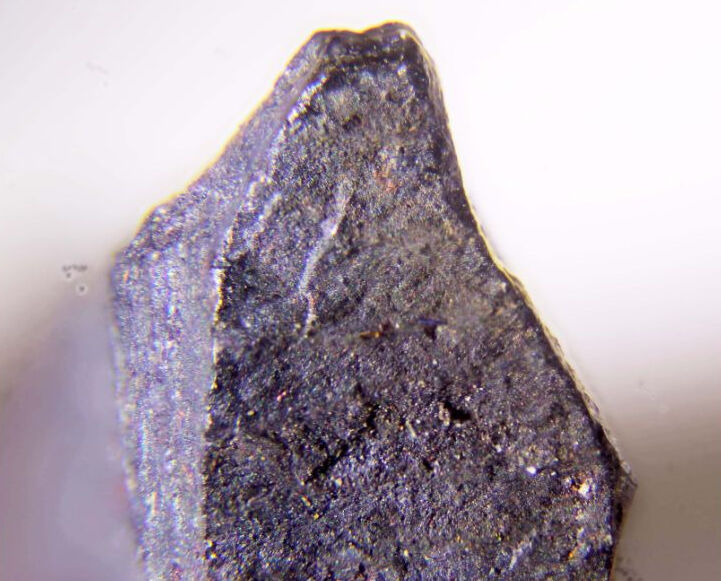
- a bluish gray color
Crystallography
- Space group
- Fd-3m
- Cell parameters
- a = 9.757(2) Å
- Z
- 8
- Type-locality form
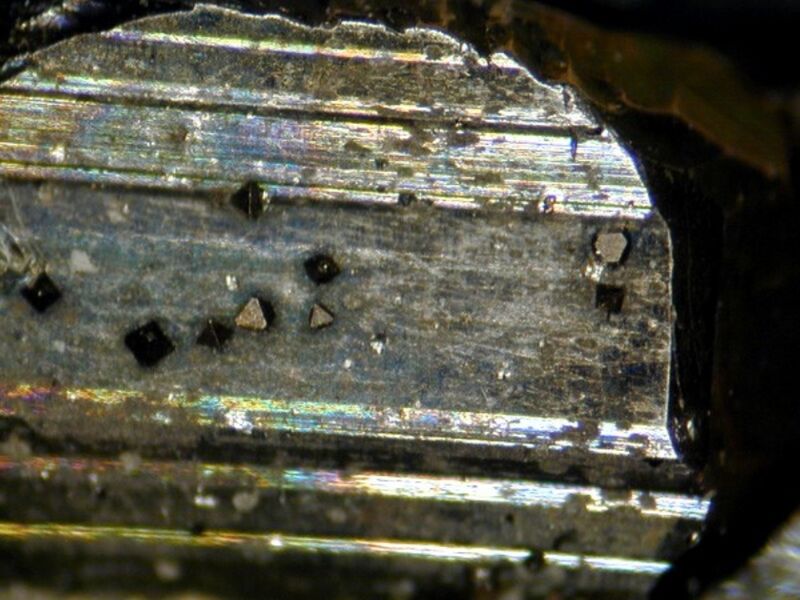
Isoferroplatinum-based grains are often accompanied by black to gray colored nubs from 20 to 500 μm in size. Shiranuiite and cuprorhodsite occur as dominant minerals of such nubs, although both are indistinguishable based on the occurrence mode and can only be distinguished by chemical analysis.
Chemical composition
Synonyms
- Shiranuiiet
In other languages
- German
- Shiranuiit
- Italian
- Shiranuiite
- Japanese
- 不知火鉱
Classification
2.DA.05
- 2Sulfides and SulfosaltsClass
- 2.DMetal Sulfides, M: S = 3 :4 and 2:3Division
- 2.DAM:S = 3:4Group
- 2.DA.05ShiranuiiteSpecies
Group, growth & confusion
- BerndlehmanniteCu(CrV)S4Mineral—
 CarrolliteCuCo2S4Mineral—
 CuproiridsiteCu(Ir3+Ir4+)S4Mineral—
- CuprokalininiteCu(Cr3+Cr4+)S4Mineral—
- EzochiiteCu+(Rh3+Pt4+)S4Mineral—
 FletcheriteCuNi2S4Mineral—
- FlorensoviteCu(Cr1.5Sb0.5)S4Mineral—
 MalaniteCu1+(Ir3+Pt4+)S4Mineral—
 RhodostanniteCu1+(Fe2+0.5Sn4+1.5)S4Mineral—
 ToyohaiteAg1+(Fe2+0.5Sn4+1.5)S4Mineral—
Literature, links & citation
- —Nishio-Hamane, D., Tanaka, T., and Shinmachi, T.: Shiranuiite, IMA 2023-072a, in: CNMNC Newsletter 78, Eur. J. Mineral., 36, https://doi.org/10.5194/ejm-36-361-2024, 2024.
- 2024NISHIO-HAMANE, Daisuke, SAITO, Katsuyuki (2024) Ezochiite, Cu+(Rh3+Pt4+)S4, a new mineral in the thiospinel group from Hokkaido, Japan. Journal of Mineralogical and Petrological Sciences, 119 (1). 240304 doi:10.2465/jmps.240304DOI: 10.2465/jmps.240304
- 2025Cabri, Louis J.; McDonald, Andrew M. (2025) Ezochiite and shiranuiite are cuprorhodsite and are not new mineral species. American Mineralogist, 110 (6). 941-944 doi:10.2138/am-2024-9517DOI: 10.2138/am-2024-9517
Entry last updated
@misc{mineral2026,
  author    = {Mineral Index editorial board},
  title     = {Shiranuiite — Mineral Index},
  year      = {2026},
  url       = {https://mineralindex.org/minerals/shiranuiite-471057}
}