History
The name strontianite is a place name twice over. It comes from the village of Strontian on the west coast of Scotland, and the village name in turn comes from the Gaelic Sròn an t-Sìthein — "the point of the fairy hill" — a knoll once said to be inhabited by the sìdhe. A lead mine opened in the hills above the village in 1725, and it was from that mine's ore that the mineral was eventually pulled and named.
The lead mines themselves were a Hanoverian-era enterprise. Sir Alexander Murray had found galena — the lead-sulfide ore — in the hills in 1722. Three years later he opened a working in partnership with the 8th Duke of Norfolk and General Wade. Among the rock the miners brought up was a pale, fibrous carbonate that none of the chemistry of the time could quite place.
In 1790 the Edinburgh physician Adair Crawford and the chemist William Cruickshank examined a specimen of that carbonate and concluded that "the Scotch mineral is a new species of earth which has not hitherto been sufficiently examined". The following year Friedrich Gabriel Sulzer analysed the same kind of specimen in Göttingen, working with the naturalist Johann Friedrich Blumenbach. He agreed it carried a new earth — eine neue Grunderde — and gave the mineral the name strontianite after the locality. In 1793 the Edinburgh chemist Thomas Charles Hope proposed naming the new earth itself strontites, writing simply "I have called it Strontites, from the place it was found". The metal itself was finally isolated by Humphry Davy in 1808, by electrolysis of a moist strontium chloride paste. He renamed it strontium to match the other alkaline-earth metals he was working with.
The Westphalian strontianite boom
For most of the 19th century strontianite was a curiosity. That changed when the German sugar industry discovered it could use strontium to pull more sugar out of beet molasses.
The chemistry had been patented in 1849 by the French chemists Hippolyte Leplay and Augustin-Pierre Dubrunfaut, originally with barium and then extended to strontium salts. Carl Scheibler reworked it into something that actually ran at industrial scale, with a string of patents between 1881 and 1883. The process — known as the Strontian process — heated calcined strontianite with beet molasses. The strontium hydroxide combined with the sugar into a poorly soluble strontium saccharide that could be filtered out. Carbon dioxide then split the saccharide apart, recovering both the sugar and the carbonate.
The first refinery to run it was the Dessauer Zuckerraffinerie in Dessau, where the chemist Emil Fleischer introduced Scheibler's method. The strontianite itself came from veins in the Münsterland — the calcareous-marl country around Hamm and Münster in North Rhine–Westphalia. Demand triggered what locals at the time called a Strontianitfieber, a strontianite gold-fever. A major working was opened at Drensteinfurt, named for the refinery director Dr Reichardt. Pre-war Germany's beet-sugar industry consumed on the order of 100,000 to 150,000 tonnes of strontium hydroxide a year.
The Westphalian boom was short. By 1883 demand for the German mineral had already begun to shrink. From 1884 onward, large-scale celestine deposits in Gloucestershire began to undercut strontianite on price. Falling sugar prices made molasses extraction unprofitable shortly afterward, and the process was eventually abandoned.
Industrial & practical applications
Strontianite is, in principle, an ore of strontium. Together with its sulfate cousin celestine, it is one of the two minerals from which the element is commercially extracted. In practice, almost all of that work is now done from celestine. Celestine deposits are larger, more concentrated, and cheaper to mine.
Where strontianite is still pulled from the ground, the strontium recovered from it enters the same downstream uses as the celestine-sourced material. Calcined to strontium carbonate, it becomes a feedstock for ferrite magnets — the inexpensive ceramic magnets in loudspeakers, small motors, and the magnets that hold notes on a refrigerator door. Strontium nitrate and carbonate are also the colourants in red pyrotechnics. Emergency flares and the deep crimson in fireworks displays draw their colour from strontium burning, an application that absorbs about five percent of world strontium production.
The mineral itself, rather than the element it carries, has a narrower modern profile. Well-formed strontianite — pale, fibrous, sometimes faintly green or yellow — is sought by mineral collectors and by museum collections as a representative carbonate species. Specimens from the original Strontian locality and from the Westphalian veins around Hamm and Münster carry historical interest in addition to their mineralogy.
Where it forms, where it's found
- Geological setting
In veins in gneiss.
Forms in low-temperature hydrothermal deposits in limestone and marl or as a gangue mineral in sulfide veins; as geodes or concretionary masses in limestone or clay.
- Type locality
- Strontian
- Fort William and Ardnamurchan
- Highland
- Scotland
- UK
56.6960°, -5.5690°
Varieties
Physical
- Hardness
- 1Talc
- 2Gypsum
- 3Calcite
- 4Fluorite
- 5Apatite
- 6Orthoclase
- 7Quartz
- 8Topaz
- 9Corundum
- 10Diamond
- Transparency
- Transparent · Translucent
- Colour
- Colourless · white · gray · light yellow · green · brown · colourless in transmitted light
- Streak
- White
- Tenacity
- brittle
- Cleavage
- Very Good
On (110) nearly perfect; on (021) poor; on (010) in traces.
- Fracture
- Irregular/Uneven · Sub-Conchoidal
- Density
- 3.74 g/cm³
Optical
- Optical type
- Biaxial (-) · 2V measured = 7° · 2V calc = 12 – 8°
- Refractive index
- 1.516 – 1.668
- Surface relief
- Moderate
- Principal indices
- nα 1.516 – 1.520 · nβ 1.663 – 1.667 · nγ 1.667 – 1.668
- Birefringence
- 0.090
- Pleochroism
- Non-pleochroic
- Dispersion
- weak
- Extinction
- Parallel
- UV response
- Fluorescent and phosphorescent in UV, X-rays, and electron beams. Bluish white (SW, MW, and LW), also white, pink or greenish white.
Crystallography
- Cell parameters
- a = 5.1059(7) Å · b = 8.4207(13) Å · c = 6.0319(11) Å
- Ratio a:b:c
- 1 : 1.649 : 1.181
- Z
- 4
- Morphology
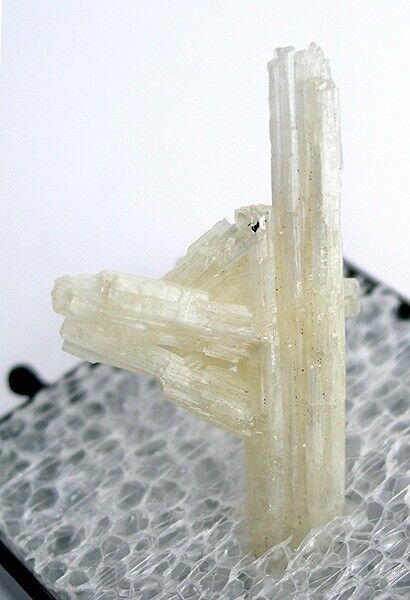
Crystals short to long prismatic [001], often acicular. Often pseudohexagonal in aspect due to equal development of (110) and (010) or of {hhl} and {0.2h.l}. (110) and (010) are striated horizontally, the steep {hhl} and {0kl} forms are rounded at times. Massive, columnar to fibrous; granular; rounded masses.
- Twinning
Very common. Twin plane (110), usually as contact twins, rarely as penetration twins; also repeated, as trillings, fourlings, or polysynthetic, yielding enclosed twin lamellae.
- Parting
- None noted.
- Comment
Non-standard space group setting (Pmcn).
Chemical composition
Synonyms
- Emmonsite (of Thomson)
- Kohlensaure Strontianerde
- Silberstein
- Stronthianit
- Stronthianite
- Strontian
- Strontian Spar
- Strontiane carbonatée
- Strontianita
In other languages
- French
- 1633-05-2 · Carbonate de strontium · Emmonite · Emmonsite · SrCO3 · Strontiane carbonatée · Strontianite
- German
- Strontianit · Stronzianit
- Spanish
- estroncianita
- Italian
- strontianite · stronzianite
- Portuguese
- estroncianita · Estroncianite
- Japanese
- ストロンチアン石
- Chinese
- 菱鍶礦 · 菱锶矿
- Simplified Chinese
- 菱锶矿
- Traditional Chinese
- 菱鍶礦
- Russian
- Стронцианит
- Arabic
- سترونتيانيت
- Hindi
- स्ट्रोन्शियानाइट
Classification
5.AB.15
- 5CarbonatesClass
- 5.ACarbonates without additional anions, without H2ODivision
- 5.ABAlkali-earth (and other M2+) carbonatesGroup
- 5.AB.15StrontianiteSpecies
14.01.03.03
- 14Anhydrous Normal CarbonatesClass
- 14.01A(XO3)Type
- 14.01.03Aragonite Group (Orthorhombic: Pmcn)Group
- 14.01.03.03StrontianiteSpecies
11.5.1
- 11CarbonatesClass
- 11.5Carbonates of Sr and BaGroup
- 11.5.1StrontianiteSpecies
Group, growth & confusion
Literature, links & citation
- 1778Bras-de-Fer, L. (1778) Terre (Élément). in Explication Morale du Jeu de Cartes, Anecdote Curieuse et Interessante Bruxelles: 99-100.
- 1791Sulzer (1791) Lichtenberg's Magazine: 7, 3, 68.
- 1791Sulzer, R. (1791) Ueber den Strontianit, ein Schottisches Fossil, das ebenfalls eine neue Grunderde zu enthalten scheint. Bergmännisches Journal, Freiberg (Neues Bergmännisches Journal): 1(5): 433-435.
- 1791Sulzer R (1791) Ueber den Strontianit, ein Schottisches Fossil, das ebenfalls eine neue Grunderde zu enthalten scheint. Bergmannisches Journal 1, 433-435
- 1795Klaproth, M. H. (1795) XVIII. Untersuchung des Strontianits, in Vergleichung mit dem Witherit. In Beiträge zur chemischen Kenntniss der Mineralkörper Vol. 1. Rottmann. p.260-278.
Entry last updated
@misc{mineral2026,
  author    = {Mineral Index editorial board},
  title     = {Strontianite — Mineral Index},
  year      = {2026},
  url       = {https://mineralindex.org/minerals/strontianite-3805}
}