Where it forms, where it's found
- Geological setting
occurs in a single, rounded nodule ~8–10 cm across of dark brown fluorapatite in biotite – quartz – plagioclase paragneiss
- Type locality
- Johnston Firth
- Stornes Peninsula
- Larsemann Hills
- Prydz Bay
- Ingrid Christensen Coast
- Princess Elizabeth Land
- East Antarctica
- Antarctica
-69.4153°, 76.0664°
1recorded occurrences
Physical
Optical
- Optical type
- Biaxial (+) · 2V measured = 46° · 2V calc = 37°
- Refractive index
- 1.712 – 1.722
- Surface relief
- High
- Principal indices
- nα 1.712 · nβ 1.713 · nγ 1.722
- Pleochroism
- Visible
X dark blue, Y blue, Z light brown Absorption: X > Y >> Z
- Dispersion
- very weak
- UV response
- none
Δ = 0Δmax
PPLpleochroism per grain
XPLindependent extinctions · rotate the stage
PPLpleochroism only · colour blends on rotation
XPLinterference colour · extinct every 90°
Retardation100 nm
Order1st order
XPL colour
Crystallography
- Space group
- Pbca
- Cell parameters
- a = 12.4595(7) Å · b = 11.5955(16) Å · c = 12.7504(7) Å
- Ratio a:b:c
- 1 : 0.931 : 1.023
- Unit cell volume
- 1842.1 ų
- Z
- 4
- Type-locality form
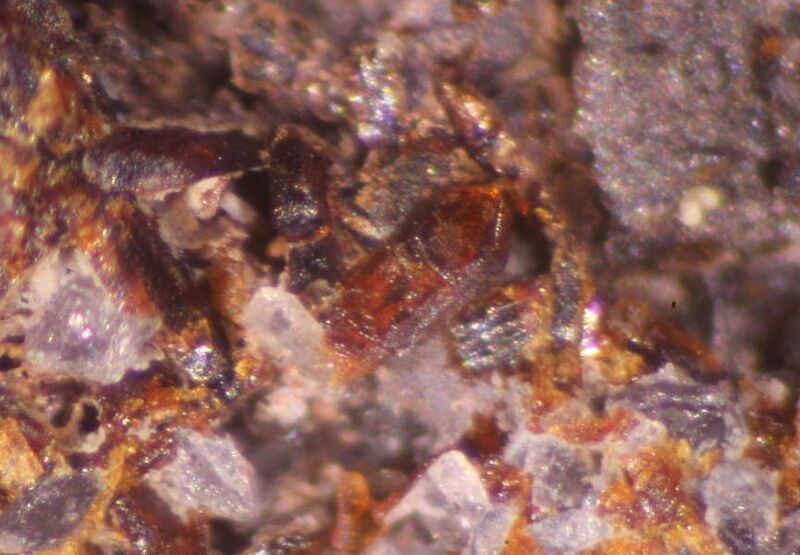
A few larger grains of tassieite (i.e., 0.5–1 mm) show crystal faces and cleavage traces, but most grains, which are 0.02 to 0.3 mm in longest dimension, are platy and anhedral
Crystal structure
Chemical composition
Synonyms
- IMA2005-051
- Tassieiet
In other languages
- German
- IMA 2005-051 · Tassieit
- Italian
- tassieite
Classification
Strunz
10th ed.8.CF.05
- 8Phosphates, Arsenates, VanadatesClass
- 8.CPhosphates without additional anions, with H2ODivision
- 8.CFWith large and medium-sized cations, RO4:H2O > 1:1Group
- 8.CF.05TassieiteSpecies
Dana
8th ed.40.02.16.03
- 40Hydrated Normal Phosphates, Arsenates and VanadatesClass
- 40.02AB2(XO4)2·xH2OType
- 40.02.16— unnamed intermediate level —Group
- 40.02.16.03TassieiteSpecies
Group, growth & confusion
Literature, links & citation
Citations
- 2007Grew, E. S., Armbruster, T., Medenbach, O., Yates, M. G., Carson, C. J. (2007) Tassieite, (Na,◻)Ca2(Mg,Fe2+,Fe3+)2(Fe3+,Mg)2(Fe2+,Mg)2(PO4)6 · 2H2O, a new hydrothermal wicksite-group mineral in fluorapatite nodules from granulite-facies paragneiss in the Larsemann Hills, Prydz Bay, East Antarctica. The Canadian Mineralogist, 45 (2) 293-305 doi:10.2113/gscanmin.45.2.293 DOI: 10.2113/gscanmin.45.2.293
- 2014(2014) Tassieite. Handbook of Mineralogy. Mineralogical Society of America
Cite this entry
Entry last updated
@misc{mineral2025,
  author    = {Mineral Index editorial board},
  title     = {Tassieite — Mineral Index},
  year      = {2025},
  url       = {https://mineralindex.org/minerals/tassieite-29006}
}