Where it forms, where it's found
- Geological setting
attributed to hyperalkaline pegmatite of type 4a comprising almost all fresh, highly mineralized pegmatites of the Mt. Alluaiv district
- Type locality
- Alluaiv Mountain
- Lovozersky District
- Murmansk Oblast
- Russia
67.8645°, 34.5124°
1recorded occurrences
Physical
Optical
- Optical type
- Uniaxial (+)
- Refractive index
- 1.61 – 1.619
- Surface relief
- Moderate
- Principal indices
- nω 1.619 · nε 1.610
- Pleochroism
- Visible
Lemon yellow (X), brownish pink (Y)
- UV response
- none
Δ = 0Δmax
PPLpleochroism per grain
XPLindependent extinctions · rotate the stage
PPLpleochroism only · colour blends on rotation
XPLinterference colour · extinct every 90°
Retardation90 nm
Order1st order
XPL colour
Crystallography
- Space group
- #78
- Cell parameters
- a = 14.205(7) Å · c = 30.265(15) Å
- Z
- 3
- Type-locality form
isolated, isometric, irregularly shaped grains 1–3 mm in size or as aggregates of the grains up to 1 cm across
Chemical composition
- Impurities
- F
- Sr
- K
- La
- Nd
- Nb
Synonyms
- IMA2007-023
- Voronkoviet
In other languages
- German
- IMA 2007-023 · Voronkovit
- Italian
- voronkovite
Classification
Strunz
10th ed.9.CO.10
- 9SilicatesClass
- 9.CCyclosilicatesDivision
- 9.CO[Si9O27]18- 9-membered ringsGroup
- 9.CO.10VoronkoviteSpecies
Dana
8th ed.64.01.03.03
- 64Cyclosilicates Rings with Other Anions and Insular Silicate GroupsClass
- 64.01Rings with Other Anions and Insular Silicate Groups with mixed ring typesType
- 64.01.03— unnamed intermediate level —Group
- 64.01.03.03VoronkoviteSpecies
Group, growth & confusion
- AlluaiviteNa19(Ca,Mn2+)6(Ti,Nb)3Si26O74Cl · 2H2OMineral—
- Amableite-(Ce)Na15[(Ce1.5Na1.5)Mn3]Mn2Zr3◻Si[Si24O69(OH)3](OH)2·H2OMineral—
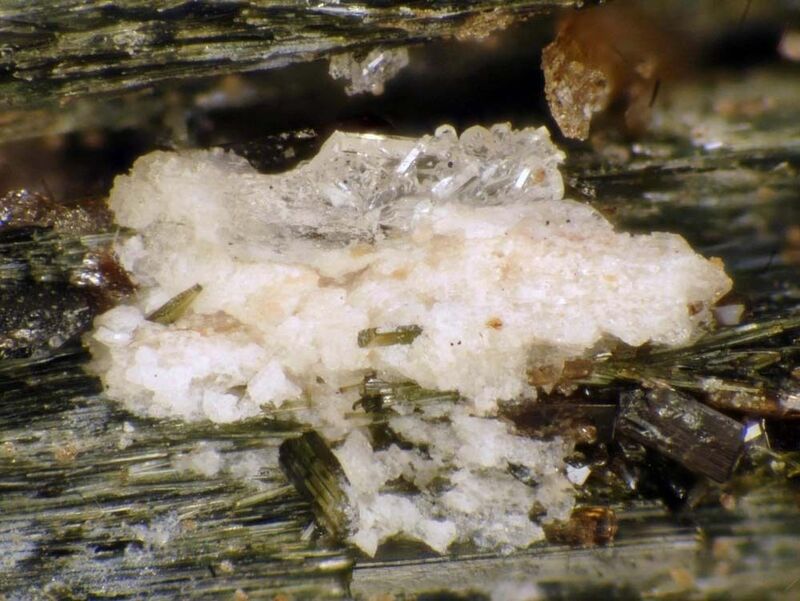 AndrianoviteNa12(K,Sr,Ce)3Ca6Mn3Zr3Nb(Si25O73)(O,H2O,OH)5Mineral—
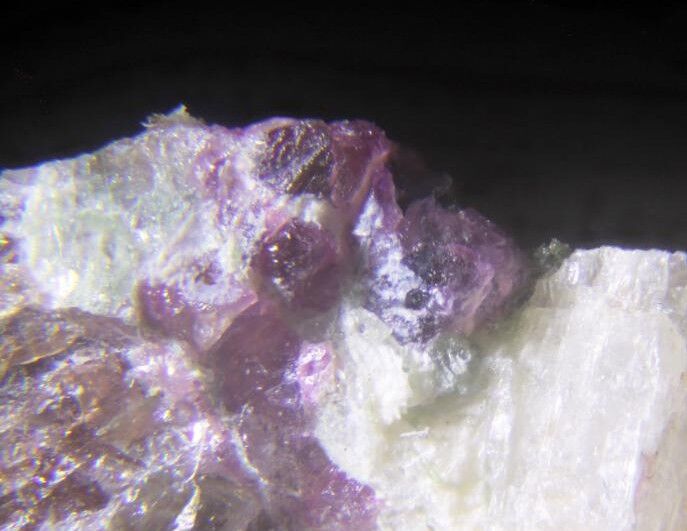 Aqualite(H3O)8(Na,K,Sr)5Ca6Zr3Si26O66(OH)9ClMineral—
- Carbokentbrooksite(Na,◻)12(Na,Ce)3Ca6Mn3Zr3NbSi25O73(OH)3(CO3) · H2OMineral—
- DavinciiteNa12K3Ca6Fe2+3Zr3(Si26O73OH)Cl2Mineral—
- DualiteNa30(Ca,Na,Ce,Sr)12(Na,Mn,Fe,Ti)6Zr3Ti3MnSi51O144(OH,H2O,Cl)9Mineral—
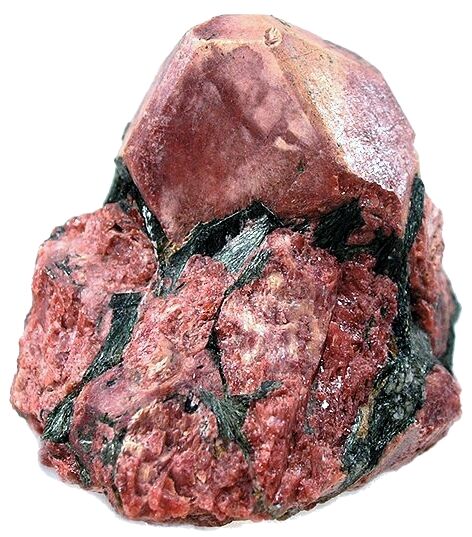 EudialyteNa15Ca6Fe3Zr3Si(Si25O73)(O,OH,H2O)3(Cl,OH)2Mineral—
- FeklicheviteNa11Ca9(Fe3+,Fe2+)2Zr3Nb(Si25O73)(OH,H2O,Cl,O)5Mineral—
- FengchengiteNa12◻3Ca6Fe3+3Zr3Si(Si25O73)(H2O)3(OH)2Mineral—
Literature, links & citation
Citations
- 2009Khomyakov, A.P., Nechelyustov, G.N., Rastsvetaeva, R.K. (2009) Voronkovite, Na15(Na,Ca,Ce)3(Mn,Ca)3Fe3Zr3Si26O72(OH,O)4Cl·H2O, a new mineral species of the eudialyte group from the Lovozero alkaline pluton, Kola Peninsula, Russia. Geology of Ore Deposits: 51(8): 750-756.
- 2009Khomyakov, A.P., Nechelyustov, G.N., Rastvetaeva, R.K. (2009) Voronkovite, Na15(Na,Ca,Ce)3(Mn,Ca)3Fe3Zr3Si26O72(OH,O)4Cl·H2O - a new mineral of the eudialyte group from Lovozero Alkaline Massif, Kola Peninsula, Russia. Zapiski Rossiiskogo Mineralogicheskogo Obshchetstva: 138: 66-74.
- 2012Rastsvetaeva, R. K., Chukanov, N. V. (2012) Classification of eudialyte-group minerals. Geology of Ore Deposits, 54 (7) 487-497 doi:10.1134/s1075701512070069DOI: 10.1134/s1075701512070069
- 2022(2022) Voronkovite. Handbook of Mineralogy. Mineralogical Society of America
Cite this entry
Entry last updated
@misc{mineral2025,
  author    = {Mineral Index editorial board},
  title     = {Voronkovite — Mineral Index},
  year      = {2025},
  url       = {https://mineralindex.org/minerals/voronkovite-32199}
}