Where it forms, where it's found
- Geological setting
Calcite - siderite veins.
- Type locality
- Consols Mine (ABH Consols Mine
- Australian Broken Hill Consols Mine)
- Broken Hill
- Broken Hill district
- Yancowinna Co.
- New South Wales
- Australia
-31.9634°, 141.4823°
31recorded occurrences
Physical
Crystallography
- Cell parameters
- a = 5.86 Å
- Z
- 4
- Morphology
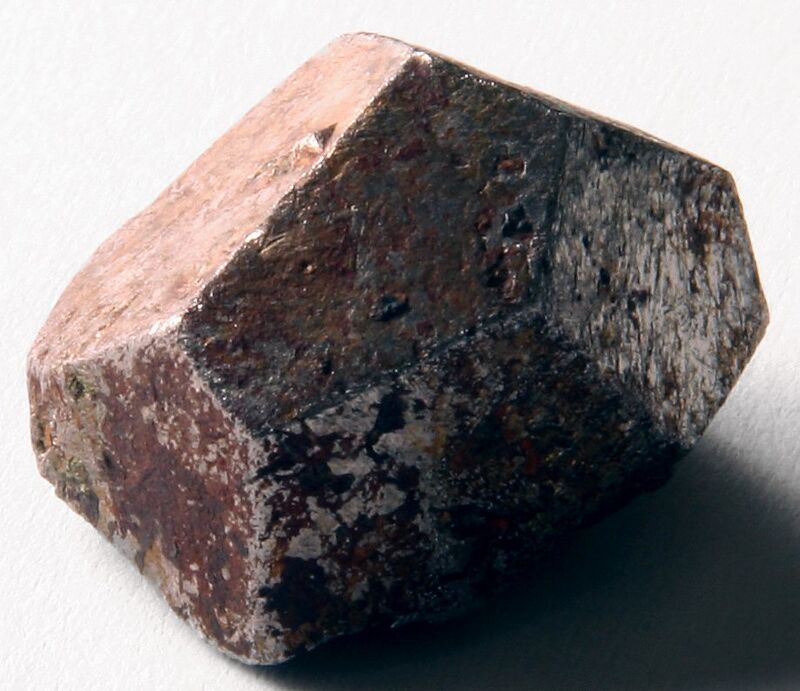
Zoned crystals to several mm.
- Type-locality form
Crystals several mm on a side, showing zonal growth patterns.
- Comment
Symmetry and space group unknown, but probably monoclinic or triclinic. Pseudocubic; a ~ b ~ c within error limits.
Chemical composition
- Impurities
- Fe
- As
Synonyms
- Antimonnickelkobaltglanz
- Willyamiet
In other languages
- German
- IMA 1969-001a · Willyamit
- Italian
- willyamite
Classification
Strunz
10th ed.2.EB.25
- 2Sulfides and SulfosaltsClass
- 2.EMetal Sulfides, M: S <= 1:2Division
- 2.EBM:S = 1:2, with Fe, Co, Ni, PGE, etc.Group
- 2.EB.25WillyamiteSpecies
Dana
8th ed.02.12.03.04
- 02SulfidesClass
- 02.12AmBnXp, with (m+n):p = 1:2Type
- 02.12.03Cobaltite Group (Cubic or pseudocubic crystals)Group
- 02.12.03.04WillyamiteSpecies
CIM
—3.11.39
- 3Sulphides, Selenides, Tellurides, Arsenides and Bismuthides (except the arsenides, antimonides and bismuthides of Cu, Ag and Au, which are included in Section 1)Class
- 3.11Sulphides etc. of NiGroup
- 3.11.39WillyamiteSpecies
Group, growth & confusion
Literature, links & citation
Citations
- 1893Pittman, E.F. (1893): Note on the occurrence of a new mineral at Broken Hill. Proceedings of the Royal Society of New South Wales 27: 366-375.
- 1970Cabri, L.J., Harris, D.C., Stewart, J.M., Rowland, J.F. (1970): Willyamite redefined. Proceedings of the Australasian Institute of Mining and Metallurgy 233, 95-100.
- 1971Fleischer, Michael (1971) New Mineral Names. American Mineralogist, 56 (1-2) 358-362
- 1986Bayliss, P. (1986) Subdivision of the pyrite group and a chemical and x-ray-diffraction investigation of ullmannite. The Canadian Mineralogist, 24 (1) 27-33
- 1991Dobbe, R. T. M. (1991) Ullmannite, cobaltian ullmannite and willyamite from Tunaberg, Bergslagen, central Sweden. The Canadian Mineralogist, 29 (2) 199-205
Cite this entry
Entry last updated
@misc{mineral2026,
  author    = {Mineral Index editorial board},
  title     = {Willyamite — Mineral Index},
  year      = {2026},
  url       = {https://mineralindex.org/minerals/willyamite-4295}
}