History
Long before it had a mineralogical name, acanthite was the dark, leaden stuff that silver miners pulled out of veins across central Europe. They called it silver glance in English, Silberglanz in German — names that described the metallic sheen of a fresh-broken crystal rather than what the mineral was.
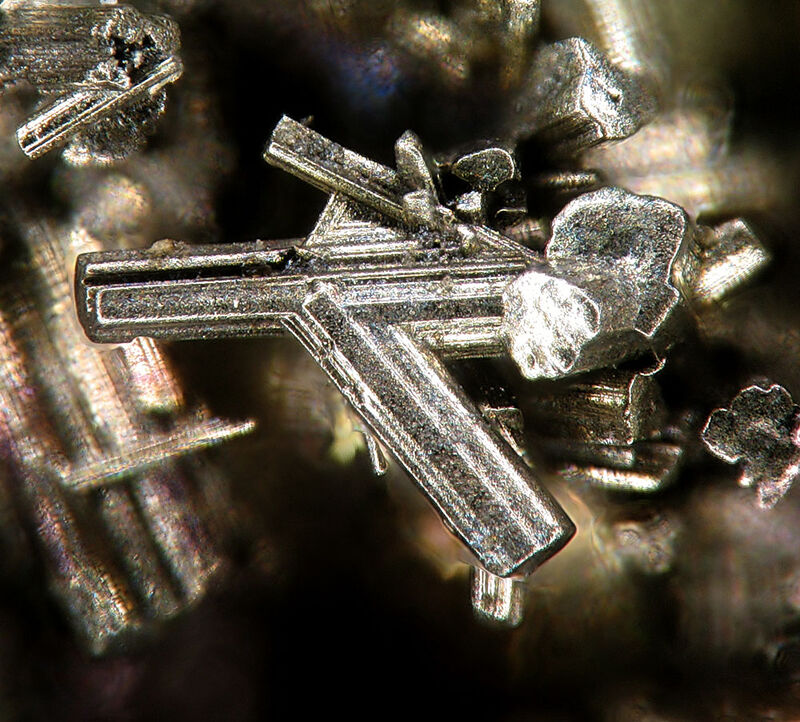
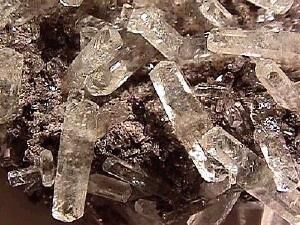
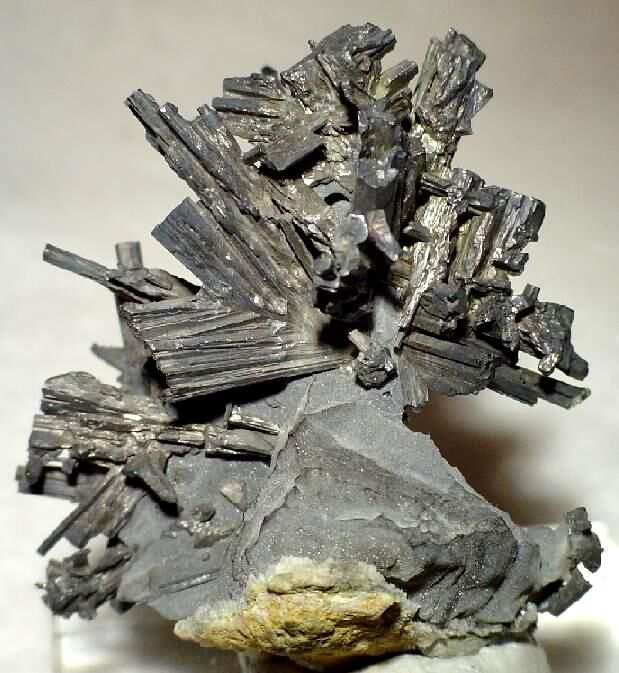
The formal name came in 1855, when the mineralogist Gustav Adolf Kenngott described specimens with sharp, pointed crystals and named the mineral from the Greek akantha — meaning thorn — in reference to that crystal shape. The type locality was the silver district around Jáchymov — Joachimsthal in German — in the Ore Mountains of Bohemia.
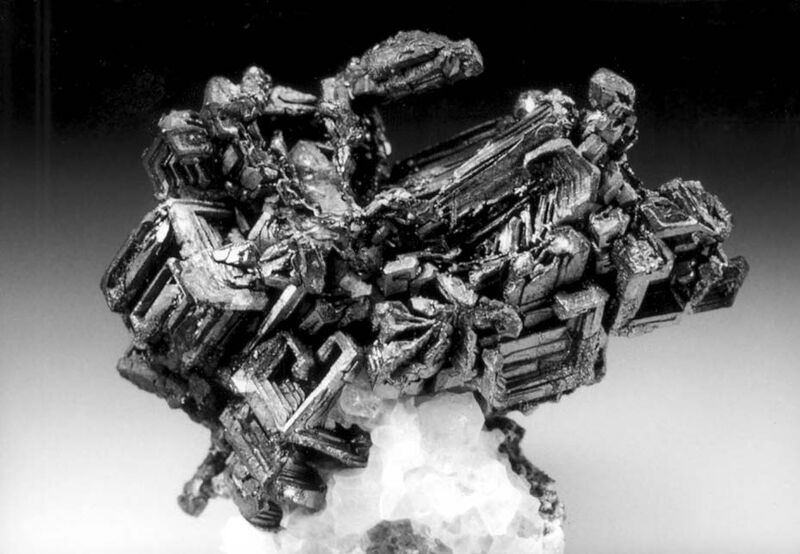
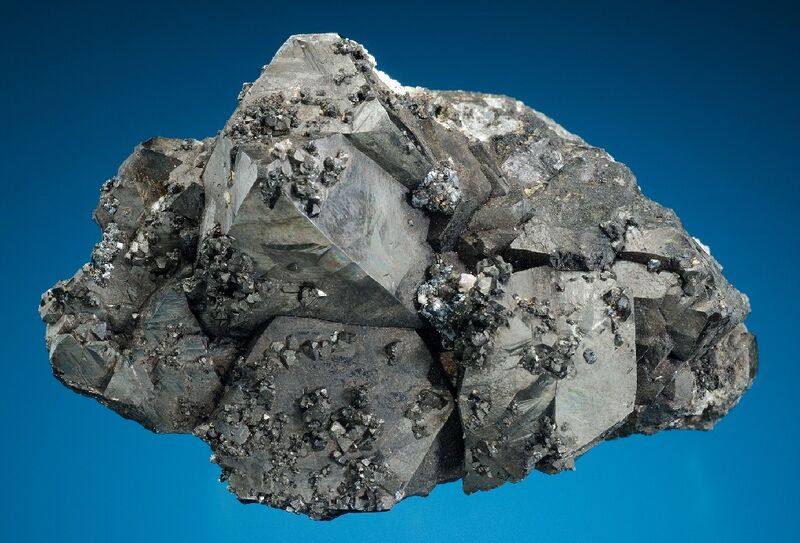
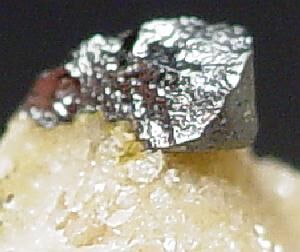
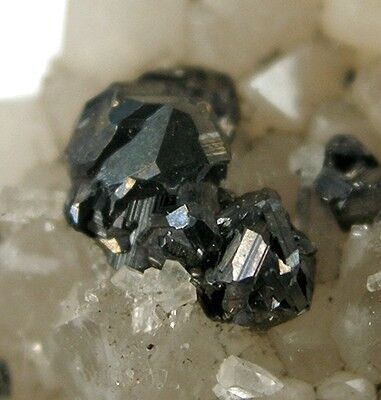
For a time, two minerals seemed to coexist. Kenngott's pointed acanthite was monoclinic, with crystals tapering like spines. But silver miners had long known a second form with cubic, blocky crystals: that one had been called argentite, from the Latin argentum for silver. With the arrival of X-ray and other instrumental analysis, the two names resolved into one substance. The cubic argentite of the old labels is the high-temperature form of silver sulfide, stable only above 173 °C. The room-temperature form is monoclinic acanthite. As argentite crystals cool below that temperature, they distort internally into acanthite while keeping their outward cubic shape — a paramorph, meaning a crystal whose external form was inherited from a higher-temperature mineral but whose internal lattice has been rebuilt. Every old "argentite" label in a museum drawer is, by atomic structure, an acanthite.
Acanthite in the great silver districts
The history of acanthite is, in practice, the history of silver mining. The mineral itself was the ore — under whatever name miners gave it locally.
In 1546, Spanish prospectors struck the great silver mountain of Potosí in what is now Bolivia. The Mexican district of Zacatecas was discovered the same year. The two became the engines of the Spanish silver economy and triggered what historians call the Spanish Price Revolution across Europe. Acanthite, together with native silver and the silver halides, was a principal ore in both fields.
Three centuries later, the centre of gravity shifted north. The Comstock Lode at Virginia City, Nevada, opened in 1859 as the first major silver ore deposit in the United States.
Industrial & practical applications
Acanthite is the most important ore of silver. Where the mineral occurs in workable concentrations — together with native silver, the silver halides like chlorargyrite, and the silver sulfosalts — it is mined for the metal it carries.
The bulk of the world's silver, however, no longer comes from ores worked for silver alone. Most of it is recovered as a by-product of copper, gold, lead, and zinc refining. Acanthite is one of the minerals that accompanies these base-metal sulfides, and the silver it carries enters the same refinery streams.
When acanthite is processed for silver, the route runs through froth flotation, which separates the fine-ground sulfide grains from the surrounding rock. A cyanide leach then dissolves the silver out of the concentrate — the same chemistry used for gold. When silver instead comes out of a copper smelter, it is recovered during the electrolytic refining of the copper, the step that uses an electric current to deposit pure metal on a cathode. Peru and Mexico remain among the principal silver-producing countries, and roughly a fifth of world supply comes from recycling rather than fresh mining.
What the silver becomes
Silver has the highest electrical and thermal conductivity of any metal, and the highest optical reflectivity. That set of properties drives most of its modern industrial use.
The largest current demand sits in electronics. Silver is used in electrical contacts and conductors, and at radio frequencies in the very-high-frequency band and above, where its conductivity advantage matters most. Silver is also used in solar panels.
A second cluster of uses is medical and antibacterial. Dilute solutions of silver nitrate and other silver compounds serve as disinfectants and microbiocides; they are added to bandages, wound dressings, catheters, and other medical instruments.
The remaining demand is spread across jewellery, high-value tableware, brazing alloys, specialised mirrors and window coatings, catalysis of chemical reactions, photographic and X-ray film, and as a colorant in stained glass.
Where it forms, where it's found
- Geological setting
A common silver species in moderately low-temperature hydrothermal sulphide veins, and in zones of secondary enrichment. Widespread in silver deposits. Localities for fine primary and paramorphic crystals include Jáchymov (St Joachimsthal), Czech Republic [TL]; In Germany, at Freiberg, Schneeberg, Annaberg, and Marienberg, Saxony; and from St Andreasberg, Harz. In Mexico, large paramorphs from Arizpe, Sonora; In the Rayas and other mines at Guanajuato; And from many mines in Zacatecas, Chihuahua, etc; In the USA, at Butte, Silver Bow Co., Montana; Tonopah, Nye Co. and the Comstock Lode, Virginia City, Storey Co., Nevada; From various mines at Cobalt, Ontario, Canada; At Chañarcillo, south of Copiapó, Atacama, Chile.
- Type locality
- Jáchymov
- Karlovy Vary District
- Karlovy Vary Region
- Czech Republic
50.3661°, 12.9233°
Physical
Optical
- Anisotropism
- Weak
- Tropism
- Anisotropic
- Reflectance R%
- (32.8) 400, (32.9) 420, (33.0) 440, (33.1) 460, (33.0) 480, (32.7) 500, (32.0) 520, (31.2) 540, (30.5) 560, (29.9) 580, (29.2) 600, (28.7) 620, (28.2) 640, (27.6) 660, (27.0) 680, (26.4) 700
- Luminescence
- None
- UV response
- Not fluorescent in UV
Crystallography
- Space group
- #15
- Cell parameters
- a = 4.229 Å · b = 6.931 Å · c = 7.862 Å
- Cell angles
- β = 99.61 °
- Ratio a:b:c
- 1 : 1.639 : 1.859
- Z
- 4
- Morphology
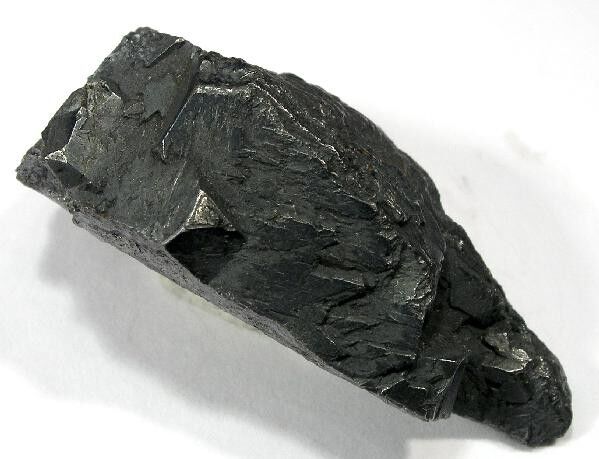
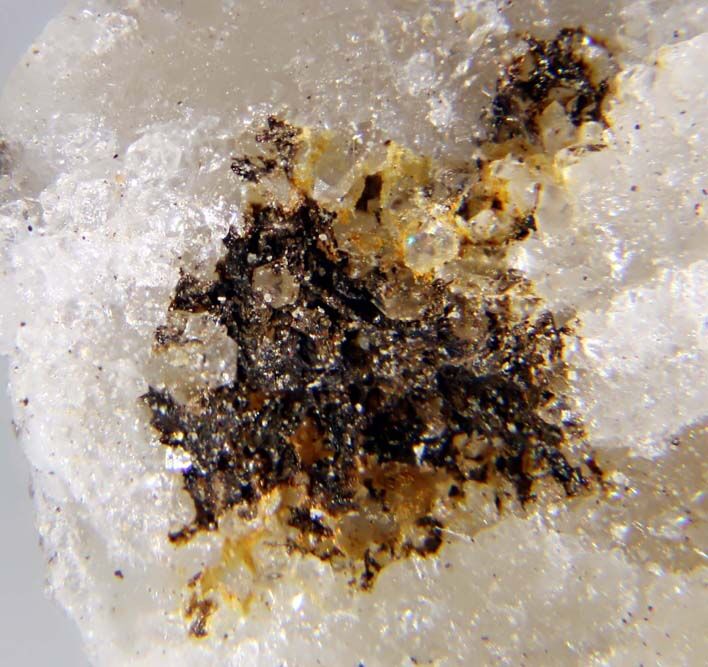
Typically found as pseudo-cubic and pseudo-octahedral crystals, paramorphic after argentite. Also found as thorn-shaped monoclinic crystals, usually small to microscopic in size. Large primary crystals are uncommon, other than fine overgrowths and replacements of native silver; they are prismatic to long prismatic, elongated along [001], to 2.5 cm, may be tubular; also massive.
Chemical composition
Synonyms
- Akanthita
- Akanthite
- Akantitt
- Argentiet
- Argentit
- Argentita
- Argentitas
- Argentite-beta
- Argentite-β
- Argentīts
- Argentyt
- Argyrit
- Argyrita
- Argyrite
- Argyrose
- Beta-Argentite
- Daleminzite
- Glanzerz
- Glaserz
- Henkelit
- Henkelita
- Henkelite
- Para-Silberglanz
- Silberglanz
- Silberschwärze
- Silver Glance
- Silverglans
- Sølvglans
- Vitreous Silver
- Weicherz
- α-Argentit
- α-Argentita
- α-Argentite
- β-Argentit
- β-Argentita
- β-Argentite
In other languages
- French
- 12068-32-5 · Acanthite · Acantite · Akanthite · Argent vitreux · Argentite · Argentite-β · Argyrite · Argyrose · Daleminzite · Henkélite
- German
- Ag2S · Akanthit
- Spanish
- acantita
- Italian
- acanthite · acantite
- Portuguese
- Acantita · acantite
- Japanese
- アカンサイト · 針銀鉱
- Chinese
- 螺状硫银矿 · 螺硫银矿
- Traditional Chinese
- 螺狀硫銀礦
- Russian
- Акантит
- Arabic
- أكانثيت
Classification
2.BA.35
- 2Sulfides and SulfosaltsClass
- 2.BMetal Sulfides, M: S > 1: 1 (mainly 2: 1)Division
- 2.BAWith Cu, Ag, AuGroup
- 2.BA.35AcanthiteSpecies
02.04.01.01
- 02SulfidesClass
- 02.04AmBnXp, with (m+n):p = 2:1Type
- 02.04.01Acanthite GroupGroup
- 02.04.01.01AcanthiteSpecies
3.2.1
- 3Sulphides, Selenides, Tellurides, Arsenides and Bismuthides (except the arsenides, antimonides and bismuthides of Cu, Ag and Au, which are included in Section 1)Class
- 3.2Sulphides etc. of AgGroup
- 3.2.1AcanthiteSpecies
Group, growth & confusion
Literature, links & citation
- 1795Klaproth, M. H. (1795) IX. Untersuchung der Silbererze, Silberglanzers . In Beiträge zur chemischen Kenntniss der Mineralkörper Vol. 1. Rottmann. p.158-160.
- 1855Kenngott, Adolf (1855) Ueber den Akanthit, eine neue Species in dem Geschlechte der Silber-Glanze. Annalen der Physik und Chemie, 171. 462-464 doi:10.1002/andp.18551710710DOI: 10.1002/andp.18551710710
- 1855Sitzungsberichte der Kaiserlichen Akademie der Wissenschaften (1855) IV, 447-468.
- 1926Emmons, R. C., Stockwell, C. H:, Jones, R. H. B. (1926) Argentite and acanthite. American Mineralogist, 11 (12) 326-328
- 1944Palache, Charles, Berman, Harry, Frondel, Clifford (1944) The System of Mineralogy (7th ed.) Vol. 1 - Elements, Sulfides, Sulfosalts, Oxides. John Wiley and Sons, New York.
Entry last updated
@misc{mineral2026,
  author    = {Mineral Index editorial board},
  title     = {Acanthite — Mineral Index},
  year      = {2026},
  url       = {https://mineralindex.org/minerals/acanthite-10}
}