History
The name schorl is among the oldest still in working use in mineralogy. It was attached to the black tourmaline of Saxony long before the modern science of minerals existed — borrowed straight from the German miners who first dug it.
The word was already in circulation in the Erzgebirge — the Ore Mountains of Saxony — before 1400. A small mining village near the tin workings was then known as Schorl itself; today the same place is called Zschorlau. The village's nearby mines yielded cassiterite, the chief ore of tin, and alongside it black prisms of what we now call tourmaline. The miners had no name for the prisms as a species; they used the word the place gave them.
The first written mention came from Ulrich Rülein von Calw in 1505, in the earliest printed mining manual published in the German lands. A generation later, Johannes Mathesius (1504–1565) gave the mineral its first detailed description. In his 1562 work Sarepta oder Bergpostill, Mathesius recorded it under the spelling schürl and tied it to its occurrence in the various tin mines of the Saxony Ore Mountains.
Spelling drifted slowly. Up to about 1600, German texts also wrote Schurel, Schörle, and Schurl; from the 18th century onward, Schörl became the dominant German form. English mineralogy borrowed the word twice over. In the 18th century the spellings shorl and shirl were both in use. In the 19th century the Anglophone literature settled on common schorl, schörl, schorl, and — descriptively — iron tourmaline.
That last name is the chemically accurate one. Tourmaline is not one mineral but a family — a supergroup, in mineralogical English, with three dozen recognised species sharing the same crystal frame and swapping elements at a few specific sites. Schorl is the sodium-iron member of that family, and it accounts for roughly 95 percent or more of all tourmaline found in nature. Both its colour and its abundance trace to the iron filling the metal site that lithium occupies in elbaite or magnesium in dravite.
Industrial & practical applications
Schorl has no commodity-scale industrial use. The black, iron-rich tourmalines of its kind are opaque and rarely clean enough to facet. The gemstone trade in tourmaline belongs almost entirely to the coloured lithium- and magnesium-bearing species — not to the iron end-member.
What market schorl does support is collector and specimen. As the most common tourmaline species — roughly 95 percent of all tourmaline in nature — it yields well-formed prismatic crystals in great quantity. The best of them, often grown on a matrix of feldspar or quartz, circulate among private cabinets, museum cases, and university reference suites. A small share of cleaner material is cut as polished domes, called cabochons, or faceted into novelty black stones for jewellery.
Where it forms, where it's found
- Geological setting
In placers.
In granites and granitic pegmatites, high temperature hydrothermal veins, metamorphic rocks.
Varieties
Physical
- Hardness
- 1Talc
- 2Gypsum
- 3Calcite
- 4Fluorite
- 5Apatite
- 6Orthoclase
- 7Quartz
- 8Topaz
- 9Corundum
- 10Diamond
- Lustre
- Vitreous to oily · dull.
- Transparency
- Translucent · Opaque
- Colour
- Bluish-black to black · sometimes brownish-black · rarely greenish-black.
- Streak
- Greyish-white to bluish-white.
- Tenacity
- brittle
- Cleavage
- Poor/Indistinct
Very poor on (110), (101)
- Fracture
- Irregular/Uneven · Sub-Conchoidal
- Density
- 3.18 g/cm³
Optical
- Optical type
- Uniaxial (-)
- Refractive index
- 1.635 – 1.672
- Surface relief
- High
- Principal indices
- nω 1.66 – 1.672 · nε 1.635 – 1.65
- Pleochroism
- Strong
O= yellow brown E= pale yellow, pale brown
- Luminescence
- Nonfluorescent.
- Notes
May be slightly biaxial under strain.
Crystallography
- Space group
- #86
- Cell parameters
- a = 15.98(5) Å · c = 7.15(3) Å
- Z
- 3
- Morphology
Prismatic to acicular.
- Twinning
Rarely on (100) and (401).
Chemical composition
- Impurities
- Mn
- Mg
- Ca
- Li
- Cr
- Ti
- F
- K
Synonyms
- Afrisite
- Cockle
- Eisenturmalin
- Schirl
- Schorlite (of Hunt)
- Shirl
- Shorl
In other languages
- French
- Schorl
- German
- Schirl · Schörl · Schörl (Mineral) · Schorlit · Schürl
- Spanish
- chorlo
- Italian
- Sciorlite
- Russian
- Чёрный турмалин · Шерл
Classification
9.CK.05
- 9SilicatesClass
- 9.CCyclosilicatesDivision
- 9.CK[Si6O18]12- 6-membered single rings, with insular complex anionsGroup
- 9.CK.05SchorlSpecies
61.03.01.10
- 61Cyclosilicates Six-membered RingsClass
- 61.03Six-Membered Rings with borate groupsType
- 61.03.01— unnamed intermediate level —Group
- 61.03.01.10SchorlSpecies
17.5.44
- 17Silicates Containing other AnionsClass
- 17.5BorosilicatesGroup
- 17.5.44SchorlSpecies
Group, growth & confusion
- AdachiiteCaFe2+3Al6(Si5AlO18)(BO3)3(OH)3(OH)Mineral—
- Alumino-oxy-rossmaniteAl3Al6(Si5AlO18)(BO3)3(OH)3OMineral—
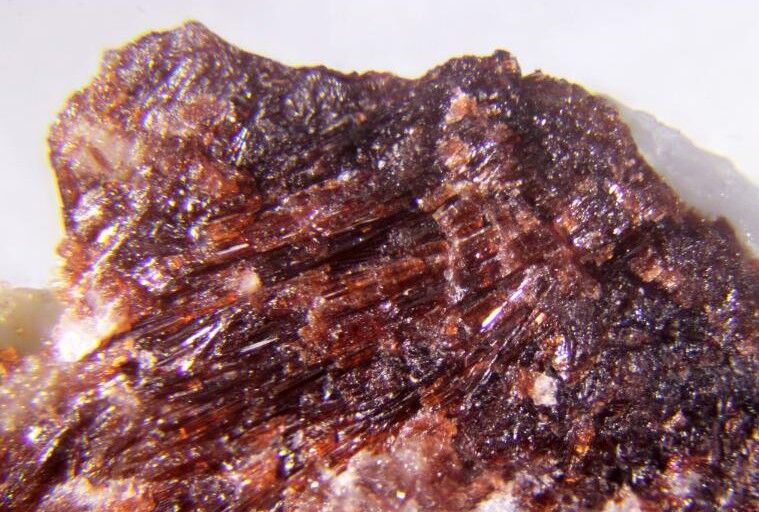 BosiiteNaFe3+3(Al4Mg2)(Si6O18)(BO3)3(OH)3OMineral—
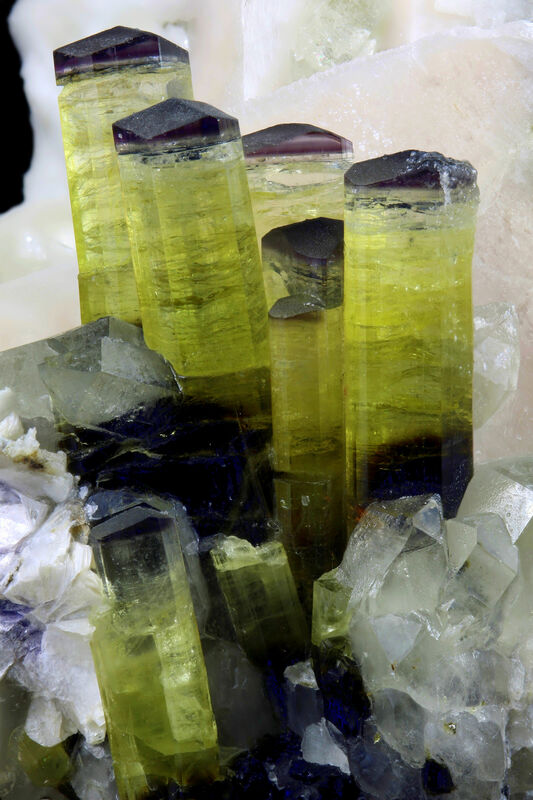 Celleriite◻(Mn2+2Al)Al6(Si6O18)(BO3)3(OH)3(OH)Mineral—
- Chromium-draviteNaMg3Cr3+6(Si6O18)(BO3)3(OH)3(OH)Mineral—
- Chromo-alumino-povondraiteNaCr3(Al4Mg2)(Si6O18)(BO3)3(OH)3OMineral—
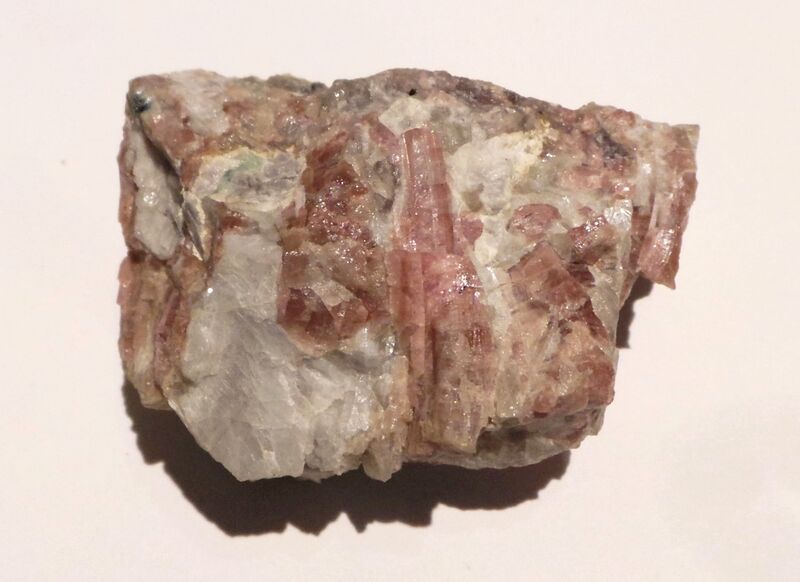 DarrellhenryiteNa(Al2Li)Al6(Si6O18)(BO3)3(OH)3OMineral—
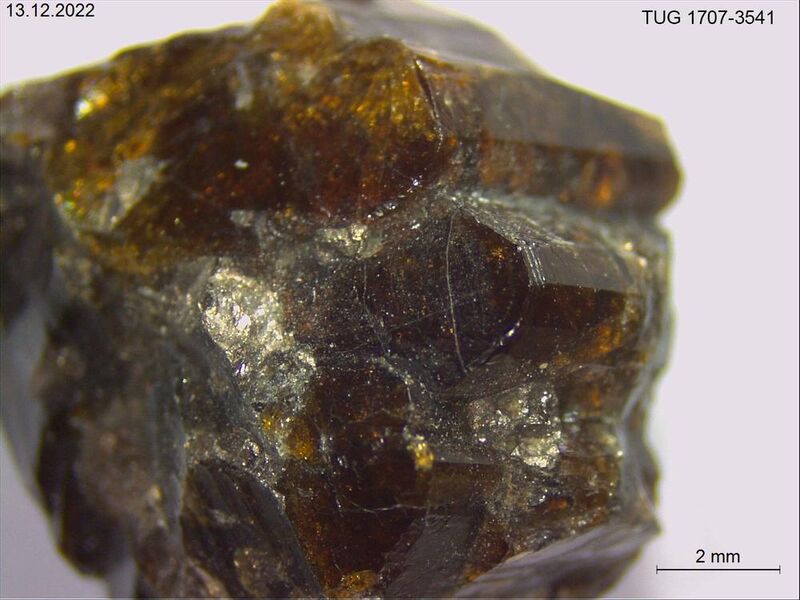 DraviteNaMg3Al6(Si6O18)(BO3)3(OH)3(OH)Mineral—
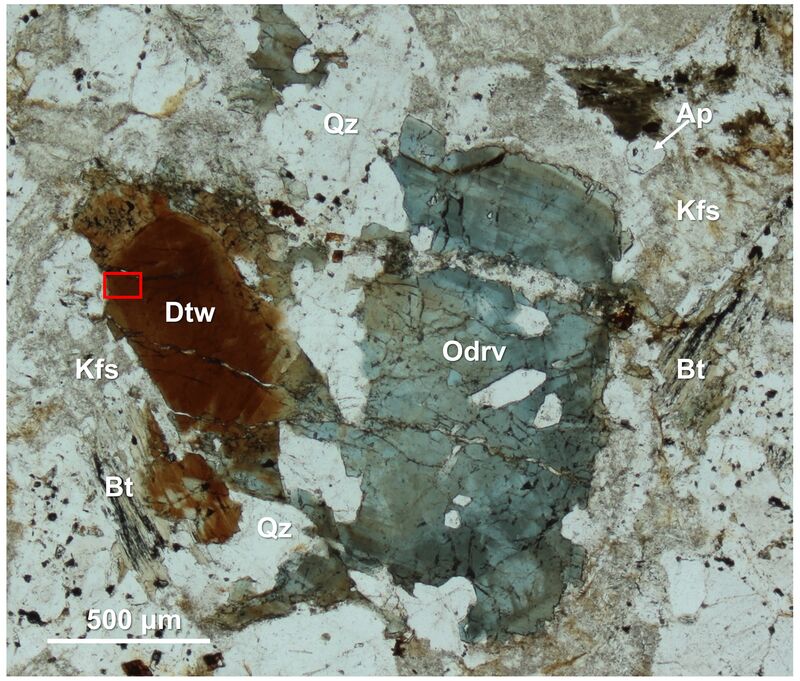 DutrowiteNa(Fe2+2.5Ti0.5)Al6(Si6O18)(BO3)3(OH)3OMineral—
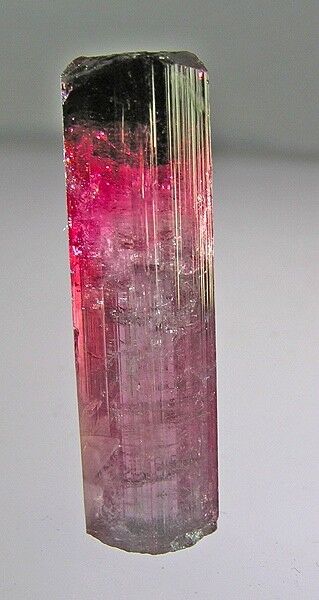 ElbaiteNa(Al1.5Li1.5)Al6(Si6O18)(BO3)3(OH)3(OH)Mineral—
Literature, links & citation
- 1505Rülein von Calw, U. (1505) Ein wolgeordnetz: unnd nuczlicho büchlin wie man bergwerck suchen und erfinden sol von allerlay mettal die denn die sieben planeten generieren und würcken yeglicher nach seiner natur ....-Augsburg, printed by Erhart Ratdolt (first description as "schorlein" or "schörlein", occurring in placers together with gold or tin ore in Saxony)
- 1562Mathesius, J. (1562) Sarepta oder Bergpostill sampt der Joachimßthalischen kurtzen Chroniken.- Nürnberg, Johann vom Berg and Ulrich Newber, 233 p. (description)
- 1748Linné, C. (1748) Systema Naturæ sistens regna tria naturæ, in classes et ordines, genera et species, redacta tabulisque æneis illustrata.- Lipsiæ, Godofr. Kiesewetteri, p. 181. [description of the crystals, first drawing of a schorl crystal]
- 1785Wiegleb, J.C. (1785) Crells Chemische Annalen: 246-253. [first quantitative chemical analysis of schorl, material from Burkhardsgrün near Zschorlau, Saxony]
- 1810Klaproth, M. H. (1810) Chemische Untersuchung des gemeinen Schörls. In Beiträge zur chemischen Kenntniss der Mineralkörper Vol. 5. Rottmann. p.144-149.
Entry last updated
@misc{mineral2026,
  author    = {Mineral Index editorial board},
  title     = {Schorl — Mineral Index},
  year      = {2026},
  url       = {https://mineralindex.org/minerals/schorl-3578}
}