History
Few minerals have carried so many names before settling on one. The mineral now called bornite was first lumped with other copper-iron sulfides in 1725 by the German mineralogist Johann Friedrich Henckel. He grouped it under the catch-all kupferkies — German for "copper pyrite". The specimens had come from the Ore Mountains of Bohemia, in what is today the Karlovy Vary region of the Czech Republic.
A succession of 18th- and early 19th-century mineralogists tried to give the species a proper identity. In 1747 the Swedish chemist Johan Gottschalk Wallerius assigned it various multi-word Latin descriptors. In 1791 the German geologist Abraham Gottlieb Werner called it buntkupfererz — German for "variegated copper ore". The name pointed straight at the mineral's most arresting feature. In 1802 the French crystallographer René Just Haüy translated the name into "purple copper ore" and "variegated copper ore".
A brief renaming followed in 1832, when the mineralogist Wilhelm Sulpice Beudant proposed the name phillipsite. The label did not stick on this species.
The modern name dates to 1845, when the Austrian mineralogist Wilhelm Karl von Haidinger renamed the species bornite in honour of his compatriot Ignaz von Born (1742–1791), an Austrian mineralogist and invertebrate zoologist.
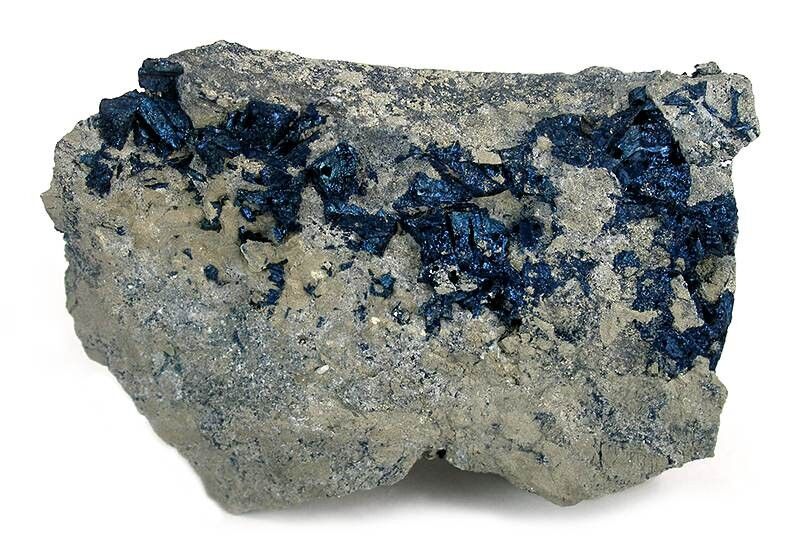
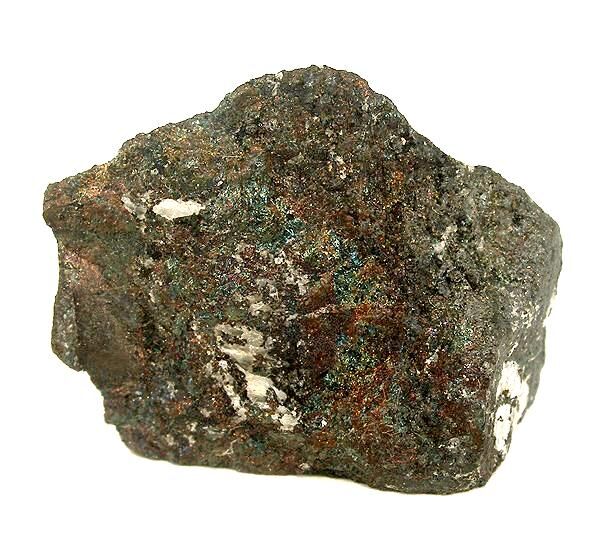
Bornite has also long carried a folk name in English: peacock ore. The label describes a tarnish, not the fresh mineral. Broken cleanly, bornite is a brown to copper-red colour. Exposed to air, the surface tarnishes to iridescent shades of blue and purple. That thin tarnish film is what earned the peacock name.
Industrial & practical applications
Bornite is a working copper ore. By mass, it is about 63 percent copper. The species sits in the regular feedstock of the copper industry alongside the more common chalcopyrite.
Bornite occurs widely in porphyry copper deposits — large, low-grade ore bodies in which copper sulfides are scattered through an igneous host rock. Typical occurrences are at Mount Lyell in Tasmania, in Chile and Peru, and at Butte, Montana in the United States.
Extraction follows the standard copper-sulfide route. The ore is crushed, ground, and concentrated by froth flotation. In flotation the sulfide grains attach to air bubbles and rise into a skimmable foam. The concentrate is then smelted and finally purified by electrolytic refining to a pure copper cathode. An increasing share of copper now comes from acid leaching of oxidised ores rather than from the sulfide chain.
The copper that comes out of the smelter ends up almost everywhere electricity travels. Electrical uses — power transmission and generation, building wiring, telecommunication, and electronic products — account for about three-quarters of total copper consumption. Building construction is the single largest market, followed by electronics, transportation, industrial machinery, and consumer products. Globally, copper ranks third in tonnage after iron and aluminium.
Beyond the smelter, bornite has a quieter second life on the specimen market. The iridescent blue-to-purple tarnish that earned the name peacock ore has made bornite a long-running favourite of mineral collectors.
Where it forms, where it's found
- Geological setting
Common and widespread in copper ore deposits. It also occurs in basic intrusives, in dikes, in contact metamorphic deposits, in quartz veins, and in pegmatites.
- Type locality
- Jáchymov
- Karlovy Vary District
- Karlovy Vary Region
- Czech Republic
50.3661°, 12.9233°
Physical
- Hardness
- 1Talc
- 2Gypsum
- 3Calcite
- 4Fluorite
- 5Apatite
- 6Orthoclase
- 7Quartz
- 8Topaz
- 9Corundum
- 10Diamond
- Lustre
- Metallic
- Transparency
- Opaque
- Colour
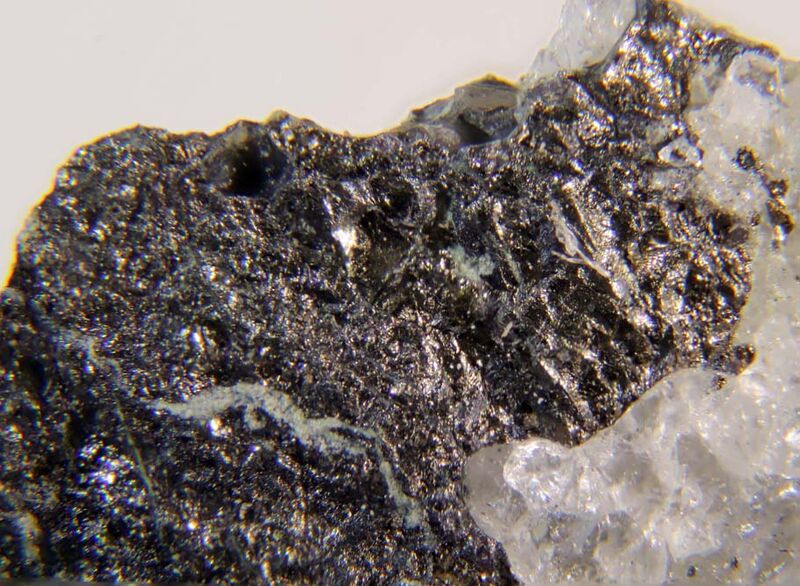
- Copper-red to pinchbeck-brown · quickly tarnishing to an iridescent purplish surface.
- Streak
- Grey-Black
- Tenacity
- brittle
- Cleavage
- Poor/Indistinct
In traces on (111).
- Fracture
- Irregular/Uneven
- Density
- 5.06 g/cm³
Optical
- Pleochroism
- Weak
- Optical colour
- Copper-red.
- Anisotropism
- Weak
- Internal reflections
- Purplish iridescence.
- Tropism
- Anisotropic
- Reflectance R%
- (19.9) 400, (18.8) 420, (17.9) 440, (17.6) 460, (18.0) 480, (18.8) 500, (20.0) 520, (21.3) 540, (22.9) 560, (24.4) 580, (26.0) 600, (27.5) 620, (28.8) 640, (30.2) 660, (31.6) 680, (32.7) 700
- Luminescence
- None
Crystallography
- Space group
- #61
- Cell parameters
- a = 10.97016(18) Å · b = 21.8803(4) Å · c = 10.9637(2) Å
- Ratio a:b:c
- 1 : 1.995 : 0.999
- Unit cell volume
- 2631.61 ų
- Z
- 16
- Morphology
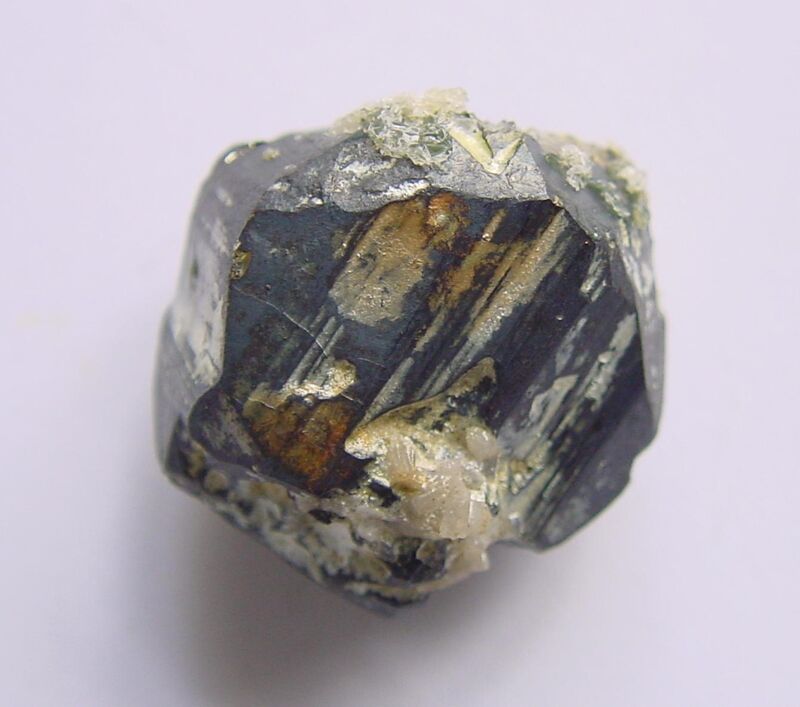
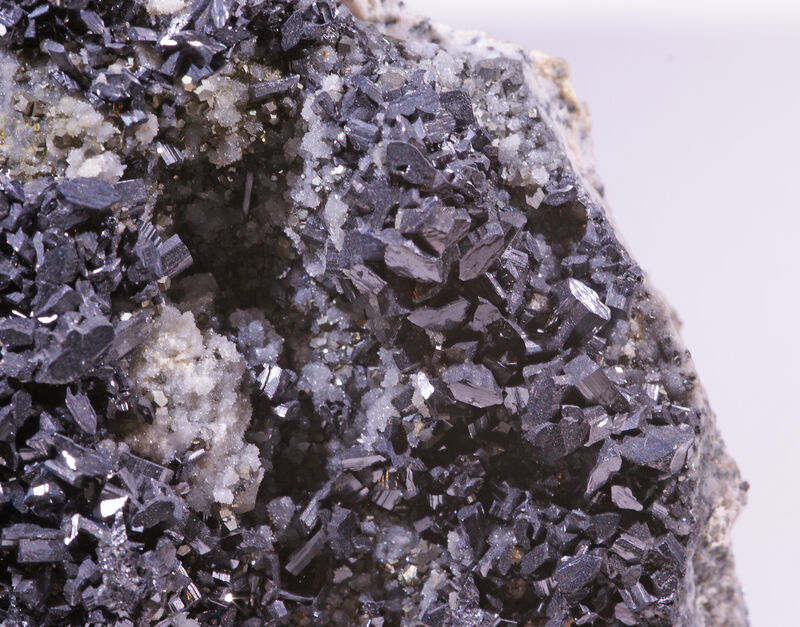
Crystals rare, usually blocky with rough curved faces, pseudo-cubic, pseudo-dodecohedral and rarely pseudo-octahedral. Forms noted: (001), (011), (111), (112), (223) and (335). Bornite is orthorhombic at 10 degrees K up to 275 degrees K (~ 2 degrees Celsius).
- Twinning
On (111), often as penetration twins.
- Parting
- None.
- Comment
Various, mostly temperature-dependent supercells are known. Cell parameters are from Shu et al. (2021). Koto & Morimoto (1975) give Pbca, and a = 10.950, b = 21.862, c = 10.950 Å. High-temperature forms are cubic.
Chemical composition
- Impurities
- Ag
- Ge
- Bi
- In
- Pb
Synonyms
- Boirnít
- Bornite (of Haidinger)
- Broket kobber
- Broket kopper
- Buntkupfererz
- Buntkupferkies
- Chalcomiklit
- Chalcomiklite
- Cuivre Panaché
- Erubescit
- Erubescita
- Erubescite
- Horse-flesh-ore
- IMA1962-s.p.
- Kupfer-Lazul
- Kupferlasurerz
- Kupferlazuerz
- Kupferlazurerz
- Leberschlag
- Lefverslag
- Pecho de Paloma
- Phillipsine
- Phillipsite (of Beudant)
- Poikilit
- Poikilite
- Purple Copper
- Purple Copper Ore
- Variegated Copper
- Variegated Copper Ore
In other languages
- French
- 1308-82-3 · bornite · Chalcomiklite · Cuivre panaché · Cuivre pyriteux hépatique · Cuivre pyriteux panaché · Double sulfure de fer et de cuivre à cassure de nickel · Érubescite · Mine de cuivre hépatique · Mine de cuivre panachée · Mine de cuivre violette azurée · Phillipsine · Poikilite
- German
- Bornit · Buntkupferkies · Chalcomiklit · Erubescit · Kupfer-Lazul · Kupferlasurerz · Poikilit
- Spanish
- bornita · erubescita
- Italian
- Bornite
- Portuguese
- bornita · Bornite
- Japanese
- 斑銅鉱
- Chinese
- 斑銅礦
- Simplified Chinese
- 斑铜矿
- Traditional Chinese
- 斑銅礦
- Russian
- Борнит
- Arabic
- بورنيت
Classification
2.BA.15
- 2Sulfides and SulfosaltsClass
- 2.BMetal Sulfides, M: S > 1: 1 (mainly 2: 1)Division
- 2.BAWith Cu, Ag, AuGroup
- 2.BA.15BorniteSpecies
02.05.02.01
- 02SulfidesClass
- 02.05AmBnXp, with (m+n):p = 3:2Type
- 02.05.02— unnamed intermediate level —Group
- 02.05.02.01BorniteSpecies
3.1.23
- 3Sulphides, Selenides, Tellurides, Arsenides and Bismuthides (except the arsenides, antimonides and bismuthides of Cu, Ag and Au, which are included in Section 1)Class
- 3.1Sulphides etc. of CuGroup
- 3.1.23BorniteSpecies
Group, growth & confusion
Literature, links & citation
- 1845Haidinger, W. (1845) Zweite Klasse: Geogenide. XIII. Ordnung. Kiese. V. Kupperkies. Bornit.. in Handbuch der Bestimmenden Mineralogie, Bei Braumüller and Seidel (Wien): 559-562.
- 1859Jackson, C. (1859) On Bornite from Dahlonega, Georgia. American Journal of Science and Arts: 27(81): 366.
- 1903Harrington, B.J. (1903) On the Formula of Bornite. American Journal of Science: 16(92): 151.
- 1911Laney, F.B. (1911) The relation of bornite and chalcocite in the copper ores of the Virgilina district of North Carolina and Virginia. Proceedings of the U.S. National Museum: 40: 513-524.
- 1914Kraus, E.H., Goldsberry, J.P. (1914) The chemical composition of bornite and its relation to other sulpho-minerals. American Journal of Science: 4(222): 539-553.
Entry last updated
@misc{mineral2026,
  author    = {Mineral Index editorial board},
  title     = {Bornite — Mineral Index},
  year      = {2026},
  url       = {https://mineralindex.org/minerals/bornite-727}
}