History
A mineral that breaks cleanly along flat planes is easy to recognise, and that quality gave enargite its name. The word comes from the Greek enarges — meaning distinct — chosen for the sharp, distinct cleavage along which its crystals split.
The mineral was first described in 1850, by the German mineralogists Johann Friedrich August Breithaupt and Carl Friedrich Plattner. They examined material from the copper mines of the San Francisco vein, in the Junín Department of Peru — still recognised as the type locality, the place where the species was first defined.
From there enargite turned up in copper districts across the Americas and beyond. Notable specimens came from Butte, Montana; the San Juan Mountains of Colorado; and the Tintic and Bingham Canyon districts of Utah. Mexico, Argentina, Chile, the Peruvian camps of Morococha and Cerro de Pasco, and the island of Luzon in the Philippines all yielded the mineral as well. In several of these places it gathered in quantities large enough to be worked as a copper ore — the role that earned it a place in mining history.
Industrial & practical applications
Where it gathers in quantity, enargite is mined as an ore of copper — nearly half its weight is the metal. It concentrates in one kind of deposit above all: high-sulfidation epithermal systems. These are ore bodies formed near the surface by hot, strongly acidic fluids rising from a magma below. They often sit close to a porphyry copper deposit — the large, low-grade bodies that supply most of the world's copper. Butte in Montana, Chuquicamata in Chile, and the copper camps of Peru and the Philippines have all produced it.
The catch is the arsenic. Enargite carries a heavy load of it — the chemical formula is Cu₃AsS₄ — and arsenic is treated by smelters as a troublesome impurity, not a product. Melted with the copper, it is diluted and emitted in the gas and slag streams, which forces special collection and handling so it does not escape as toxic dust or fume. Buyers cap how much arsenic a concentrate may carry and charge a penalty above that limit, which makes enargite-rich ore costly to sell.
The usual fix is roasting — heating the concentrate so the arsenic volatilises and leaves through the gas before smelting. Even so, the captured arsenic becomes a toxic waste that must be locked into a stable, disposable form.
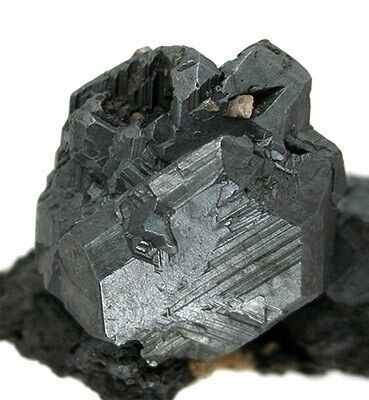
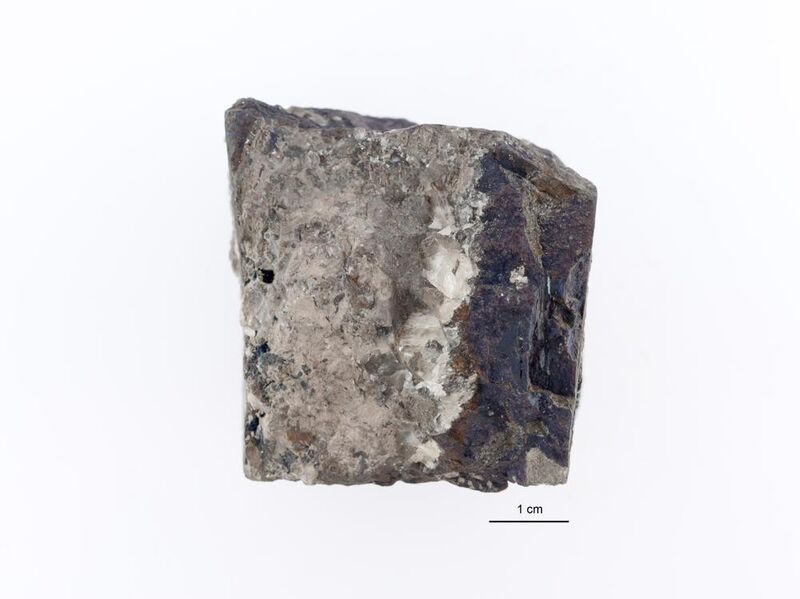
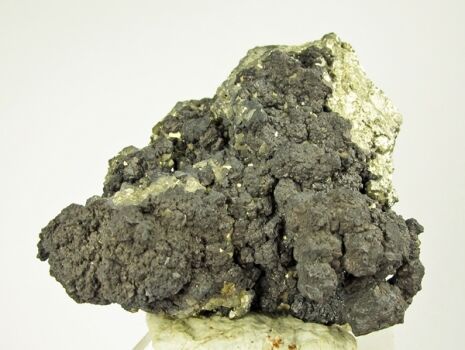
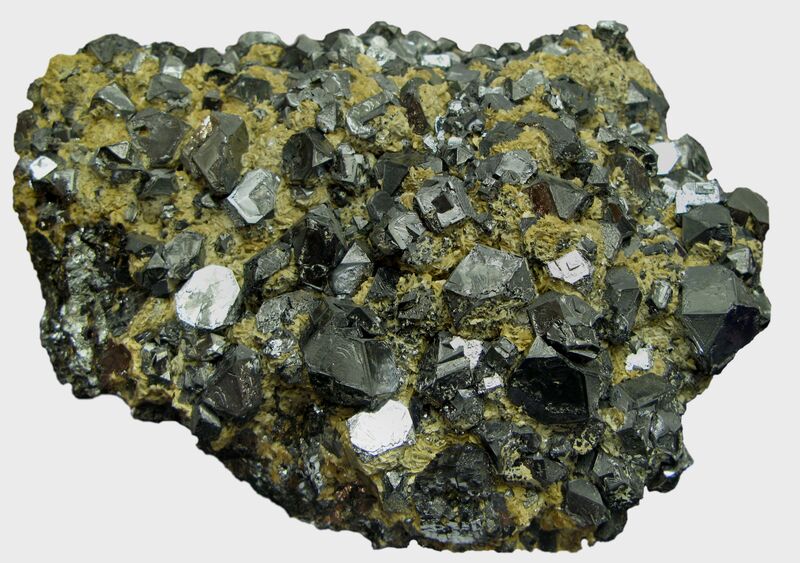
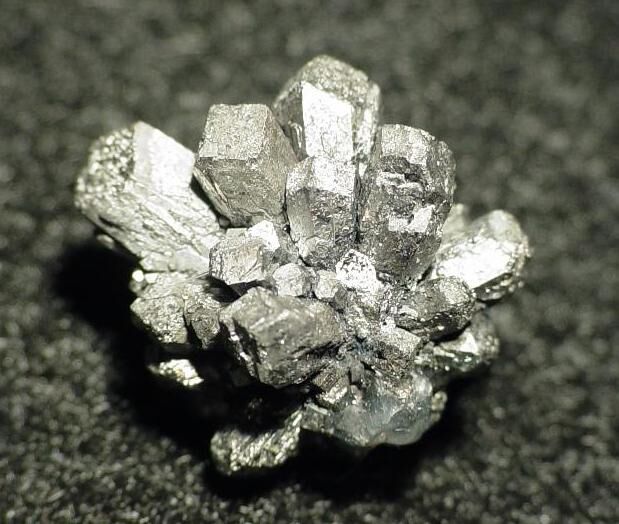
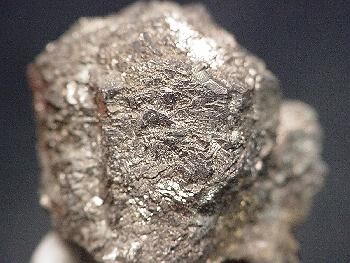
Beyond the copper it carries, enargite is also collected as mineral specimens — its sharp, lustrous black crystals are prized. Because the mineral is an arsenic compound, specimens are handled with care: dust should not be inhaled, and hands are washed after contact.
Where it forms, where it's found
- Geological setting
A mineral of moderate temperature vein and replacement deposits.
- Type locality
- San Francisco vein
- Morococha District
- Yauli Province
- Junín
- Peru
Safety & handling
Physical
- Hardness
- 1Talc
- 2Gypsum
- 3Calcite
- 4Fluorite
- 5Apatite
- 6Orthoclase
- 7Quartz
- 8Topaz
- 9Corundum
- 10Diamond
- Lustre
- Metallic
- Transparency
- Opaque
- Colour
- Greyish-black to black · grey/rose-brown in reflected light.
- Streak
- Black.
- Tenacity
- brittle
- Cleavage
- Perfect
Perfect on (110), imperfect on (100) and (010), indistinct (001).
- Fracture
- Irregular/Uneven
- Density
- 4.4 g/cm³
Optical
- Pleochroism
- Weak
- Optical colour
- Grey to light pink brown
- Anisotropism
- Strong dark violet red or olive green
- Internal reflections
- Deep red
- Tropism
- Anisotropic
- Reflectance R%
- (24.8,26.2) 400, (26.6,26.0) 420, (26.5,25.6) 440, (26.5,25.9) 460, (26.2,25.8) 480, (25.6,25.6) 500, (24.9,25.3) 520, (24.4,25.2) 540, (24.0,25.2) 560, (23.8,25.4) 580, (23.8,25.9) 600, (24.1,26.5) 620, (24.6,26.9) 640, (25.2,26.9) 660, (25.6,26.8) 680, (25.7,26.7) 700
Crystallography
- Space group
- #34
- Cell parameters
- a = 7.4127(16) Å · b = 6.4404(15) Å · c = 6.1577(14) Å
- Ratio a:b:c
- 1 : 0.869 : 0.831
- Z
- 2
- Morphology
Crystals tabular on (001), or prismatic. May be striated parallel to "c." Also found as massive material, may be granular.
- Twinning
Common on (230), sometimes as star-shaped cyclic trillings. Note that the twin law is erroneously given as (320) in the literature; an explanation the error, which was recognised by Pete Richards, is given in the FMF link (mineral-forum.com) in the references section.
- Comment
Cell parameters from Karanović et al. (2002).
Chemical composition
- Impurities
- Sb
- Fe
- Pb
- Zn
- Ag
- Ge
Synonyms
- Clarit
- Clarita
- Clarite (of Sandberger)
- Garbyit
- Garbyita
- Garbyite
- Guayacanit
- Guayacanita
- Guayacanite
In other languages
- French
- Cu3AsS4 · énargite
- German
- Clarit · Enargit · Garbyit · Guayacanit
- Spanish
- enargita
- Italian
- Enargite
- Portuguese
- enargita · Enargite
- Japanese
- 硫砒銅鉱
- Chinese
- 硫砷銅礦 · 硫砷铜矿
- Simplified Chinese
- 硫砷铜矿
- Russian
- энаргит
- Arabic
- إينارغيت
Classification
2.KA.05
- 2Sulfides and SulfosaltsClass
- 2.KSulfarsenates, SulfantimonatesDivision
- 2.KASulfarsenates with (As,Sb)S4 tetrahedraGroup
- 2.KA.05EnargiteSpecies
03.02.01.01
- 03SulfosaltsClass
- 03.02ø = 4Type
- 03.02.01— unnamed intermediate level —Group
- 03.02.01.01EnargiteSpecies
6.3.1
- 6Sulphosalts - Sulphostannates, Sulphogermanates,Sulpharsenates, Sulphantimonates, Sulphovanadates and SulphohalidesClass
- 6.3Sulpharsenates and sulphantimonatesGroup
- 6.3.1EnargiteSpecies
Group, growth & confusion
Literature, links & citation
- —Mémoires du Bureau de Recherches Géologiques et Minières: 54: 99-124.
- 1850Breithaupt, J.F.A.; Plattner, C.F. (1850) Enargit, ein neues Mineral aus der Ordnung der Glanze. Annalen der Physik, 156 (7). 383-391 doi:10.1002/andp.18501560708DOI: 10.1002/andp.18501560708
- 1859Field, F. (1859) Description of a new mineral species from Chili. American Journal of Science, 27, 52. (as guayacanite)
- 1874Sandberger, F. (1874) Correspondance, Communications to Professor G. Leonhard. Neues Jahrbuch für Mineralogie, Geognosie, Geologie und Petrefaktenkunde, 1874, 960-960. (as clarite)
- 1875Sandberger, F. (1875) Über den Clarit. Neues Jahrbuch für Mineralogie, Geognosie, Geologie und Petrefaktenkunde, 1875, 382-388.
Entry last updated
@misc{mineral2026,
  author    = {Mineral Index editorial board},
  title     = {Enargite — Mineral Index},
  year      = {2026},
  url       = {https://mineralindex.org/minerals/enargite-1380}
}