Where it forms, where it's found
- Geological setting
Quaternary andesite and older rocks hydrothermally altered by ammonia-bearing hot-spring waters below the water table.
- Type locality
- Sulphur Bank Mine (Sulfur Bank Mine
- Sulphur Bank deposits)
- Clear Lake Oaks
- Sulphur Creek Mining District (Sulfur Creek Mining District
- Wilbur Springs Mining District)
- Lake County
- California
- USA
39.0039°, -122.6653°
24recorded occurrences
Physical
Optical
- Optical type
- Biaxial (+) · 2V calc = 60°
- Refractive index
- 1.53 – 1.534
- Surface relief
- Moderate
- Principal indices
- nα 1.530 · nβ 1.531 · nγ 1.534
- Birefringence
- 0.004
- Pleochroism
- Non-pleochroic
- Dispersion
- weak
- Extinction
- Z = b; X ∧ a = 4°; Y ∧ c = 19°.
Δ = 0Δmax
PPLpleochroism per grain
XPLindependent extinctions · rotate the stage
PPLpleochroism only · colour blends on rotation
XPLinterference colour · extinct every 90°
Retardation40 nm
Order1st order
XPL colour
Crystallography
- Cell parameters
- a = 8.57 Å · b = 13.03 Å · c = 7.18 Å
- Cell angles
- β = 112.73 °
- Ratio a:b:c
- 1 : 1.520 : 0.838
- Morphology
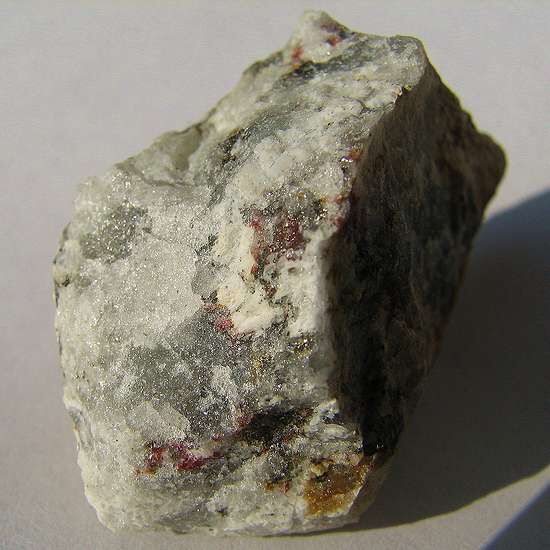
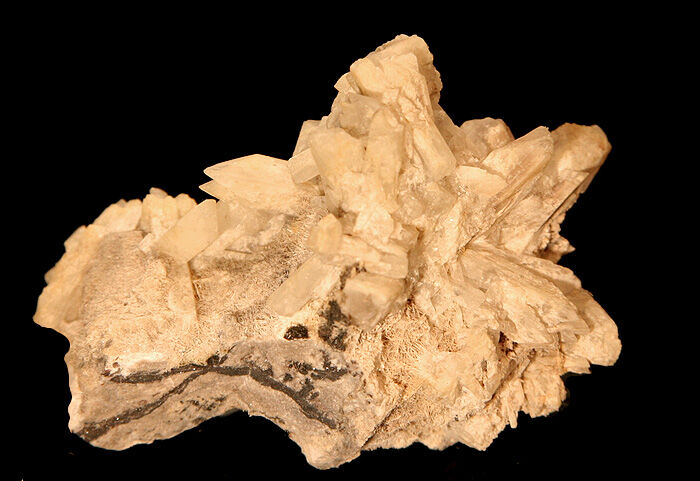
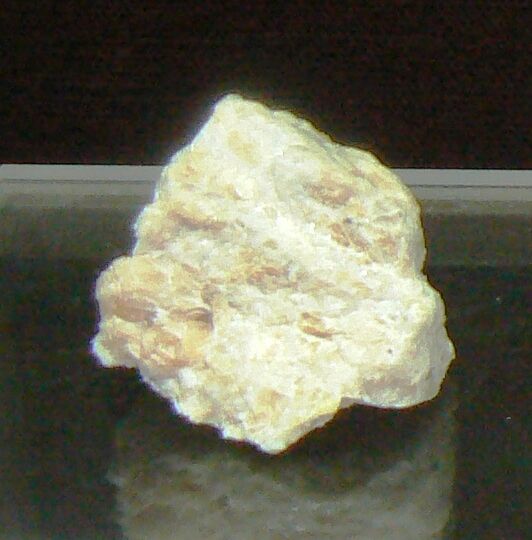
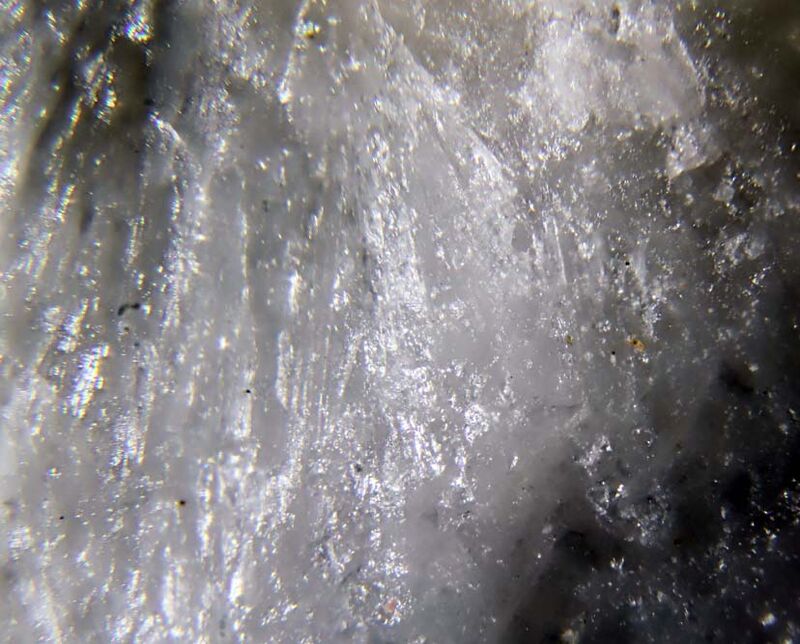
Usually fine-grained, anhedral. When developed, crystals typical of orthoclase.
- Type-locality form
Compact masses pseudomorphous after plagioclase, and as crystals as much as 0.05 mm diameter lining cavities.
- Comment
Possibly prismatic class
Crystal structure
Chemical composition
- Impurities
- Mg
- Ca
- Ba
- Na
- K
Synonyms
- IMA1963-001
In other languages
- French
- buddingtonite
- German
- Buddingtonit · IMA 1963-001
- Spanish
- Buddingtonita
- Italian
- Buddingtonite
- Portuguese
- buddingtonita · Buddingtonite · IMA1963-001
- Chinese
- 铵长石
- Russian
- Баддингтонит
Classification
Strunz
10th ed.9.FA.30
- 9SilicatesClass
- 9.FTektosilicates without zeolitic H2ODivision
- 9.FATektosilicates without additional non-tetrahedral anionsGroup
- 9.FA.30BuddingtoniteSpecies
Dana
8th ed.76.01.02.01
- 76Tectosilicates Al-si FrameworkClass
- 76.01Al-Si Framework with Al-Si frameworksType
- 76.01.02— unnamed intermediate level —Group
- 76.01.02.01BuddingtoniteSpecies
CIM
—16.5.3
- 16Silicates Containing Aluminum and other MetalsClass
- 16.5— unnamed intermediate level —Group
- 16.5.3BuddingtoniteSpecies
Group, growth & confusion
Literature, links & citation
Citations
- 1964Erd, Richard C., White, Donald E., Fahey, Joseph J., Lee, Donald E. (1964) Buddingtonite, an ammonium feldspar with zeolitic water. American Mineralogist, 49 (7-8) 831-850
- 1983Loughnan, F. C., Roberts, F. Ivor, Lindner, A. W. (1983) Buddingtonite (NH4-feldspar) in the Condor Oilshale Deposit, Queensland, Australia. Mineralogical Magazine, 47 (344) 327-334 doi:10.1180/minmag.1983.047.344.07 DOI: 10.1180/minmag.1983.047.344.07
- 1993Voncken, J.H.L.; van Roermund, H.L.M.; van der Eerden, A.M.J.; Jansen, J.B.H.; Erd, R.C. (1993) Holotype buddingtonite: An ammonium feldspar without zeolitic H2O. American Mineralogist, 78 (1-2). 204-209
- 2001(2001) Buddingtonite. Handbook of Mineralogy. Mineralogical Society of America
- 2001Harlov, D. E.; Andrut, M.; Pöter, B. (2001) Characterisation of buddingtonite (NH4)[AlSi3O8] and ND4-buddingtonite (ND4)[AlSi3O8] using IR spectroscopy and Rietveld refinement of XRD spectra. Physics and Chemistry of Minerals, 28 (3). 188-198 doi:10.1007/s002690000145DOI: 10.1007/s002690000145
Cite this entry
Entry last updated
@misc{mineral2025,
  author    = {Mineral Index editorial board},
  title     = {Buddingtonite — Mineral Index},
  year      = {2025},
  url       = {https://mineralindex.org/minerals/buddingtonite-796}
}