History
The name clinoclase carries a small instruction for anyone who handles it. It joins two Greek words — klino, to incline, and klasis, to break — because the mineral splits cleanly along a plane set at a slant rather than square to its faces. Cleavage is simply the direction along which a crystal breaks most easily, and in clinoclase that direction runs oblique.
The German mineralogist August Breithaupt coined that name in 1830, choosing it precisely for the oblique cleavage he saw. The mineral itself was first found in Cornwall, in south-west England. Its type locality — the place whose specimens define the species — is the Wheal Gorland mine at St Day.
Clinoclase belongs to the oxidised zone of copper deposits, the shallow region where weathering has broken down the original ore. There it grows as a hydrous copper arsenate, often in fine needle-like crystals. It is a rare mineral, and for most of its history it has been a subject for the collector's cabinet and the mineralogist's notebook rather than a working stone.
Industrial & practical applications
Clinoclase has no industrial use. It is far too rare for that, and it carries nothing a factory would want. Instead it is sought by mineral collectors and studied by mineralogists, prized for its sharp needle-like crystals — a striking representative of the rare copper arsenates of weathered ore.
One word of caution attaches to any specimen. Clinoclase is a copper arsenate, meaning arsenic is built into its chemistry. Handle samples with clean hands, keep them away from food, and wash after touching them. The mineral is stable on a shelf, but its dust should not be inhaled or ingested.
Where it forms, where it's found
- Type locality
- Wheal Gorland
- St Day
- Cornwall
- England
- UK
50.2417°, -5.1839°
Safety & handling
Physical
- Hardness
- 1Talc
- 2Gypsum
- 3Calcite
- 4Fluorite
- 5Apatite
- 6Orthoclase
- 7Quartz
- 8Topaz
- 9Corundum
- 10Diamond
- Lustre
- Vitreous
- Transparency
- Transparent · Translucent
- Colour
- Blue · greenish-blue · dark green-black · blue-green in transmitted light
- Streak
- Bluish green
- Tenacity
- brittle
- Cleavage
- Perfect
On (001), perfect.
- Fracture
- Irregular/Uneven
- Density
- 4.38 g/cm³
Optical
- Optical type
- Biaxial (-) · 2V measured = 30° · 2V calc = 52°
- Refractive index
- 1.73 – 1.91
- Surface relief
- Very high
- Principal indices
- nα 1.73 · nβ 1.87 · nγ 1.91
- Pleochroism
- Visible
X = Pale blue-green Y = b = Light blue green Z = near a = Benzol green
- Dispersion
- r < v, relatively strong
Crystallography
- Space group
- #14
- Cell parameters
- a = 12.4 Å · b = 6.47 Å · c = 7.27 Å
- Cell angles
- β = 99.58 °
- Ratio a:b:c
- 1 : 0.522 : 0.586
- Morphology
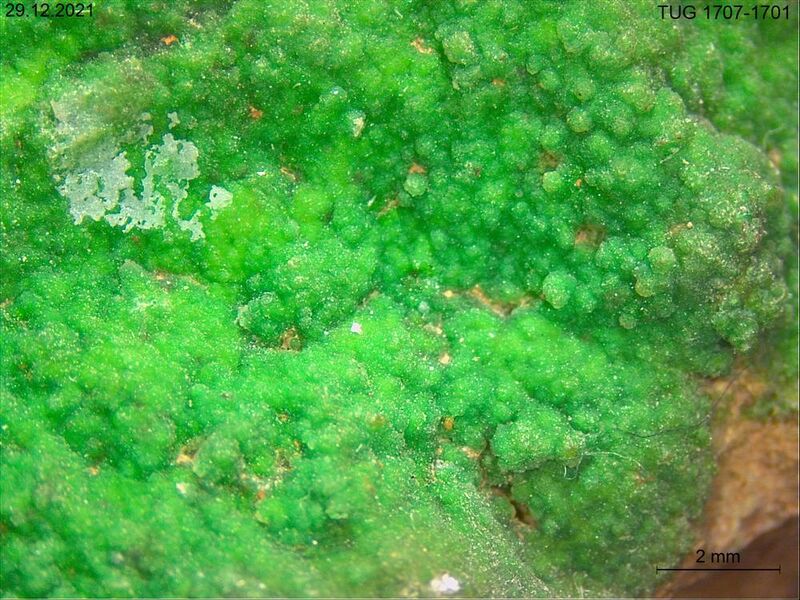
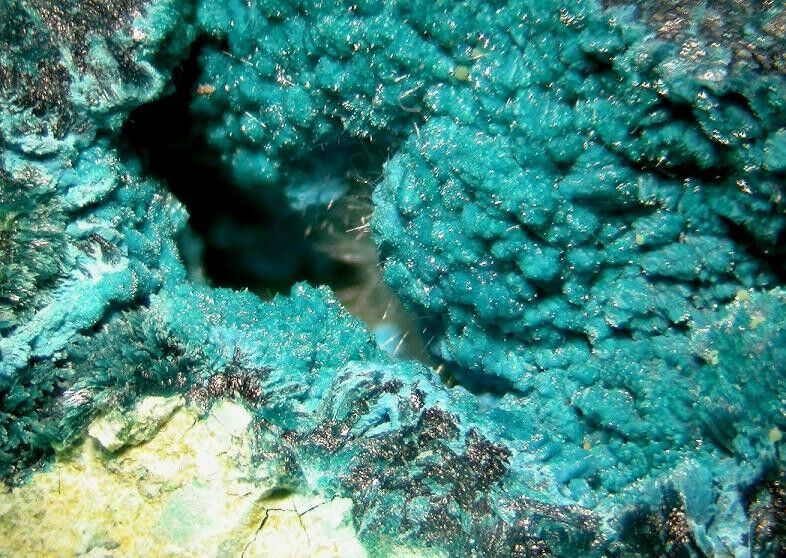
Crystals elongated [010] and tabular (001); also rhombohedral in aspect, or elongated [001] with (100) prominent; grouped into rosettes, as crusts and coatings. Densely aggregated with a fibrous structure at times. Forms include: (001), (100), (110), (02), (_201}, (11), (52), (01), (72).
Chemical composition
Synonyms
- Abichit
- Abichita
- Abichite
- Afanesita
- Aphanèse
- Aphanesit
- Aphanesite
- Arseniate of copper, 4th species
- Clinoclaas
- Clinoclase (of Breithaupt)
- Clinoclasit
- Clinoclasita
- Clinoclasite
- Cuivre Arseniaté (of Haüy)
- Klinoklasit
- Siderochalcit
- Siderochalcita
- Siderochalcite
- Strahlenerz
- Strahlenkupfer
- Strahlerz
- Strahliges Olivenerz
In other languages
- French
- Clinoclase
- German
- Klinoklas
- Spanish
- Clinoclasa
- Italian
- Clinoclasio
- Portuguese
- clinoclase
- Chinese
- 光線礦
- Arabic
- كلينوكلاس
Classification
8.BE.20
- 8Phosphates, Arsenates, VanadatesClass
- 8.BPhosphates, etc., with additional anions, without H2ODivision
- 8.BEWith only medium-sized cations, (OH, etc.):RO4 > 2:1Group
- 8.BE.20ClinoclaseSpecies
41.03.01.01
- 41Anhydrous Phosphates, Etc.containing Hydroxyl or HalogenClass
- 41.03(AB)3(XO4)ZqType
- 41.03.01Clinoclase GroupGroup
- 41.03.01.01ClinoclaseSpecies
20.1.3
- 20Arsenates (also arsenates with phosphate, but without other anions)Class
- 20.1Arsenates of CuGroup
- 20.1.3ClinoclaseSpecies
Group, growth & confusion
Literature, links & citation
- 1801Bournon (1801) Phil. Trans.: 91: 181 (as Arseniate of copper, 4th species).
- 1801Karsten (1801) Ges. nat. Freunde Berlin, N. Schr.: 3: 288 (as Strahliges Olivenerz).
- 1808Karsten, D.L.G. (1808) Mineralogische Tabellen, Berlin. second edition: 64, 97 (as Strahlenerz).
- 1813Hausmann, Johann Friedrich Ludwig (1813) Handbuch der Mineralogie (1st ed.). Vandenhoeck und Ruprecht.
- 1822Haüy, René Just (1822) Traité de Minéralogie (2nd ed.) Vol. 3. Bachelier, Paris.
Entry last updated
@misc{mineral2026,
  author    = {Mineral Index editorial board},
  title     = {Clinoclase — Mineral Index},
  year      = {2026},
  url       = {https://mineralindex.org/minerals/clinoclase-1055}
}