History
The name points straight at the place it was found. In 1846 the Bohemian mineralogist František Xaver Maximilian Zippe named the mineral after Cornwall, the county in south-west England. Cornwall also holds its type locality — the first place a mineral is ever recorded.
That first occurrence was at Wheal Gorland, one of the workings of the St Day United Mines in the St Day mining district of Cornwall.
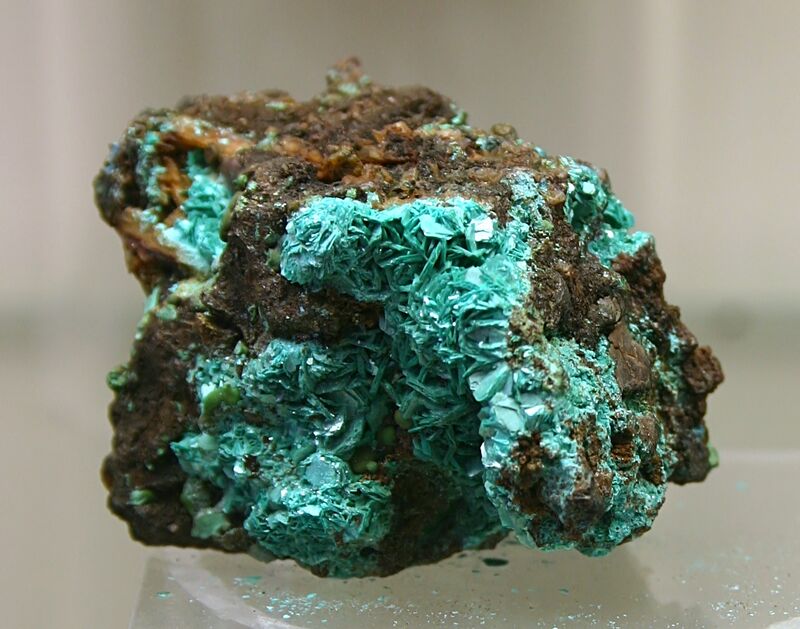
Cornwallite is a copper arsenate — a mineral built from copper, arsenic and oxygen. It forms as a secondary mineral, meaning it grows later, as earlier minerals break down rather than crystallising from the original melt or fluid. It appears in the oxidized zone of copper sulfide deposits, the near-surface band where air and water have rotted the primary ore. There it spreads as green radial to fibrous encrustations, thin crusts of needle-like crystals fanning out from a point.
Industrial & practical applications
Cornwallite has no industrial use. It is far too rare for that — an uncommon mineral found as thin green crusts in the weathered tops of a few copper deposits. Where it does turn up, it is of interest to collectors and to mineralogists studying the species, not to industry.
One practical point is worth flagging for anyone who handles a specimen. Cornwallite is a copper arsenate, so each crystal carries arsenic locked into its structure. That makes it a mineral to keep behind glass and to handle with washed hands rather than to grind, lick or breathe as dust.
Where it forms, where it's found
- Geological setting
Copper bearing sulfide veins
Found in the oxidized zones of copper deposits.
- Type locality
- Wheal Gorland
- St Day
- Cornwall
- England
- UK
50.2417°, -5.1839°
Safety & handling
Physical
- Hardness
- 1Talc
- 2Gypsum
- 3Calcite
- 4Fluorite
- 5Apatite
- 6Orthoclase
- 7Quartz
- 8Topaz
- 9Corundum
- 10Diamond
- Transparency
- Translucent · Opaque
- Colour
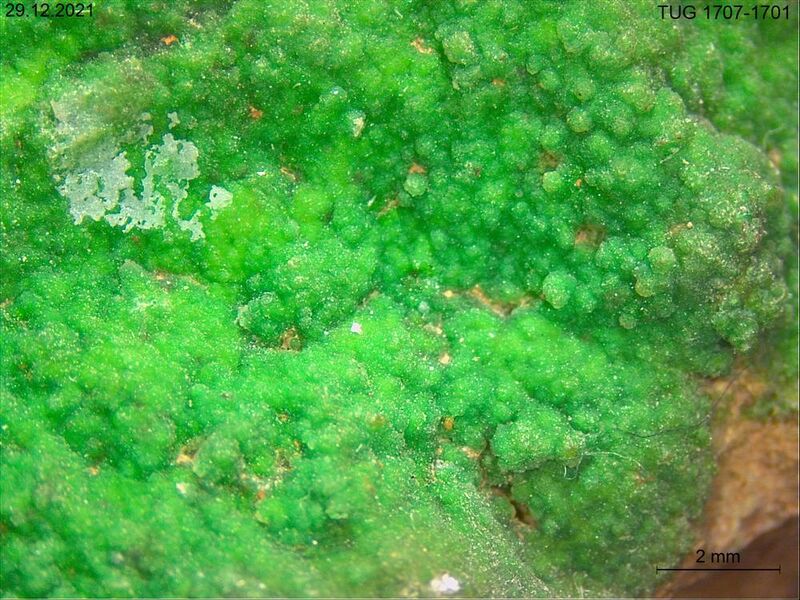
- Verdigis green · blackish-green · emerald-green · emerald-green in transmitted light.
- Streak
- Apple green
- Tenacity
- brittle
- Cleavage
- Distinct/Good
On one direction.
- Fracture
- Irregular/Uneven · Conchoidal
- Density
- 4.17 g/cm³
Optical
- Optical type
- Biaxial (+/-) · 2V measured = 30 – 50° · 2V calc = 34°
- Refractive index
- 1.81 – 1.88
- Surface relief
- Very high
- Principal indices
- nα 1.810 – 1.820 · nβ 1.815 – 1.860 · nγ 1.850 – 1.880
- Birefringence
- 0.050
- Dispersion
- r > v
- UV response
- Not Fluorescent
Crystallography
- Space group
- P21/a
- Cell parameters
- a = 17.33 Å · b = 5.82 Å · c = 4.60 Å
- Cell angles
- β = 92.22 °
- Ratio a:b:c
- 1 : 0.336 : 0.265
- Z
- 2
- Morphology
Microcrystalline, radial fibrous botyroidal to globular and vitreous crusts. Less common as rounded tabular to blocky crystals.
Chemical composition
Synonyms
- Cornwalliet
- Erinite (of Haidinger)
In other languages
- French
- cornwallite
- German
- Cornwallit
- Spanish
- Cornwallita · cornwallite
- Italian
- Cornwallite
- Chinese
- 水綠砷銅礦
- Arabic
- كورنواليت
Classification
8.BD.05
- 8Phosphates, Arsenates, VanadatesClass
- 8.BPhosphates, etc., with additional anions, without H2ODivision
- 8.BDWith only medium-sized cations, (OH, etc.):RO4= 2:1Group
- 8.BD.05CornwalliteSpecies
41.04.02.02
- 41Anhydrous Phosphates, Etc.containing Hydroxyl or HalogenClass
- 41.04(AB)5(XO4)2ZqType
- 41.04.02— unnamed intermediate level —Group
- 41.04.02.02CornwalliteSpecies
20.1.4
- 20Arsenates (also arsenates with phosphate, but without other anions)Class
- 20.1Arsenates of CuGroup
- 20.1.4CornwalliteSpecies
Group, growth & confusion
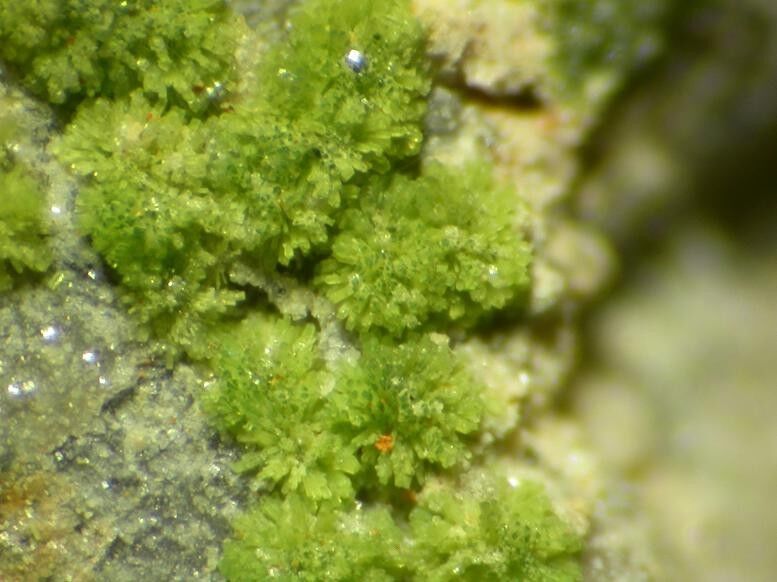 ArthuriteCuFe3+2(AsO4)2(OH)2 · 4H2OMineral—
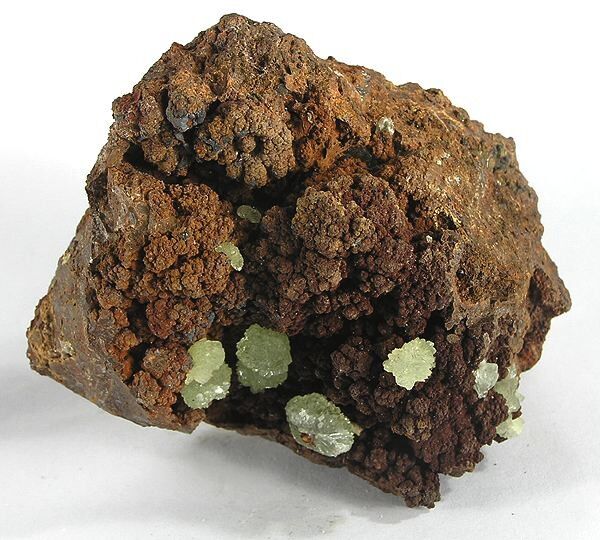 AustiniteCaZn(AsO4)(OH)Mineral—
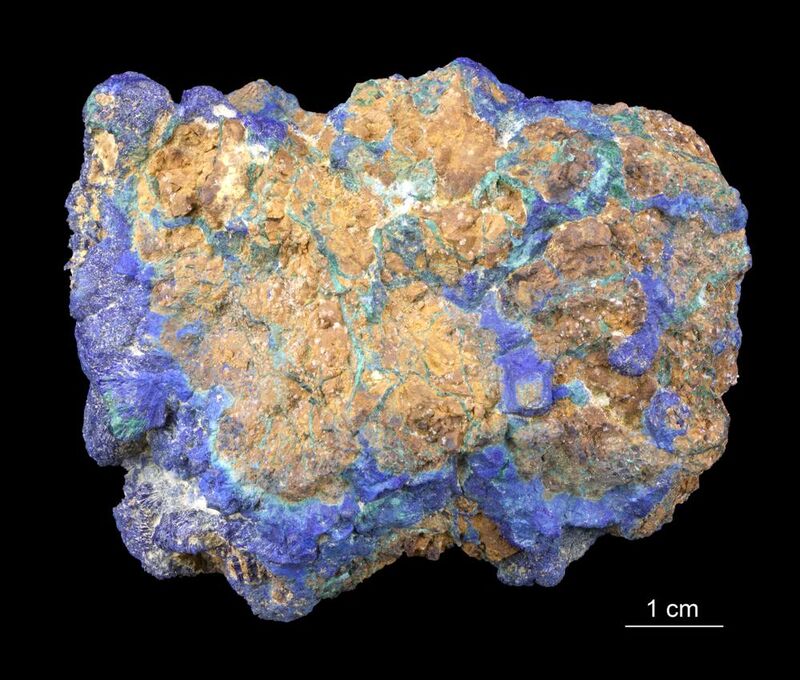 AzuriteCu3(CO3)2(OH)2Mineral—
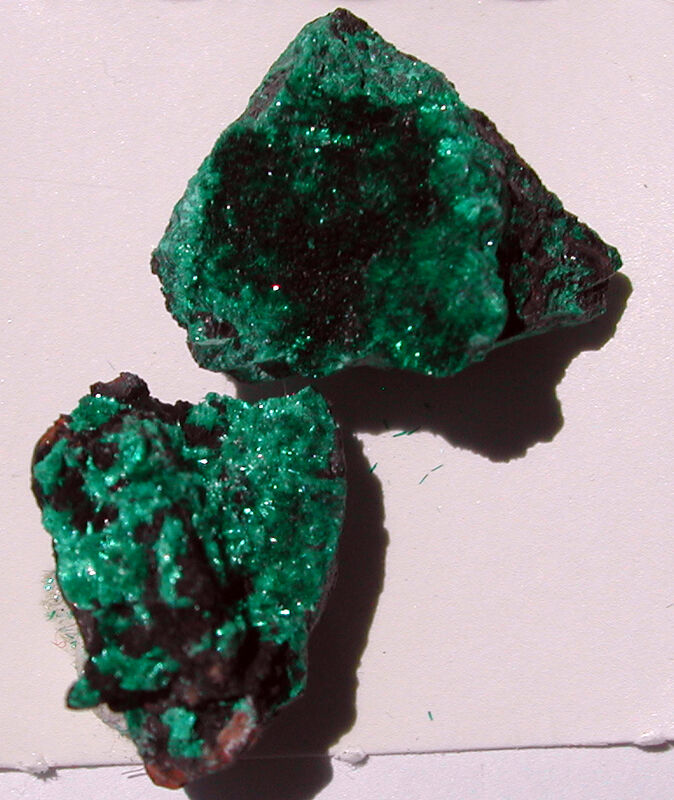 BrochantiteCu4(SO4)(OH)6Mineral—
 ChalcophylliteCu18Al2(AsO4)4(SO4)3(OH)24 · 36H2OMineral—
 ClinoclaseCu3(AsO4)(OH)3Mineral—
 ConichalciteCaCu(AsO4)(OH)Mineral—
 CornubiteCu5(AsO4)2(OH)4Mineral—
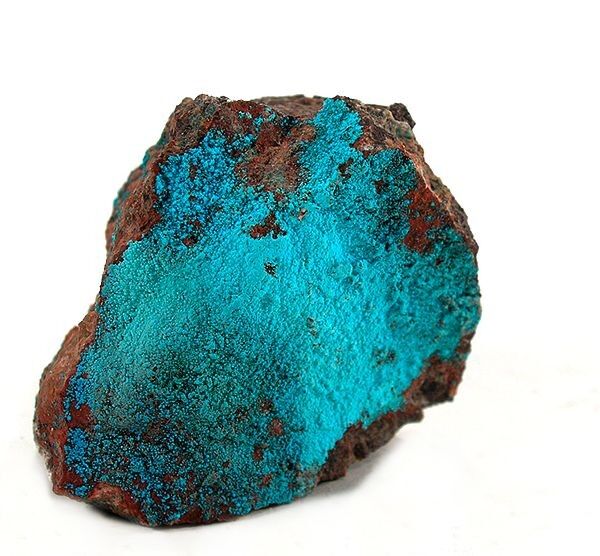 LavendulanNaCaCu5(AsO4)4Cl · 5H2OMineral—
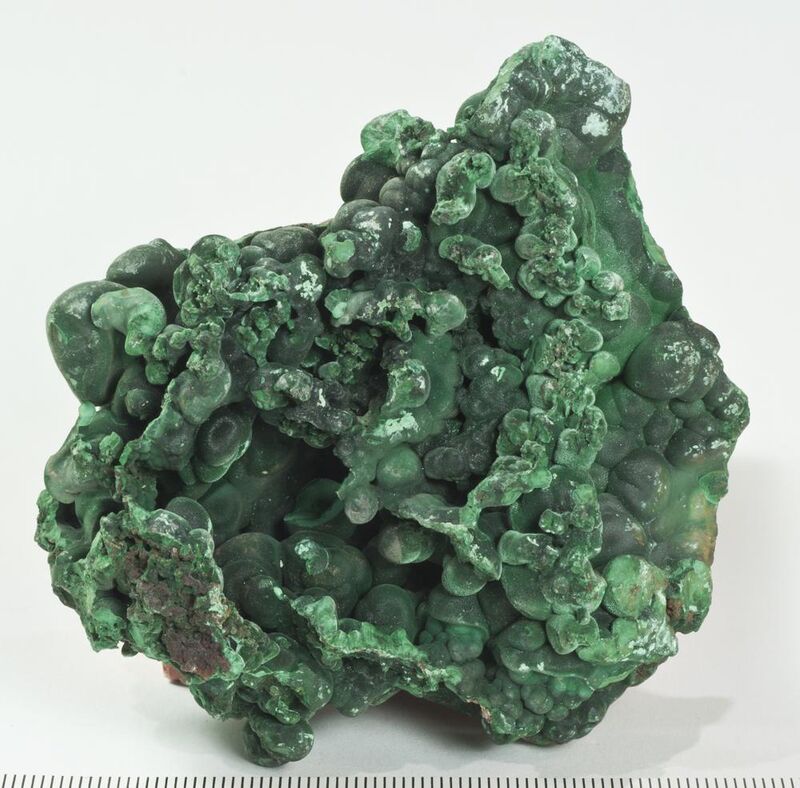 MalachiteCu2(CO3)(OH)2Mineral—
Literature, links & citation
- 1828Haidinger, H. (1828) Annalen der Physik, Halle, Leipzig: 14: 228 (as Erinite).
- 1828Haidinger, H. (1828) Erinite, a new mineral species. Philosophical Magazine and Journal of Science: 4: 154-155. (as Erinite)
- 1847Zippe, F.X.M. (1847) Über den Cornwallit, eine neue Species des Mineralreichs. Abhandlungen der Königlichen Böhmischen Gesellschaft der Wissenschaften: 4: 649-654.
- 1858Greg, Robert Philips, Lettsom, William G. (1858) Manual of the Mineralogy of Great Britain and Ireland. John Van Voorst, London.
- 1868Church, A.H. (1868) Chemical researches on new and rare Cornish minerals. V. Cornwallite. The Journal of the Chemical Society of London: 21: 276-279.
Entry last updated
@misc{mineral2026,
  author    = {Mineral Index editorial board},
  title     = {Cornwallite — Mineral Index},
  year      = {2026},
  url       = {https://mineralindex.org/minerals/cornwallite-1133}
}