History
The name conichalcite is a portrait of the mineral painted in Greek. Kónis means powder or dust; chalkós means copper. Pressed together, they describe what an early mineralogist would have seen on a cracked rock from a copper mine — a dusty green encrustation, faintly powdery to the eye.
The mineral entered the literature in 1849. The German mineralogist August Breithaupt and the chemist Carl Julius Fritzsche described it that year and gave it its Greek name. The type specimens came from the Don Bonete mine, near Hinojosa del Duque in the province of Córdoba, Andalusia, in southern Spain — still the type locality today.
Nothing earlier is on record. Conichalcite is a 19th-century discovery, with no documented antiquity. The Greek roots of its name are linguistic, not historical: the word was coined in 1849 to label a mineral the ancient writers never described.
Industrial & practical applications
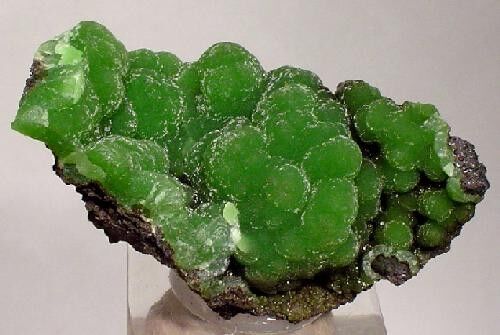
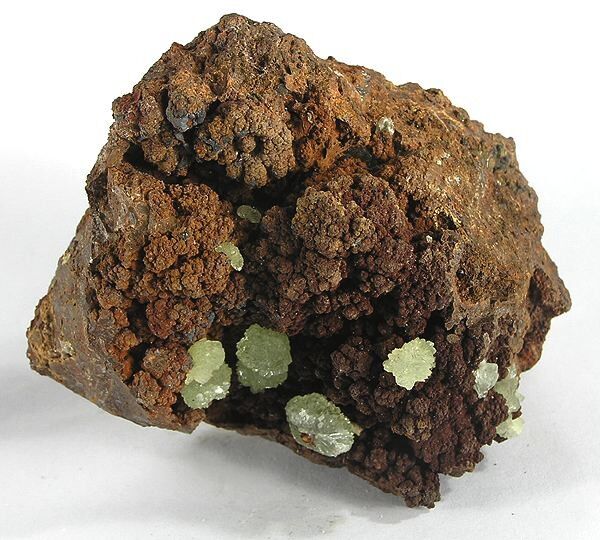
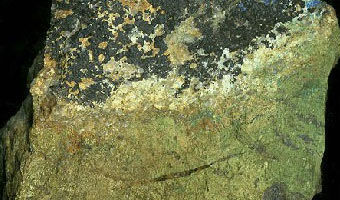
Conichalcite has no industrial application. It is too scarce and too small in crystal size to serve any commercial purpose. The copper and calcium it carries are recovered far more economically from other ores. What demand exists comes from mineral collectors. They are drawn by the vivid green colour and the contrast it makes against the rusty limonite the mineral typically grows on. Classic specimen-producing localities include the Ojuela Mine in Mexico, the Tsumeb Mine in Namibia, and the copper mines of Tooele County in Utah.
The mineral is also worth a word of care. Because conichalcite is a calcium copper arsenate, every crystal contains arsenic — a known poison. Specimens are safe to handle and display, but should not be ground, heated, or stored loose around food. In its natural setting, conichalcite is itself a product of oxidising groundwater reacting with sulfide ores in the upper part of a copper deposit. It is one of the secondary minerals that crystallise as that metal-rich fluid moves through fractured rock.
Where it forms, where it's found
- Geological setting
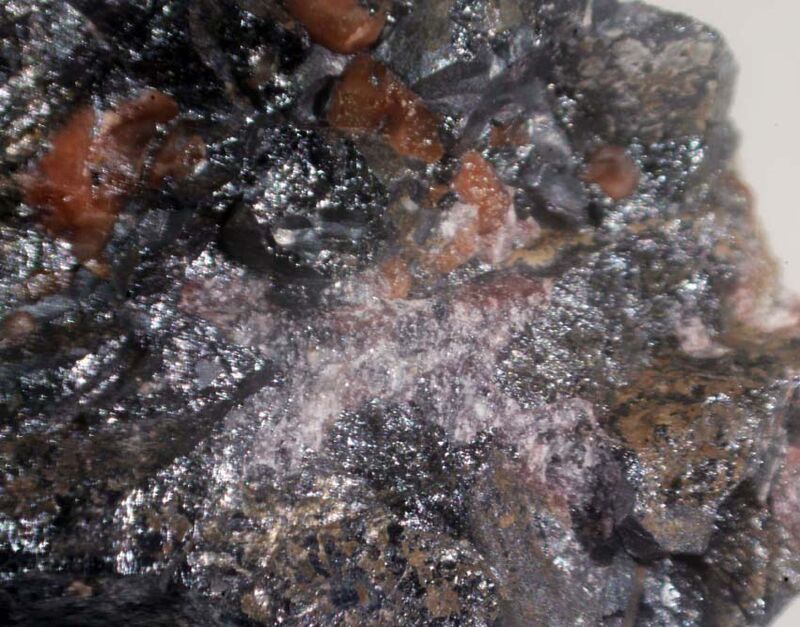
An uncommon alteration product in the oxidation zone of copper deposits. Typically an alteration product of enargite.
- Type locality
- Don Bonete mine
- Hinojosa del Duque
- Córdoba
- Andalusia
- Spain
38.5022°, -5.1758°
Safety & handling
Physical
- Hardness
- 1Talc
- 2Gypsum
- 3Calcite
- 4Fluorite
- 5Apatite
- 6Orthoclase
- 7Quartz
- 8Topaz
- 9Corundum
- 10Diamond
- Transparency
- Translucent
- Colour
- Green · yellow-green · greenish yellow · light green to yellowish green in transmitted light.
- Streak
- Light green
- Tenacity
- brittle
- Cleavage
- None Observed
- Fracture
- Irregular/Uneven
- Density
- 4.33 g/cm³
Optical
- Optical type
- Biaxial (+/-) · 2V measured = 90°
- Refractive index
- 1.778 – 1.846
- Surface relief
- Very high
- Principal indices
- nα 1.778 – 1.800 · nβ 1.795 – 1.831 · nγ 1.801 – 1.846
- Birefringence
- 0.034
- Pleochroism
- Visible
X = Nearly colorless or green Y = Light greenish or yellowish green Z = Pale bluish or blue-green
- Dispersion
- Strong r < v to r < v moderate
- Extinction
- XYZ = cba
- UV response
- Not fluorescent
- Notes
Data for pleochroism relates to Bristol (left) and Bisbee (right).
Crystallography
- Space group
- P21 21 21
- Cell parameters
- a = 7.393(1) Å · b = 9.220(1) Å · c = 5.830(1) Å
- Ratio a:b:c
- 1 : 1.247 : 0.789
- Z
- 4
- Morphology
Typically radial fibrous aggregates, botyroidal to reniform crusts, massive, rarely equant crystals are short prismatic [010].
- Twinning
Rare on (001).
Chemical composition
- Impurities
- Mg
- P
- V
- Zn
Synonyms
- Conichalcit
- Higginsite
- Staszicite
- Staszycyt
In other languages
- French
- Conichalcite
- German
- Conichalcit · Konichalcit · Parabayldonit
- Spanish
- Conicalcita
- Italian
- Conicalcite · Conichalcite
- Japanese
- コニカルコ石
- Chinese
- Conichalcite · 砷钙铜矿
- Russian
- Конихальцит
Classification
8.BH.35
- 8Phosphates, Arsenates, VanadatesClass
- 8.BPhosphates, etc., with additional anions, without H2ODivision
- 8.BHWith medium-sized and large cations, (OH,etc.):RO4 = 1:1Group
- 8.BH.35ConichalciteSpecies
41.05.01.02
- 41Anhydrous Phosphates, Etc.containing Hydroxyl or HalogenClass
- 41.05(AB)2(XO4)ZqType
- 41.05.01Adelite GroupGroup
- 41.05.01.02ConichalciteSpecies
20.1.12
- 20Arsenates (also arsenates with phosphate, but without other anions)Class
- 20.1Arsenates of CuGroup
- 20.1.12ConichalciteSpecies
Group, growth & confusion
 AdeliteCaMg(AsO4)(OH)Mineral—
 ArsendescloizitePbZn(AsO4)(OH)Mineral—
 AustiniteCaZn(AsO4)(OH)Mineral—
 ČechitePbFe2+(VO4)(OH)Mineral—
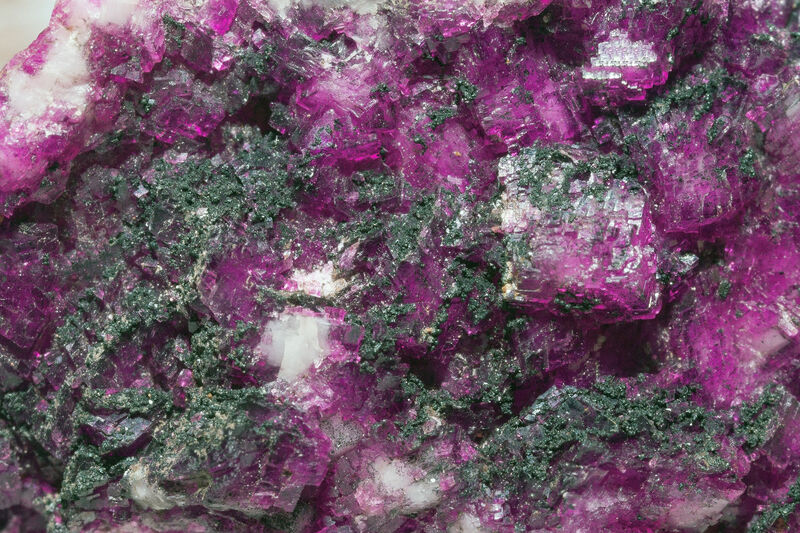 CobaltaustiniteCaCo(AsO4)(OH)Mineral—
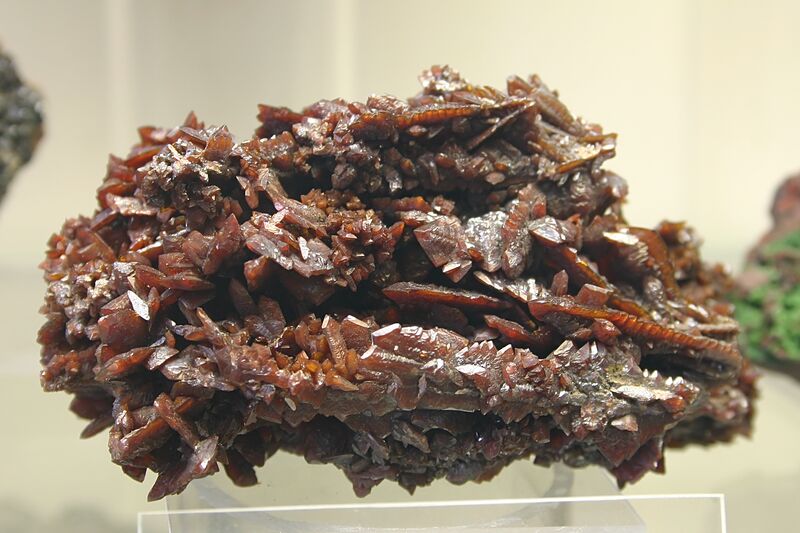 DescloizitePbZn(VO4)(OH)Mineral—
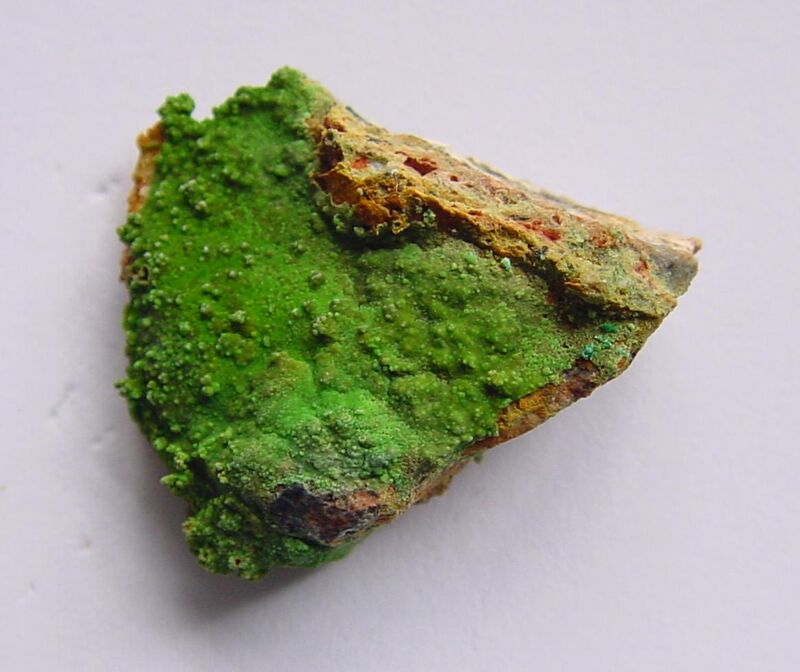 DuftitePbCu(AsO4)(OH)Mineral—
- Duftite-alphaPbCu(AsO4)(OH)Mineral—
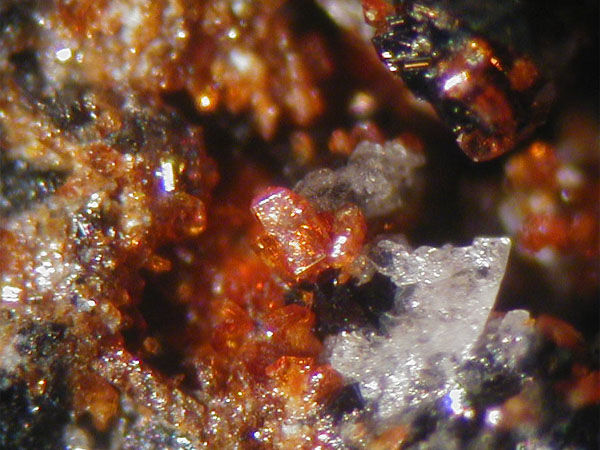 GottlobiteCaMg(VO4)(OH)Mineral—
- HermannroseiteCaCu(PO4)(OH)Mineral—
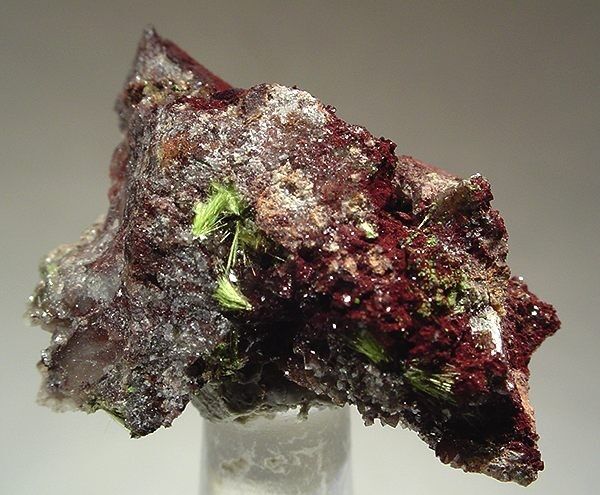 Agardite-(La)LaCu2+6(AsO4)3(OH)6 · 3H2OMineral—
- AustiniteCaZn(AsO4)(OH)Mineral—
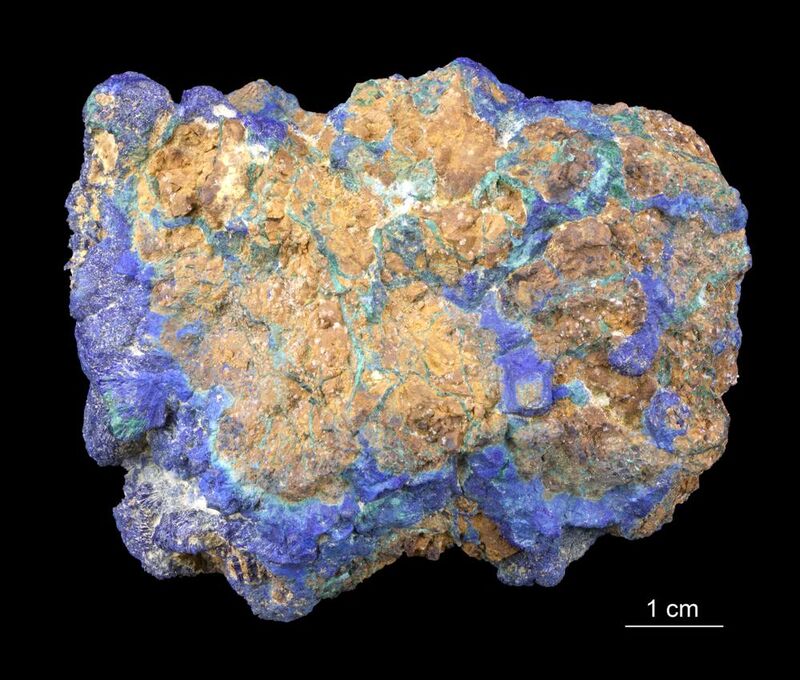 AzuriteCu3(CO3)2(OH)2Mineral—
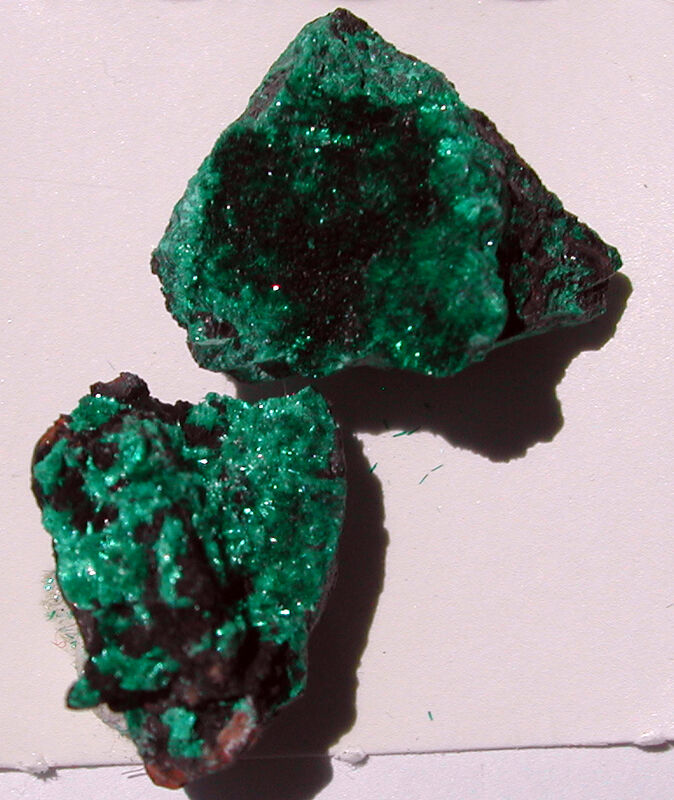 BrochantiteCu4(SO4)(OH)6Mineral—
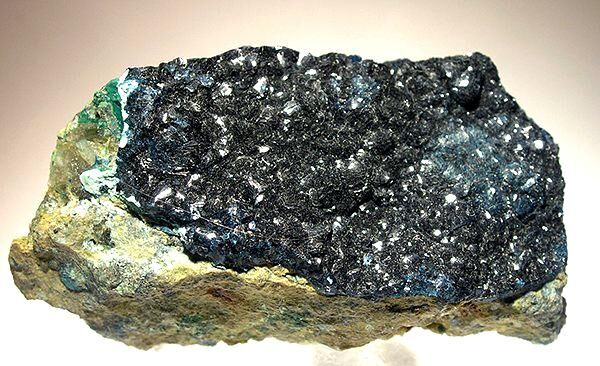 ClinoclaseCu3(AsO4)(OH)3Mineral—
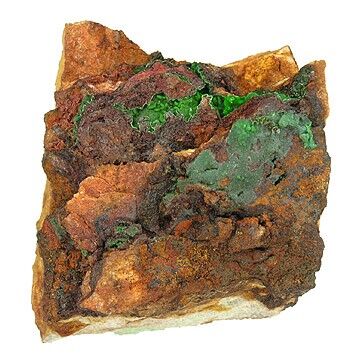 CornwalliteCu5(AsO4)2(OH)4Mineral—
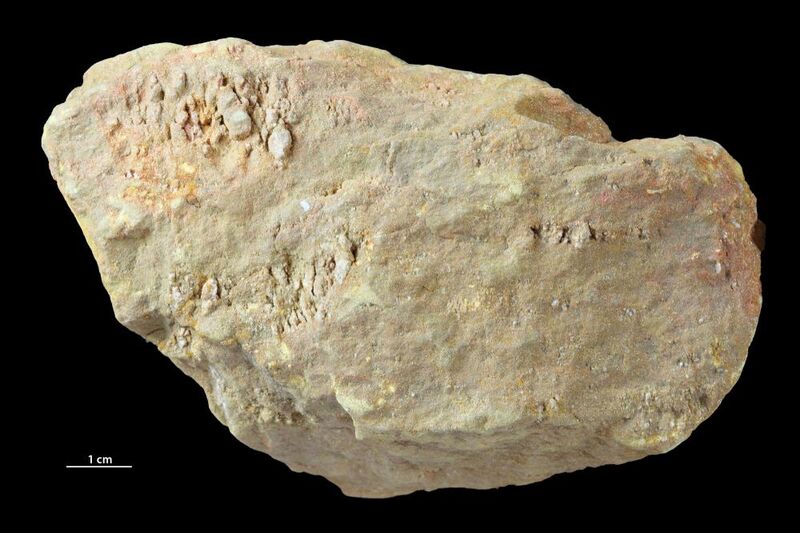 JarositeKFe3+3(SO4)2(OH)6Mineral—
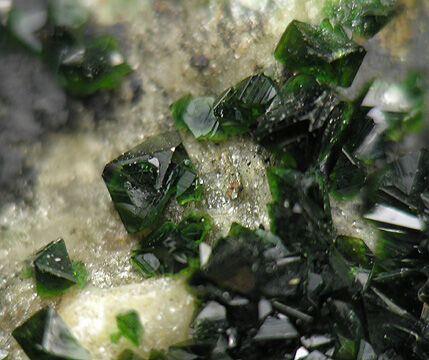 LibetheniteCu2(PO4)(OH)Mineral—
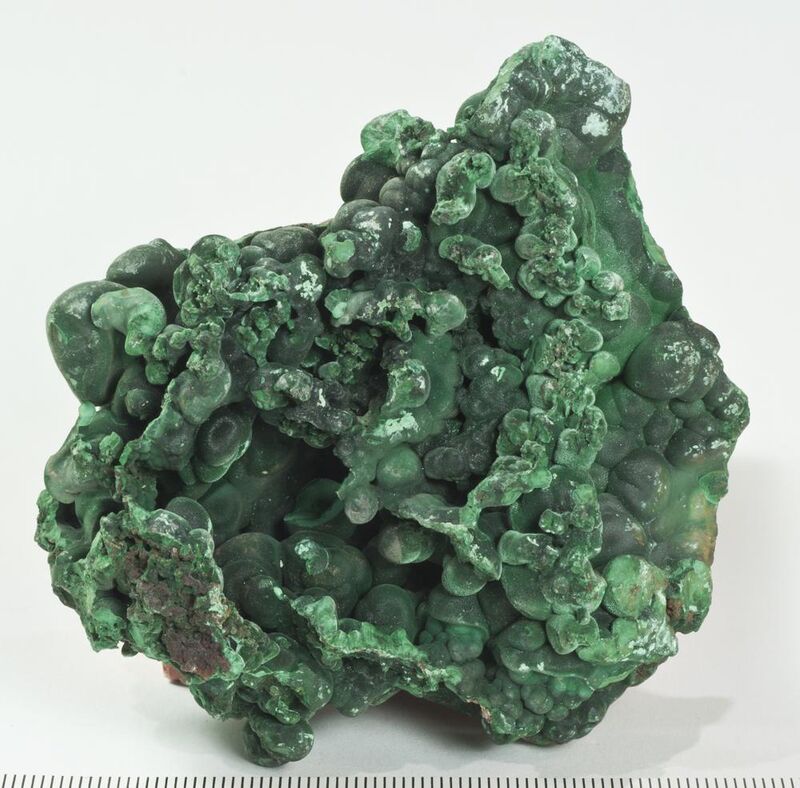 MalachiteCu2(CO3)(OH)2Mineral—
 OliveniteCu2(AsO4)(OH)Mineral—
Literature, links & citation
- 1849Breithaupt, J.F.A., Fritzsche, F.W. (1849) Bestimmung neuer mineralien: Konichalcit. Annalen der Physik und Chemie, Halle, Leipzig: 77: 139-141.
- 1849Fritzsche (1849) Annalen der Physik, Halle, Leipzig: 77: 180.
- 1883Hillebrand, W.F. (1883) On an Association of Rare Minerals from Utah. Proceedings of the Colorado Science Society: 1: 112-123 (114).
- 1909Michel, M.L. (1909) Sur la forme cristalline de la conichalcite. Bulletin de la Société française de Minéralogie: 32: 50-51.
- 1918Morozewicz, J. (1918) Staszicite, a new mineral from the copper mine at Miedzianka. Rull. intern. acad. sci. Cracovie, Class A: Sci. Math.: 4-16. [see also Mineralog. Abstr. 2, 51] (as Staszycyt [Staszicite]).
Entry last updated
@misc{mineral2026,
  author    = {Mineral Index editorial board},
  title     = {Conichalcite — Mineral Index},
  year      = {2026},
  url       = {https://mineralindex.org/minerals/conichalcite-1119}
}