Where it forms, where it's found
- Geological setting
syenite pegmatite
- Type locality
- Nunarssuatsiaq
- Tunulliarfik Fjord
- Ilímaussaq complex
- Kujalleq
- Greenland
60.9539°, -45.8511°
18recorded occurrences
Physical
Optical
- Optical type
- Biaxial (-) · 2V measured = 60 – 80° · 2V calc = 80°
- Refractive index
- 1.61 – 1.77
- Surface relief
- High
- Principal indices
- nα 1.610 · nβ 1.650 – 1.770 · nγ 1.682 – 1.770
- Dispersion
- relatively strong
- Notes
Z ^ c = 70°
Δ = 0Δmax
PPLpleochroism per grain
XPLindependent extinctions · rotate the stage
PPLpleochroism only · colour blends on rotation
XPLinterference colour · extinct every 90°
Retardation1160 nm
Order3rd order
XPL colour
Crystallography
- Cell parameters
- a = 5.41 Å · b = 7.08 Å · c = 12.07 Å
- Cell angles
- α = 103.03 ° · β = 96.03 ° · γ = 88.36 °
- Ratio a:b:c
- 1 : 1.309 : 2.231
- Z
- 1
- Type-locality form
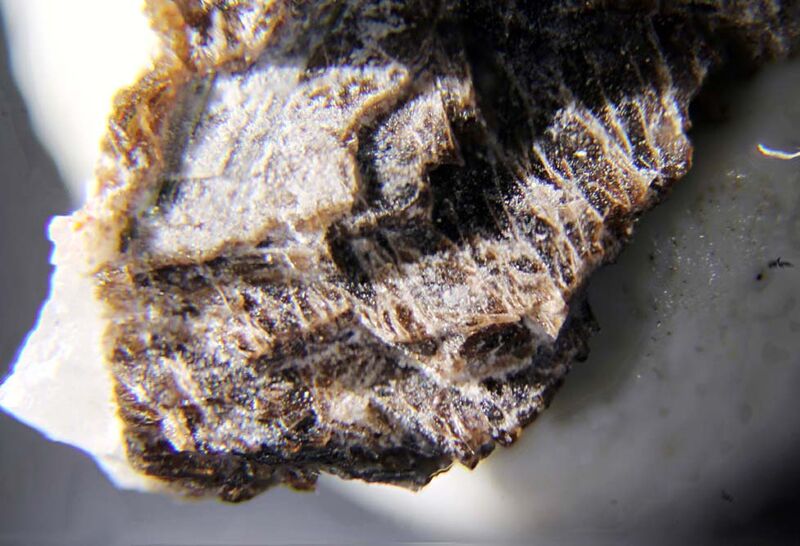
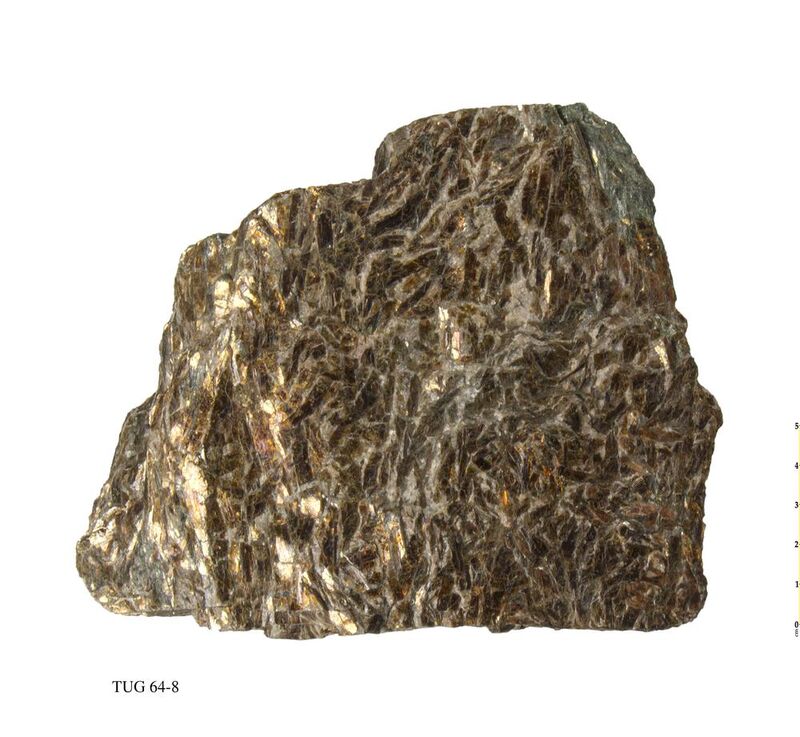
Silvery plates
Crystal structure
Chemical composition
- Impurities
- Al
- Ta
- Fe
- Mn
- Mg
- Ca
- K
- F
- P
Synonyms
- Epistoliet
In other languages
- German
- Epistolit
- Italian
- Epistolite
Classification
Strunz
10th ed.9.BE.30
- 9SilicatesClass
- 9.BSorosilicatesDivision
- 9.BESi2O7 groups, with additional anions; cations in octahedral [6] and greater coordinationGroup
- 9.BE.30EpistoliteSpecies
Dana
8th ed.56.02.07.01
- 56Sorosilicates Si2o7 Groups, with Additional O, Oh, F and H2oClass
- 56.02Si2O7 Groups and O, OH, F, and H2O with cations in [4] and/or >[4] coordinationType
- 56.02.07Murmanite groupGroup
- 56.02.07.01EpistoliteSpecies
CIM
—17.8.1
- 17Silicates Containing other AnionsClass
- 17.8Silicates with niobate or tantalateGroup
- 17.8.1EpistoliteSpecies
Group, growth & confusion
- Barytolamprophyllite(BaK)Ti2Na3Ti(Si2O7)2O2(OH)2Mineral—
 BornemaniteNa6(Na◻)Ba2Ti2Nb2(Si2O7)4(PO4)2O4(OH)2F2Mineral—
 DelindeiteBa2Ti2(Na2◻)Ti(Si2O7)2(OH)2(H2O)2O2Mineral—
 EmmerichiteBa2Ti2Na3Fe3+(Si2O7)2O2F2Mineral—
- Fluorbarytolamprophyllite(Ba,Sr,K)2[(Na,Fe2+)3TiF2][Ti2(Si2O7)2O2]Mineral—
 Fluorlamprophyllite(SrNa)Ti2Na3Ti(Si2O7)2O2F2Mineral—
- InneliteBa4Ti2Na(NaCa)Ti(Si2O7)2[(SO4)(PO4)]O2[O(OH)]Mineral—
- KazanskyiteBa◻TiNbNa3Ti(Si2O7)2O2(OH)2(H2O)2Mineral—
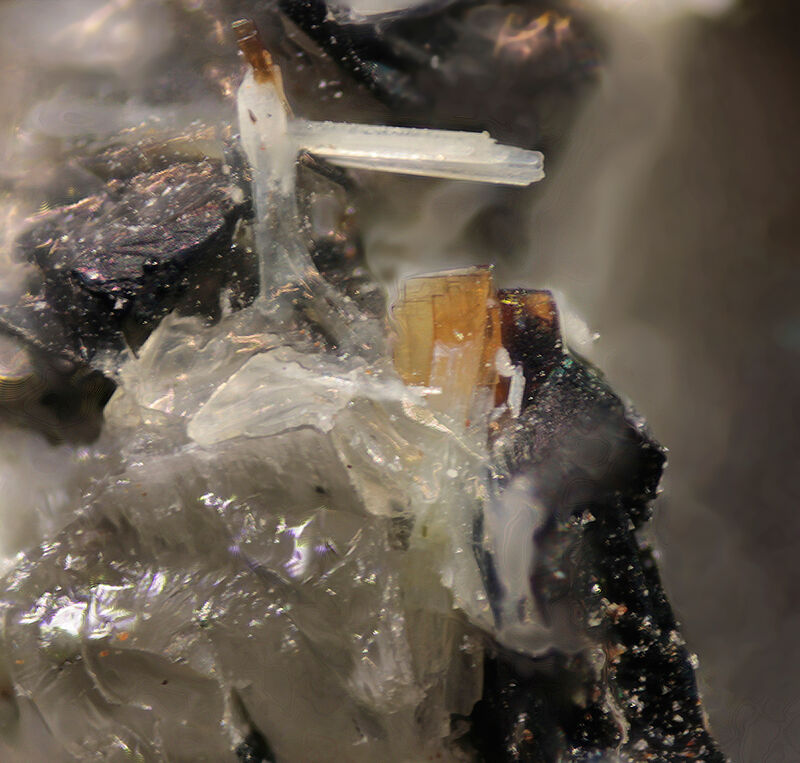
 Lamprophyllite(SrNa)Ti2Na3Ti(Si2O7)2O2(OH)2Mineral—
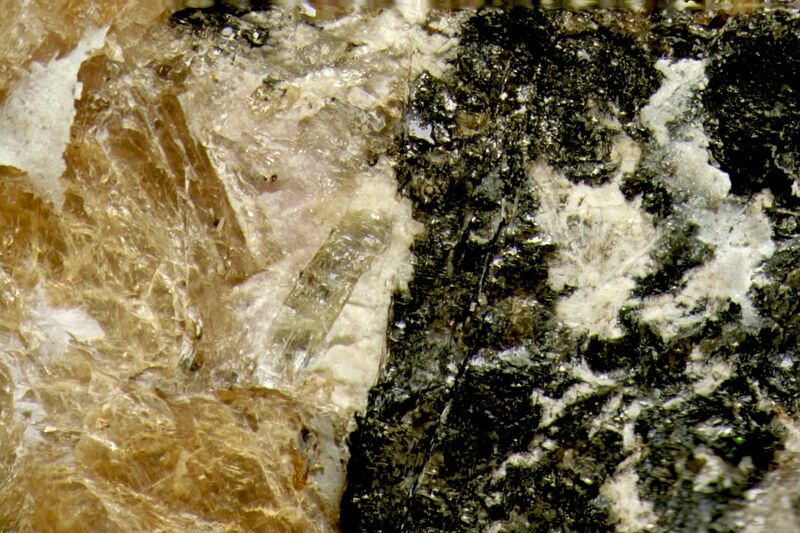
 LileyiteBa2Ti2Na2Fe2+Mg(Si2O7)2O2F2Mineral—
Literature, links & citation
Citations
- 1901Boegghild, O.B. (1901) Epistolite, a new mineral. Meddelelser om Grønland, 24. 183-190
- 1986Karup-Møller, S. (1986) Epistolite from the Ilímaussaq alkaline complex in South Greenland. Neues Jahrbuch für Mineralogie, Abhandlungen 155: 289-304.
- 2004Sokolova, E., Hawthorne, F. C. (2004) The crystal chemistry of epistolite. The Canadian Mineralogist, 42 (3) 797-806 doi:10.2113/gscanmin.42.3.797 DOI: 10.2113/gscanmin.42.3.797
- 2005Jambor, John L., Roberts, Andrew C. (2005) New Mineral Names. American Mineralogist, 90 (1) 271-275 doi:10.2138/am.2005.429DOI: 10.2138/am.2005.429
- 2005Nemeth, P., Ferraris, G., Radnoczi, G., Ageeva, O. A. (2005) TEM and X-ray study of syntactic intergrowths of epistolite, murmanite and shkatulkalite. The Canadian Mineralogist, 43 (3) 973-987 doi:10.2113/gscanmin.43.3.973 DOI: 10.2113/gscanmin.43.3.973
Cite this entry
Entry last updated
@misc{mineral2025,
  author    = {Mineral Index editorial board},
  title     = {Epistolite — Mineral Index},
  year      = {2025},
  url       = {https://mineralindex.org/minerals/epistolite-1392}
}