Where it forms, where it's found
- Geological setting
Lacustrine clay sediments in an alkali lake.
Soda lakes.
- Type locality
- Laguna de Urao
- Lagunillas
- Mérida
- Venezuela
8.5040°, -71.3996°
53recorded occurrences
Physical
- Hardness
- 1Talc
- 2Gypsum
- 3Calcite
- 4Fluorite
- 5Apatite
- 6Orthoclase
- 7Quartz
- 8Topaz
- 9Corundum
- 10Diamond
- Transparency
- Transparent · Translucent
- Colour
- Colourless · yellowish · greyish · white · colourless in transmitted light
- Streak
- Uncoloured to greyish white
- Tenacity
- very brittle
- Cleavage
- Perfect
On (110) perfect; (001) rather difficult.
- Fracture
- Conchoidal
- Density
- 1.991 g/cm³
Optical
- Optical type
- Biaxial (-) · 2V measured = 34° · 2V calc = 34°
- Refractive index
- 1.444 – 1.523
- Principal indices
- nα 1.444 · nβ 1.5155 · nγ 1.523
- Dispersion
- Relatively strong, r < v.
- Extinction
- X = b; Z ∧ c = –15°.
Δ = 0Δmax
PPLpleochroism per grain
XPLindependent extinctions · rotate the stage
PPLpleochroism only · colour blends on rotation
XPLinterference colour · extinct every 90°
Retardation790 nm
Order2nd order
XPL colour
Crystallography
- Space group
- C2/c
- Cell parameters
- a = 11.589 Å · b = 7.780 Å · c = 11.207 Å
- Cell angles
- β = 102.5 °
- Ratio a:b:c
- 1 : 0.671 : 0.967
- Z
- 4
- Morphology
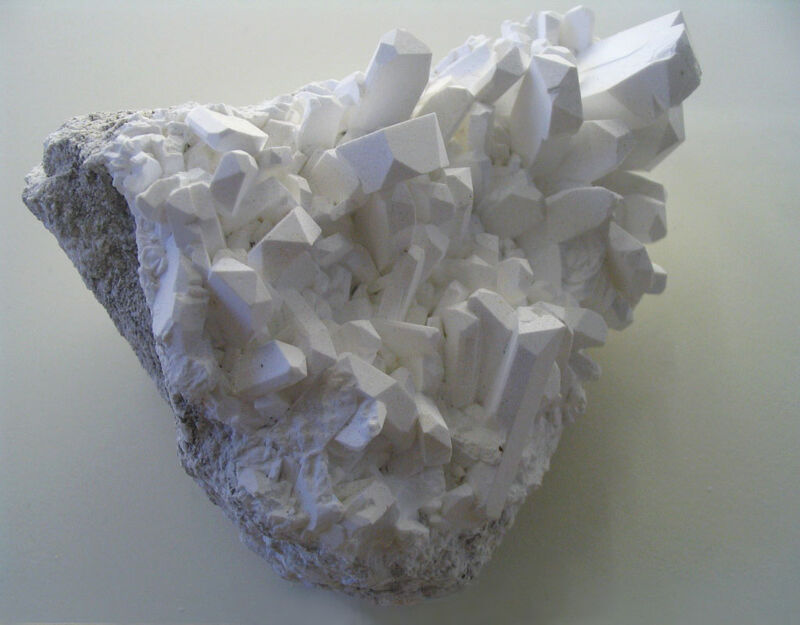
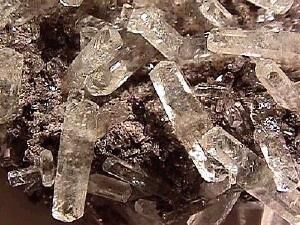
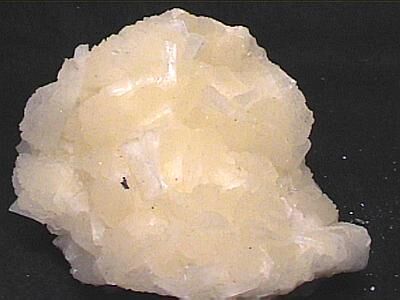
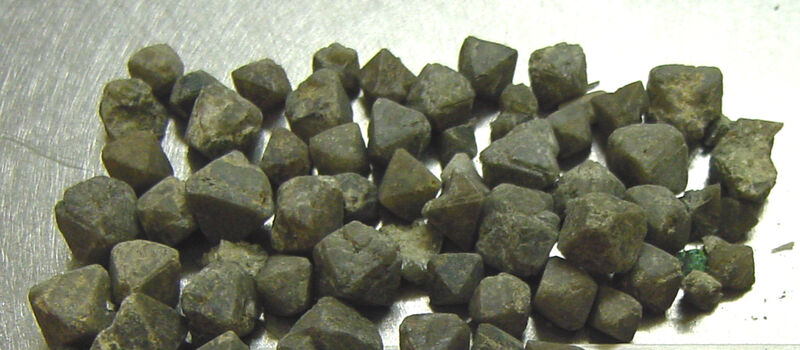
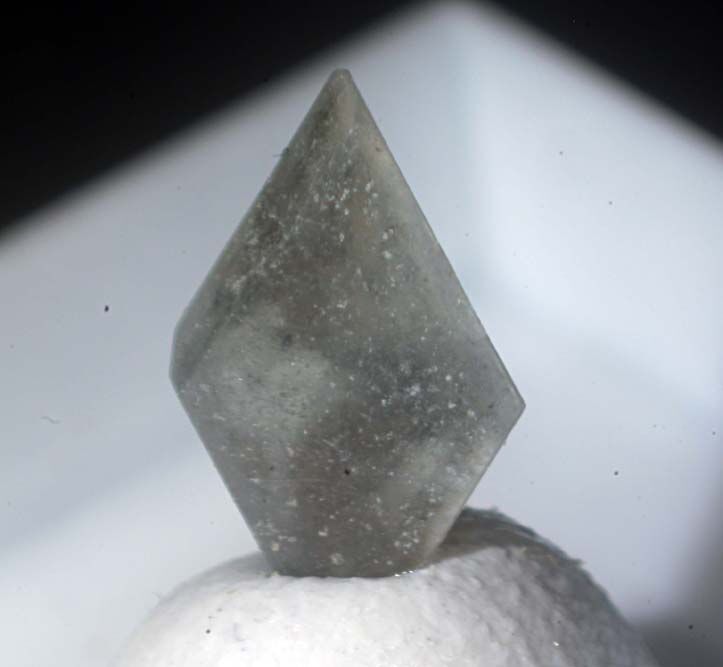
Crystals frequently elongated [100]; also flattened, wedge-shaped, with dominant (110), and (011). Surfaces commonly rough, with (011) striated (11).
Crystal structure
Chemical composition
Synonyms
- Gay-Lussite
- Gaylussacit
- Gaylussacita
- Gaylussacite
- Gaylussiet
- Natrium-calciumcarbonat-Pentahydrat
- Natrocalcit
In other languages
- French
- Gaylussite
- German
- Gaylussit
- Spanish
- Gaylussita
- Italian
- Gaylussite · Natrocalcite
- Japanese
- ゲーリュサイト · ゲイリュサック石
- Chinese
- 针碳钠钙石
- Russian
- Гей-люссит · Гейлюссит
Classification
Strunz
10th ed.5.CB.35
- 5CarbonatesClass
- 5.CCarbonates without additional anions, with H2ODivision
- 5.CBWith large cations (alkali and alkali-earth carbonates)Group
- 5.CB.35GaylussiteSpecies
Dana
8th ed.15.02.02.01
- 15Hydrated Normal CarbonatesClass
- 15.02AmBn(XO3)p·xH2O, with (m+n):p > 1:1Type
- 15.02.02— unnamed intermediate level —Group
- 15.02.02.01GaylussiteSpecies
CIM
—11.1.14
- 11CarbonatesClass
- 11.1Carbonates of the alkali metals and ammoniumGroup
- 11.1.14GaylussiteSpecies
Group, growth & confusion
Literature, links & citation
Citations
- 1826Boussingault, J.B. (1826) Analyse d'une nouvelle substance minérale (la Gay-Lussite). Annales de Chimie et de Physique: 31: 270-276.
- 1826Cordier, L. (1826) Sur la Gay-Lussite ou bi-carbonate hydraté de soude et de chaux, récemment découvert dans l'Amérique du Sud, par M. Boussingault. Annales de Chimie et de Physique: 31: 276-283.
- 1827Phillips, W. (1827) Observations on the Crystalline Form, &c. of the Gaylussite. The Philosophical Magazine and Journal of Science, 1:4: 263-266.
- 1839Glocker, E.F. (1839) Handbuch der Mineralogie, 2nd. edition, Nürnberg: 673 (as Natrocalcit).
- 1843Hartmann (1843) Minéralogie: 2: 271.
Cite this entry
Entry last updated
@misc{mineral2026,
  author    = {Mineral Index editorial board},
  title     = {Gaylussite — Mineral Index},
  year      = {2026},
  url       = {https://mineralindex.org/minerals/gaylussite-1662}
}