Where it forms, where it's found
- Geological setting
Low-temperature oxidation product of phosphate minerals.
- Type locality
- Ak-Kezen' pegmatite
- Belogorskiy
- Ulan District
- East Kazakhstan Region
- Kazakhstan
32recorded occurrences
Physical
Optical
- Optical type
- Biaxial (+) · 2V measured = 40 – 82°
- Refractive index
- 1.79 – 1.82
- Surface relief
- Very high
- Principal indices
- nα 1.79 · nβ 1.80 · nγ 1.82
- Pleochroism
- Strong
X = wine-yellow; Y = orange-brown; Z = reddish brown.
- Dispersion
- r < v or r > v, strong.
- Notes
Optic axial plane (OAP) ⊥ (001).
Δ = 0Δmax
PPLpleochroism per grain
XPLindependent extinctions · rotate the stage
PPLpleochroism only · colour blends on rotation
XPLinterference colour · extinct every 90°
Retardation300 nm
Order1st order
XPL colour
Crystallography
- Cell parameters
- a = 9.450(2) Å · b = 10.013(2) Å · c = 8.179(2) Å
- Ratio a:b:c
- 1 : 1.060 : 0.866
- Z
- 4
- Type-locality form
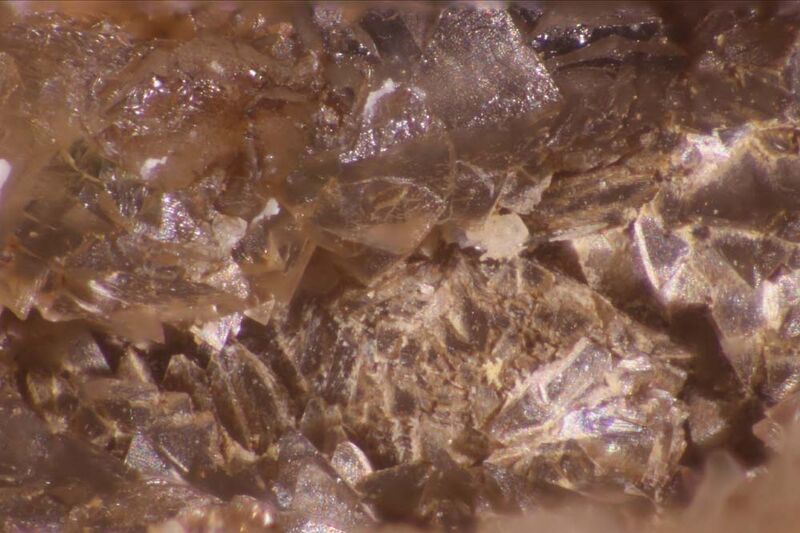
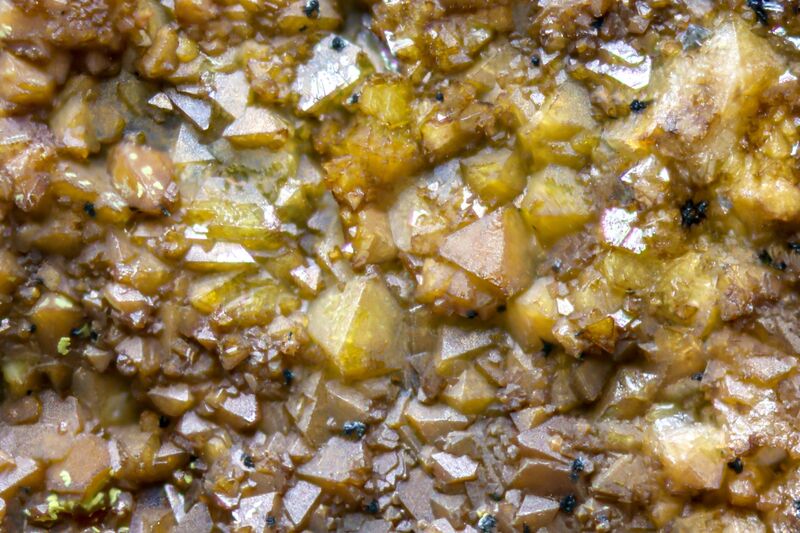
Poorly formed crystals of prismatic habit, up to 2-3 cm in diameter.
- Comment
Space Group: P bna
Crystal structure
Chemical composition
Synonyms
- Kruzhanovskit
- Kruzhanovskita
- Kruzhanovskite
- Kruzhanowskit
- Kryjanovskit
- Kryjanovskita
- Kryjanovskite
- Kryschanowskit
- Kryshanovskit
- Kryshanowskit
- Kryzhanovskiet
In other languages
- German
- Kryzhanovskit
- Italian
- Kryzhanovskite
Classification
Strunz
10th ed.8.CC.05
- 8Phosphates, Arsenates, VanadatesClass
- 8.CPhosphates without additional anions, with H2ODivision
- 8.CCWith only medium-sized cations, RO4:H2O = 1:1.5Group
- 8.CC.05KryzhanovskiteSpecies
Dana
8th ed.40.03.02.02
- 40Hydrated Normal Phosphates, Arsenates and VanadatesClass
- 40.03A3(XO4)2·xH2OType
- 40.03.02Phosphoferrite GroupGroup
- 40.03.02.02KryzhanovskiteSpecies
CIM
—19.12.17
- 19PhosphatesClass
- 19.12Phosphates of MnGroup
- 19.12.17KryzhanovskiteSpecies
Group, growth & confusion
Literature, links & citation
Citations
- 1950Ginzburg, A.I. (1950) Kryzhanovskite, a new phosphate mineral. Doklady Akademii Nauk SSSR: 72: 763-766.
- 1951Fleischer, M. (1951) New mineral names. American Mineralogist, 36 (3-4). 381-384
- 1971Moore, Paul Brian (1971) The Fe2+3(H2O)n(PO4)2 homologous series: Crystal-chemical relationships and oxidized equivalents. American Mineralogist, 56 (1-2) 1-17
- 1974MOORE, PAUL BRIAN (1974) Evidence for a complete mixed valence solid solution series in Fe23+(H2O)3[PO4]2 (phosphoferrite) Fe33+(OH)3[PO4]2 (kryzhanovskite). Nature, 251 (5473). 305-306 doi:10.1038/251305a0DOI: 10.1038/251305a0
- 1976Moore, Paul Brian., Araki, Takaharu. (1976) Mixed-valence solid-solution series. Crystal structures of phosphoferrite, Fe32+(H2O)3[PO4]2, and kryzhanovskite, Fe33+(OH)3[PO4]2. Inorganic Chemistry, 15 (2) 316-321 doi:10.1021/ic50156a015DOI: 10.1021/ic50156a015
Cite this entry
Entry last updated
@misc{mineral2025,
  author    = {Mineral Index editorial board},
  title     = {Kryzhanovskite — Mineral Index},
  year      = {2025},
  url       = {https://mineralindex.org/minerals/kryzhanovskite-2281}
}