History
The name says exactly where this mineral sits. It comes from the Greek mesos, meaning middle, because its composition falls between two close relatives: natrolite and scolecite. All three are zeolites — a family of silicate minerals built with water trapped inside an open, cage-like framework. Mesolite is the sodium-and-calcium member that lands between the sodium-rich natrolite and the calcium-rich scolecite.
The three were not always seen as separate. In 1801 the French mineralogist René Just Haüy lumped them together under a single name, mésotype. He could not yet tell them apart by their chemistry.
That changed early in the next century. The German chemists Adolph Ferdinand Gehlen and Johann Nepomuk von Fuchs studied the group, and in 1816 Fuchs split Haüy's mésotype into three distinct species. He gave them the names still used today — natrolite, scolecite, and mesolite — each tied to its own composition. The first specimens that anchored the new species came from the Cyclopean Islands near Catania, on Sicily.
Industrial & practical applications
Mesolite has no commercial or industrial use. It is mined nowhere on purpose and worked into nothing — it is too scarce and too localised to be a raw material.
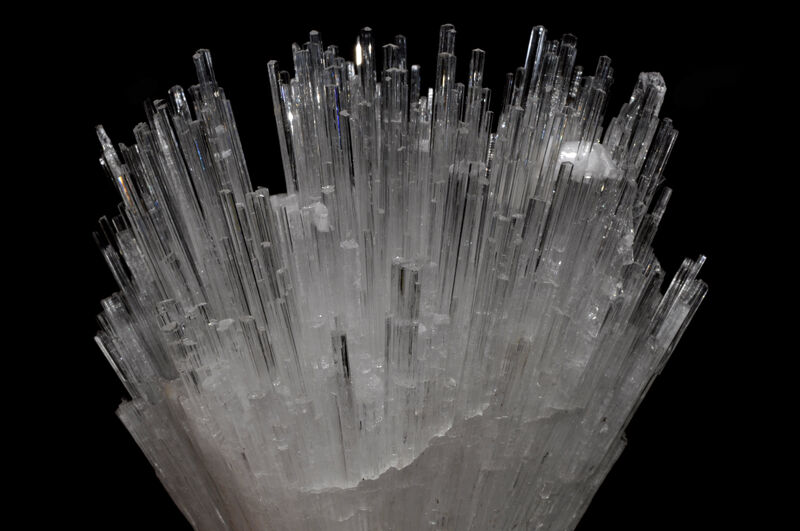
What demand it has comes from mineral collectors. Mesolite forms delicate radiating sprays of needle-like crystals, and fine cabinet specimens — often paired with other zeolites in volcanic cavities — are prized for that fragile, hair-fine habit.
The wider zeolite family — silicate minerals with open, water-holding frameworks — does have heavy industrial uses. They serve as molecular sieves that filter gases and liquids by molecular size, in water-softening, and in catalysis. But those jobs are filled almost entirely by manufactured synthetic zeolites and by a handful of abundant natural species such as clinoptilolite. Mesolite is not among them.
Where it forms, where it's found
- Geological setting
In cavities in basalts.
Physical
- Hardness
- 1Talc
- 2Gypsum
- 3Calcite
- 4Fluorite
- 5Apatite
- 6Orthoclase
- 7Quartz
- 8Topaz
- 9Corundum
- 10Diamond
- Transparency
- Transparent · Translucent · Opaque
- Colour
- Colorless · white · gray · yellowish
- Streak
- White
- Tenacity
- brittle
- Cleavage
- Perfect
Perfect on (110) (10)
Compact masses are tough.
- Fracture
- Irregular/Uneven
- Density
- 2.26 g/cm³
Optical
- Optical type
- Biaxial (+) · 2V measured = 80°
- Refractive index
- 1.5048 – 1.5053
- Surface relief
- Moderate
- Principal indices
- nα 1.5048 · nβ 1.505 · nγ 1.5053
- Dispersion
- r > v strong
- Extinction
- X ∧ c ≃ 8°; Z = b.
Crystallography
- Space group
- #23
- Cell parameters
- a = 18.4049(8) Å · b = 56.655(6) Å · c = 6.5443(4) Å
- Ratio a:b:c
- 1 : 3.078 : 0.356
- Z
- 8
- Morphology
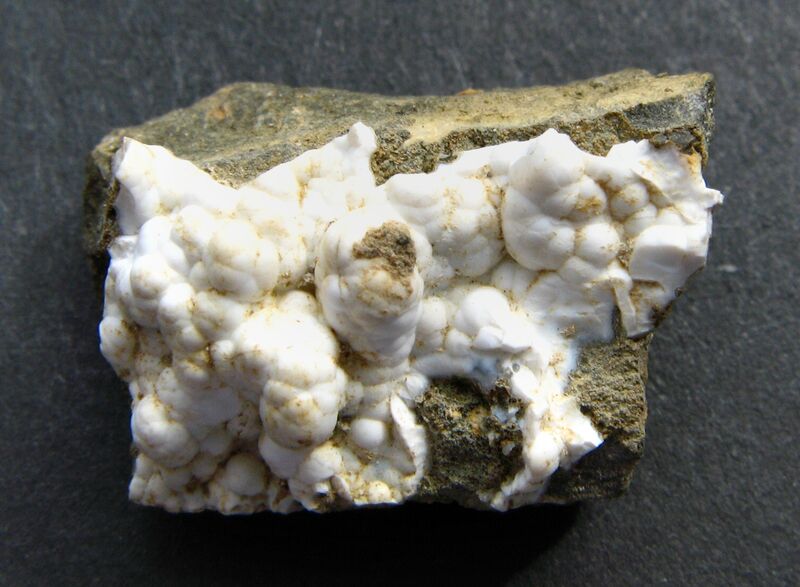
Elongated prismatic crystals, hairlike tufts, porcelaneous, massive. Forms: Common (110), (111). Rare (100), (010), (101), (011).
- Twinning
Characteristically on (010) (100)
Chemical composition
Synonyms
- Cotton-Stone
- Harringtonite
- Lime-Soda-Mesotype
- Metaskolezit
- Poonahlit
- Poonahlita
- Poonahlite
- Poonalit
- Poonalita
- Poonalite
In other languages
- French
- Mésolite
- German
- Mesolith
- Spanish
- Mesolita
- Italian
- mesolite
- Chinese
- 中沸石
Classification
9.GA.05
- 9SilicatesClass
- 9.GTektosilicates with zeolitic H2O; zeolite familyDivision
- 9.GAZeolites with T5O10 Units – The Fibrous ZeolitesGroup
- 9.GA.05MesoliteSpecies
77.01.05.04
- 77Tectosilicates ZeolitesClass
- 77.01Zeolite group - True zeolitesType
- 77.01.05Natrolite and related speciesGroup
- 77.01.05.04MesoliteSpecies
16.10.6
- 16Silicates Containing Aluminum and other MetalsClass
- 16.10Aluminosilicates of Ca and alkalisGroup
- 16.10.6MesoliteSpecies
Group, growth & confusion
Literature, links & citation
- 1801Haüy, René Just (1801) Traité de Minéralogie (1st ed.) Vol. 3. Chez Louis, Paris.
- 1813Gehlen, A.F., Fuchs, J.N. (1813) Ueber Werner's zeolith, Hauy's mesotype und stilbite. Journal für Chemie und Physik: 8: 353-366.
- 1857(1857) VI. On mesolite and faröelite (mesole) The London, Edinburgh, And Dublin Philosophical Magazine And Journal Of Science, S. 4 Vol. 13 (83) 50-55 doi:10.1080/14786445708642242DOI: 10.1080/14786445708642242
- 1933Hey, Max H. (1933) Studies on the zeolites. Part V. Mesolite. Mineralogical Magazine and Journal of the Mineralogical Society, 23 (143) 421-447 doi:10.1180/minmag.1933.023.143.01 DOI: 10.1180/minmag.1933.023.143.01
- 1955Peng, C. J. (1955) Thermal analysis study of the natrolite group. American Mineralogist, 40 (9-10) 834-856
Entry last updated
@misc{mineral2026,
  author    = {Mineral Index editorial board},
  title     = {Mesolite — Mineral Index},
  year      = {2026},
  url       = {https://mineralindex.org/minerals/mesolite-2657}
}