History
Hold a slender crystal of scolecite to a flame and it does something strange. The fibre curls and writhes as it loses its water, and that wriggle gave the mineral its name. It comes from the Greek skōlēx — worm — chosen for that reaction to the blowpipe, the hot flame early mineralogists used to test a sample.
The mineral was described in 1813. It was placed in the zeolite group, a family of minerals built from a rigid framework of silicon, aluminium and oxygen with water trapped in the open spaces inside. Within that family scolecite sits closest to natrolite, another slender, needle-like zeolite.
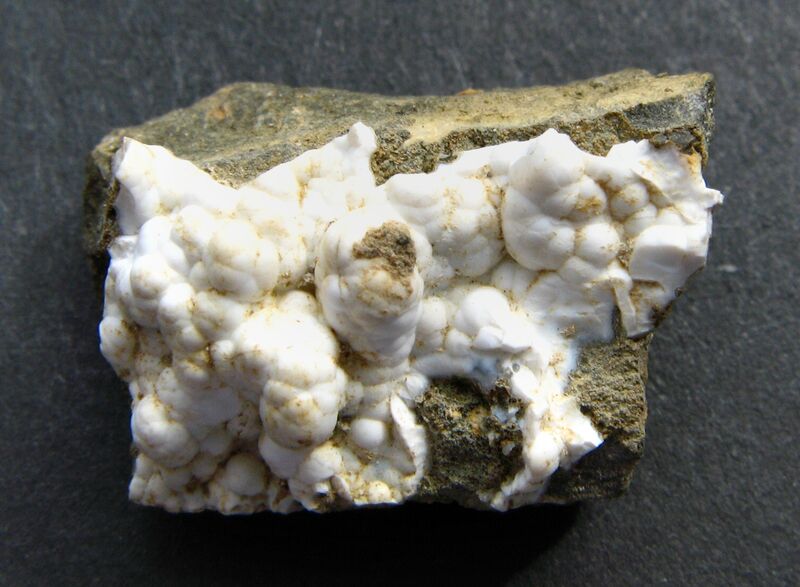
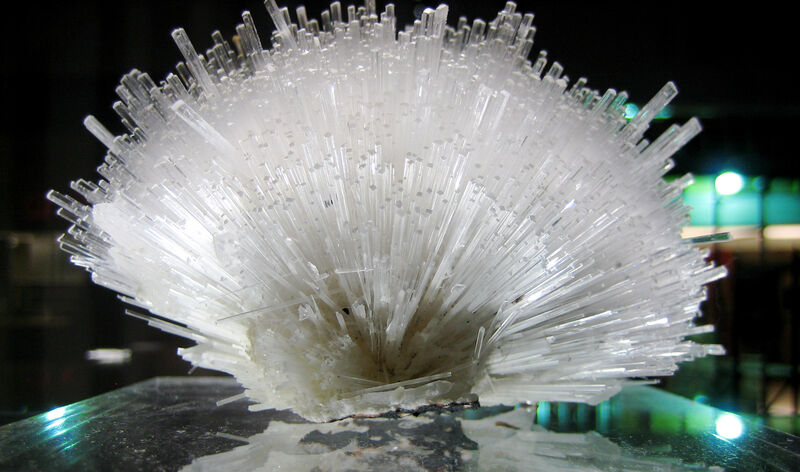
Most of its human story since then has been a collector's story rather than an industrial one. The finest specimens come from the Tertiary Deccan Basalt near Nasik and Pune, in the Indian state of Maharashtra, where scolecite forms the radiating white sprays of fine needles that fill museum cases. Good crystals also turn up at Berufjörður, near Djúpivogur in eastern Iceland, and in Scotland, California and Brazil.
Industrial & practical applications
Scolecite has no real industrial job. The zeolite group it belongs to does heavy lifting in industry — as adsorbents that soak up water and gases, and as catalysts that speed chemical reactions — but those tasks are handed to synthetic zeolites made to order, not to this natural mineral.
What scolecite is prized for instead is its appearance. It grows in radiating sprays of fine white to colourless needles, and the best of them — from the Deccan Basalt of Maharashtra, India — are sought by collectors and shown in museum cases as display specimens.
Where it forms, where it's found
- Geological setting
Cavities in basalts; Alpine clefts.
Physical
Optical
- Optical type
- Biaxial (-) · 2V measured = 36 – 56° · 2V calc = 36 – 40°
- Refractive index
- 1.507 – 1.521
- Surface relief
- Moderate
- Principal indices
- nα 1.507 – 1.513 · nβ 1.516 – 1.52 · nγ 1.517 – 1.521
- Dispersion
- r < v strong
- Extinction
- Z = b; X ∧ c = 15° to 18°; Y ∧ a = -14° to -17°.
- UV response
- May be yellow to brown in LW and SW.
Crystallography
- Cell parameters
- a = 18.508(5) Å · b = 18.981(5) Å · c = 6.527(2) Å
- Cell angles
- β = 90.64 °
- Ratio a:b:c
- 1 : 1.026 : 0.353
- Z
- 8
- Morphology
Crystals are slender prismatic
- Twinning
On (100), twin axis [001], contact or penetration twins
- Comment
Non-standard space-group setting <i>F</i>1<i>d</i>1, chosen in order to allow easier comparison with natrolite (Fdd2). Unit-cell parameters of standard setting in space group Cc: a = 6.533, b = 19.030, c = 9.830 Å, β = 109.95° (Comodi et al., 2002).
Chemical composition
- Impurities
- Na
- K
Synonyms
- Acicular stone
- Ellagit
- Ellagita
- Ellagite
- Episcolecit
- Episcolecita
- Episcolecite
- Episkolecit
- Episkolecita
- Episkolecite
- Kalk-Mesotyp
- Lime Mesotype
- Scolecit
- Scolecita
- Scolésit
- Scolésita
- Scolésite
- Scolezit
- Scolézite
- Weissian
In other languages
- French
- ellagite · épiscolécite · mésotype sexoctonal · scolécite · scolésite
- German
- Kalkmesotyp · Skolezit
- Spanish
- Ellagita · Escolecita
- Italian
- scolecite
- Japanese
- スコレス沸石
- Chinese
- 钙沸石
- Simplified Chinese
- 钙沸石
- Traditional Chinese
- 鈣沸石
- Russian
- Сколецит
Classification
9.GA.05
- 9SilicatesClass
- 9.GTektosilicates with zeolitic H2O; zeolite familyDivision
- 9.GAZeolites with T5O10 Units – The Fibrous ZeolitesGroup
- 9.GA.05ScoleciteSpecies
77.01.05.05
- 77Tectosilicates ZeolitesClass
- 77.01Zeolite group - True zeolitesType
- 77.01.05Natrolite and related speciesGroup
- 77.01.05.05ScoleciteSpecies
16.9.22
- 16Silicates Containing Aluminum and other MetalsClass
- 16.9Aluminosilicates of CaGroup
- 16.9.22ScoleciteSpecies
Group, growth & confusion
Literature, links & citation
- 1813Gehlen, A.F. and Fuchs, T.N. (1813) Uber Werners Zeolith, Hauy Mesotype und Stilbite. Schweigg Journal of Chemistry and Physics: 8: 353-366.
- 1884Zepharovich, V. von (1884) Ueber Brookit, Wulfenit und Skolezit. Zeitschrift für Krystallographie, Mineralogie und Petrographie, 8 (1-6). 577-592 doi:10.1524/zkri.1884.8.1.577DOI: 10.1524/zkri.1884.8.1.577
- 1885Friedel, Charles; de Gramont, Arnaud (1885) Sur la pyroélectricité de la scolézite. Bulletin de Minéralogie, 8 (3). 75-78 doi:10.3406/bulmi.1885.1916DOI: 10.3406/bulmi.1885.1916
- 1936Hey, Max H. (1936) Studies on the zeolites. Part IX. Scolecite and metascolecite. Mineralogical Magazine and Journal of the Mineralogical Society, 24 (152) 227-253 doi:10.1180/minmag.1936.024.152.02 DOI: 10.1180/minmag.1936.024.152.02
- 1955Peng, C. J. (1955) Thermal analysis study of the natrolite group. American Mineralogist, 40 (9-10) 834-856
Entry last updated
@misc{mineral2026,
  author    = {Mineral Index editorial board},
  title     = {Scolecite — Mineral Index},
  year      = {2026},
  url       = {https://mineralindex.org/minerals/scolecite-3594}
}