Where it forms, where it's found
- Geological setting
hydrothermally altered pegmatite body emplaced in the nepheline syenites near their contact with ijolite–urtites
- Type locality
- Kirovskii apatite mine
- Kukisvumchorr Mt
- Murmansk Oblast
- Russia
67.6667°, 33.7167°
1recorded occurrences
Physical
Optical
- Optical type
- Biaxial (+) · 2V calc = 66°
- Refractive index
- 1.7 – 1.734
- Surface relief
- High
- Principal indices
- nα 1.700 · nβ 1.710 · nγ 1.734
- Pleochroism
- Non-pleochroic
- Dispersion
- nondiscernable
- UV response
- none
Δ = 0Δmax
PPLpleochroism per grain
XPLindependent extinctions · rotate the stage
PPLpleochroism only · colour blends on rotation
XPLinterference colour · extinct every 90°
Retardation340 nm
Order1st order
XPL colour
Crystallography
- Space group
- C2/m
- Cell parameters
- a = 5.37 Å · b = 7 Å · c = 24.05 Å
- Cell angles
- β = 91.1 °
- Ratio a:b:c
- 1 : 1.304 : 4.479
- Z
- 2
- Parting
- none
- Type-locality form
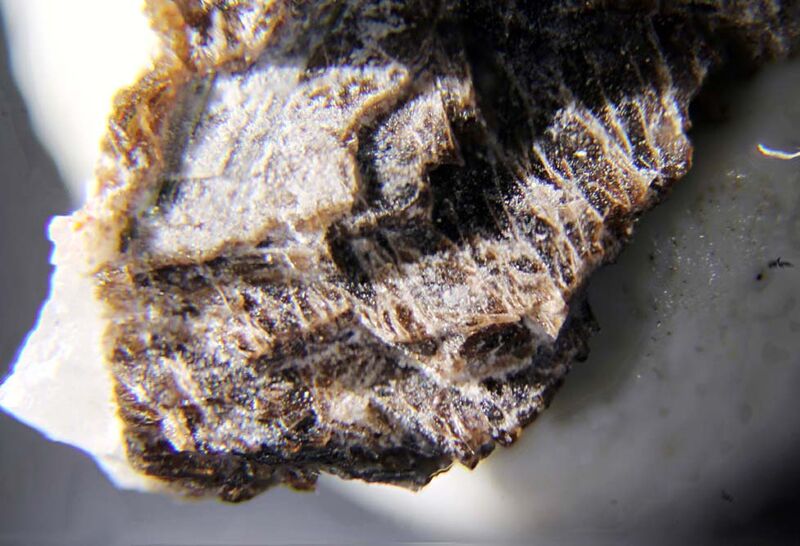
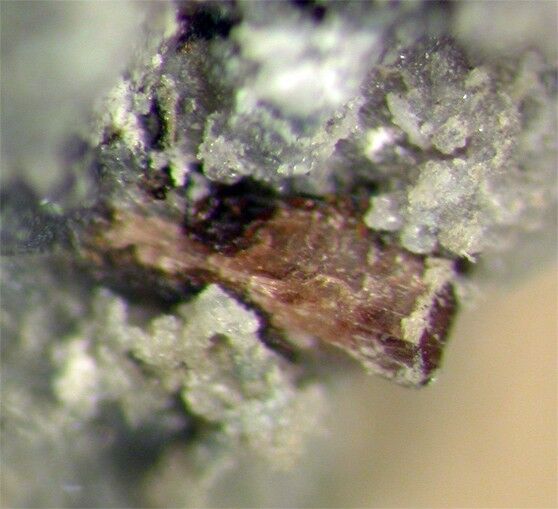
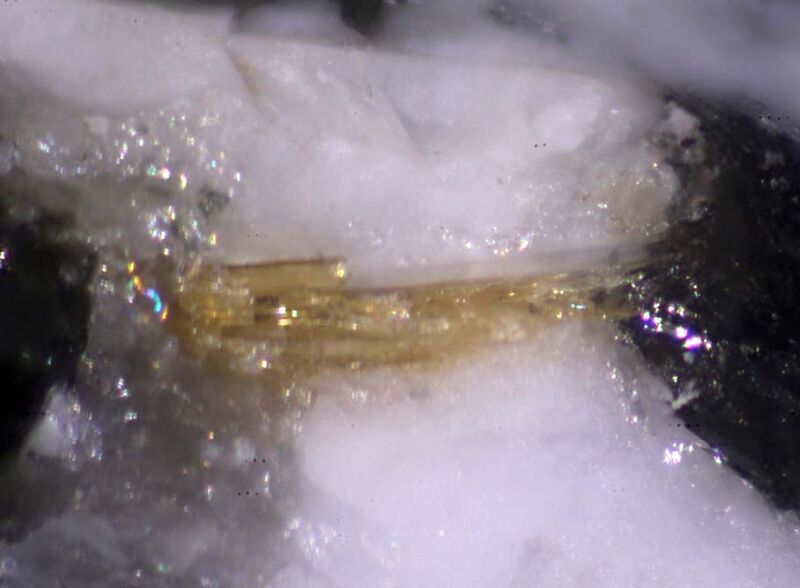
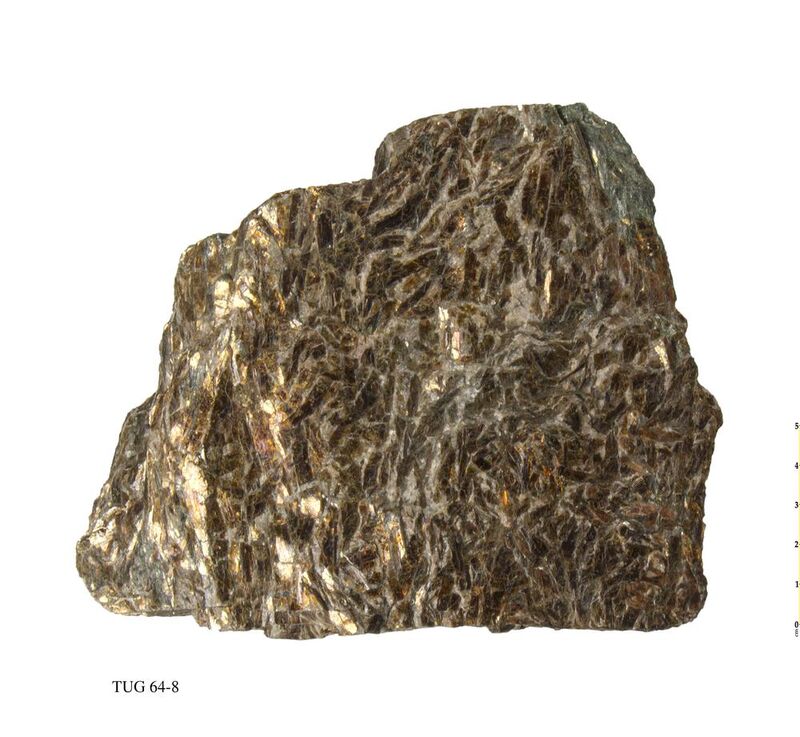
rosettes up to 1–5 cm in diameter composed of extremely fine (0.01–0.1 mm) bounded flakes and lamellae
- Comment
A2/m (2M polytype)
Crystal structure
Synonyms
- IMA2006-021
- Nechelyustoviet
In other languages
- German
- IMA 2006-021 · Nechelyustovit
- Italian
- nechelyustovite
Classification
Strunz
10th ed.9.BE.55
- 9SilicatesClass
- 9.BSorosilicatesDivision
- 9.BESi2O7 groups, with additional anions; cations in octahedral [6] and greater coordinationGroup
- 9.BE.55NechelyustoviteSpecies
Dana
8th ed.56.02.10.06
- 56Sorosilicates Si2o7 Groups, with Additional O, Oh, F and H2oClass
- 56.02Si2O7 Groups and O, OH, F, and H2O with cations in [4] and/or >[4] coordinationType
- 56.02.10Melanotekite groupGroup
- 56.02.10.06NechelyustoviteSpecies
Group, growth & confusion
- Barytolamprophyllite(BaK)Ti2Na3Ti(Si2O7)2O2(OH)2Mineral—
 BornemaniteNa6(Na◻)Ba2Ti2Nb2(Si2O7)4(PO4)2O4(OH)2F2Mineral—
 DelindeiteBa2Ti2(Na2◻)Ti(Si2O7)2(OH)2(H2O)2O2Mineral—
 EmmerichiteBa2Ti2Na3Fe3+(Si2O7)2O2F2Mineral—
 Epistolite(Na◻)Nb2Na3Ti(Si2O7)2O2(OH)2(H2O)4Mineral—
- Fluorbarytolamprophyllite(Ba,Sr,K)2[(Na,Fe2+)3TiF2][Ti2(Si2O7)2O2]Mineral—
 Fluorlamprophyllite(SrNa)Ti2Na3Ti(Si2O7)2O2F2Mineral—
- InneliteBa4Ti2Na(NaCa)Ti(Si2O7)2[(SO4)(PO4)]O2[O(OH)]Mineral—
- KazanskyiteBa◻TiNbNa3Ti(Si2O7)2O2(OH)2(H2O)2Mineral—
 Lamprophyllite(SrNa)Ti2Na3Ti(Si2O7)2O2(OH)2Mineral—
Literature, links & citation
Citations
- 2009Nèmeth, Pèter Khomyakov, Ferraris, Giovanni, Menshikov, Yuriy P. (2009) Nechelyustovite, a new heterophyllosilicate mineral, and new data on bykovaite: a comparative TEM study. European Journal of Mineralogy, 21 (1) 251-260 doi:10.1127/0935-1221/2009/0021-1864 DOI: 10.1127/0935-1221/2009/0021-1864
- 2009Cámaraite, F., Sokolova, E. (2009) From structure topology to chemical composition. X. Titanium silicates: the crystal structure and crystal chemistry of nechelyustovite, a group III Ti-disilicate mineral. Mineralogical Magazine, 73 (5) 753-775 doi:10.1180/minmag.2009.073.5.753 DOI: 10.1180/minmag.2009.073.5.753
- 2017Sokolova, E., Cámara, F. (2017) The seidozerite supergroup of TS-block minerals: nomenclature and classification, with change of the following names: rinkite to rinkite-(Ce), mosandrite to mosandrite-(Ce), hainite to hainite-(Y) and innelite-1T to innelite-1A. Mineralogical Magazine, 81 (6) 1457-1484 doi:10.1180/minmag.2017.081.010 DOI: 10.1180/minmag.2017.081.010
- 2022(2022) Nechelyustovite. Handbook of Mineralogy. Mineralogical Society of America
Cite this entry
Entry last updated
@misc{mineral2025,
  author    = {Mineral Index editorial board},
  title     = {Nechelyustovite — Mineral Index},
  year      = {2025},
  url       = {https://mineralindex.org/minerals/nechelyustovite-29548}
}