Where it forms, where it's found
- Type locality
- Dara-i-Pioz Massif
- Districts of Republican Subordination
- Tajikistan
39.4504°, 70.7163°
1recorded occurrences
Physical
Optical
- Optical type
- Biaxial (-) · 2V measured = 52.5° · 2V calc = 52.6°
- Refractive index
- 1.6 – 1.625
- Surface relief
- Moderate
- Principal indices
- nα 1.600 · nβ 1.620 · nγ 1.625
- Dispersion
- weak r<v
- UV response
- Short wave - bright yellow
Δ = 0Δmax
PPLpleochroism per grain
XPLindependent extinctions · rotate the stage
PPLpleochroism only · colour blends on rotation
XPLinterference colour · extinct every 90°
Retardation250 nm
Order1st order
XPL colour
Crystallography
- Cell parameters
- a = 5.199(3) Å · b = 9.068(7) Å · c = 10.070(4) Å
- Cell angles
- β = 99.35 °
- Ratio a:b:c
- 1 : 1.744 : 1.937
- Z
- 2
- Morphology
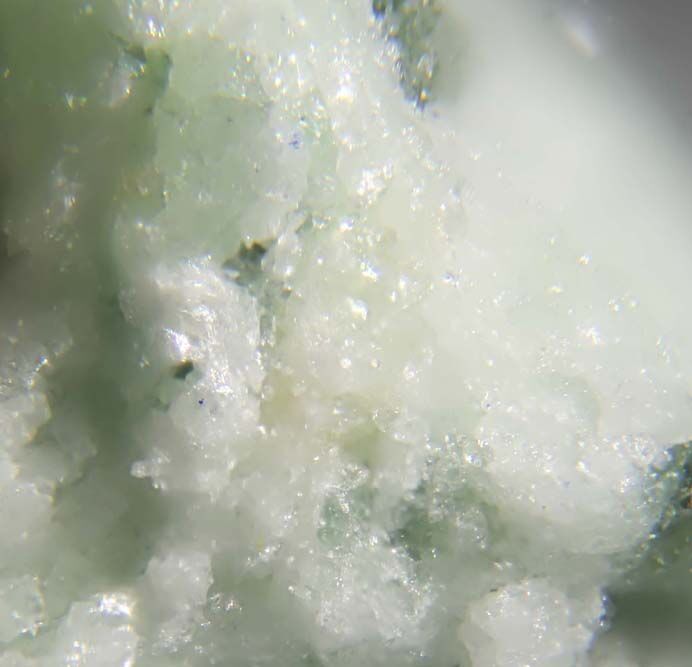
Orlovite forms lamellar, colorless grains up to 2 mm in size.
Chemical composition
Synonyms
- IMA2009-006
- Orloviet
In other languages
- German
- IMA 2009-006 · Orlovit
- Italian
- orlovite
Classification
Strunz
10th ed.9.EC.20
- 9SilicatesClass
- 9.EPhyllosilicatesDivision
- 9.ECPhyllosilicates with mica sheets, composed of tetrahedral and octahedral netsGroup
- 9.EC.20OrloviteSpecies
Dana
8th ed.71.02.09.04
- 71Phyllosilicates Sheets of Six-membered RingsClass
- 71.02Sheets of 6-membered rings with 2:1 layersType
- 71.02.09— unnamed intermediate level —Group
- 71.02.09.04OrloviteSpecies
Group, growth & confusion
- AspidoliteNaMg3(Si3Al)O10(OH)2Mineral—
- BalestraiteKLi2V5+Si4O12Mineral—
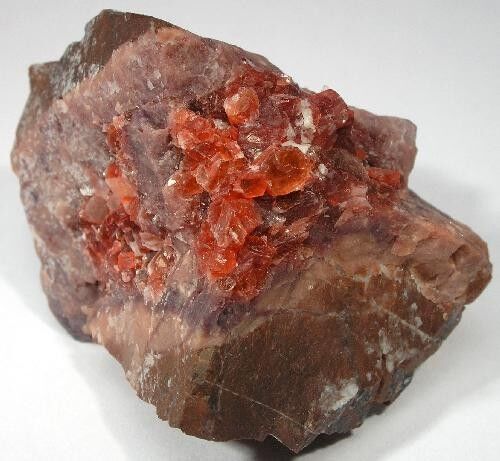 EphesiteNaLiAl2(Si2Al2)O10(OH)2Mineral—
- GarmiteCsLiMg2(Si4O10)F2Mineral—
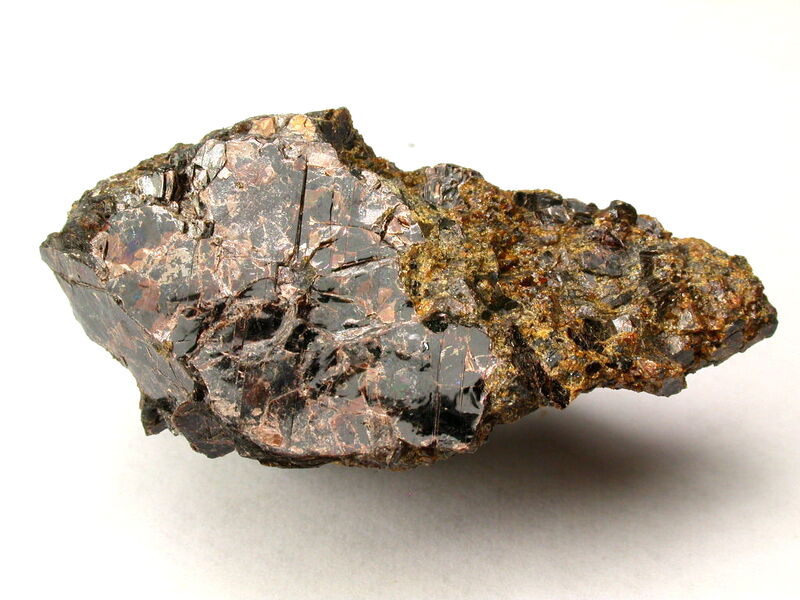 HendricksiteKZn3(Si3Al)O10(OH)2Mineral—
- KreiteriteCsLi2Fe3+Si4O10F2Mineral—
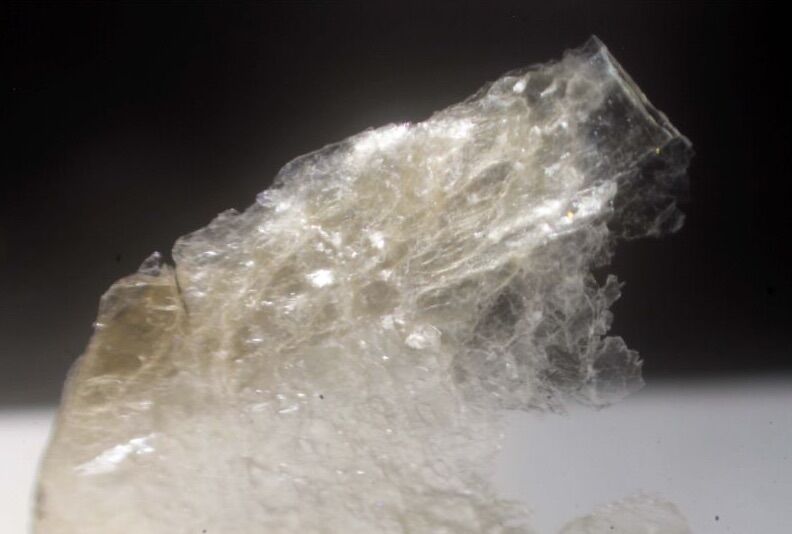 MasutomiliteKLiAlMn2+(Si3Al)O10(F,OH)2Mineral—
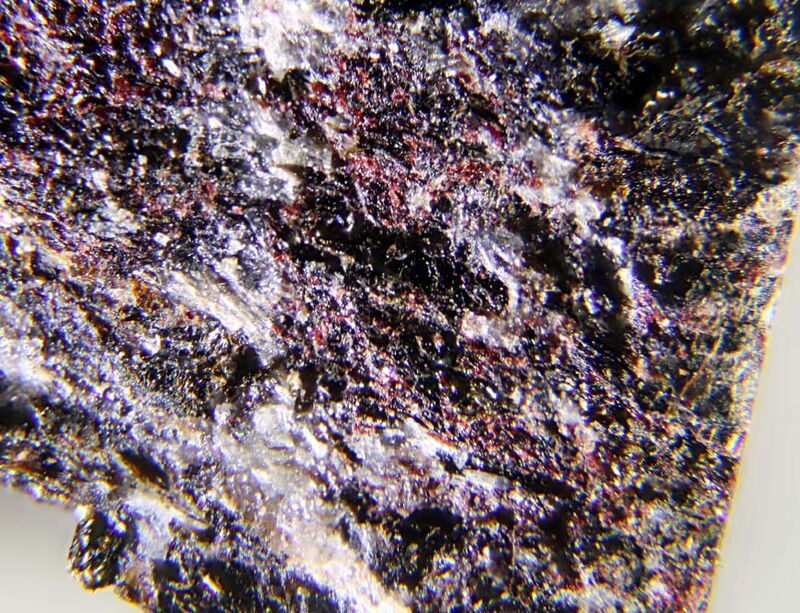 NorrishiteKLiMn3+2Si4O10O2Mineral—
 PreiswerkiteNaAlMg2(Si2Al2)O10(OH)2Mineral—
- ShirokshiniteK(Mg2Na)Si4O10F2Mineral—
Literature, links & citation
Citations
- 2011Agakhanov, A. A., Pautov, L. A., Karpenko, V. Yu., Bekenova, G. K., Uvarova, Y. A. (2011) Orlovite, KLi2TiSi4O11F, a new mineral of the mica group. New Data on Minerals, 46. Moscow. 13-19
- 2012Gatta, G. D., Camara, F., Tait, K. T., Belakovskiy, D. (2012) New Mineral Names. American Mineralogist, 97 (11) 2064-2072 doi:10.2138/am.2012.603DOI: 10.2138/am.2012.603
- 2017(2017) Orlovite. Handbook of Mineralogy. Mineralogical Society of America
- 2018Sokolova, Elena, Hawthorne, Frank C., Agakhanov, Atali A., Pautov, Leonid A., Karpenko, Vladimir Yu. (2018) The crystal structure of orlovite, KLi2Ti(Si4O10)(OF): the first example of the short-range order of Ti in true trioctahedral micas. European Journal of Mineralogy, 30 (2) 399-402 doi:10.1127/ejm/1988/0030-2724DOI: 10.1127/ejm/1988/0030-2724
Cite this entry
Entry last updated
@misc{mineral2025,
  author    = {Mineral Index editorial board},
  title     = {Orlovite — Mineral Index},
  year      = {2025},
  url       = {https://mineralindex.org/minerals/orlovite-39557}
}