History
The name comes from the Greek pēktós — compacted — chosen for a mineral that resists being crushed to powder. The German mineralogist Franz von Kobell coined it in 1828, writing it Pektolith in the literature of the day. He was describing specimens from the mountains of Trento Province in northern Italy, where the mineral was first found at Mount Baldo.
For more than a century after that, pectolite stayed a mineralogist's mineral — known, named, and otherwise unremarkable. Its second life began on a Caribbean beach.
The blue stone of Barahona
In 1916, a parish priest near Barahona in the Dominican Republic asked the authorities for permission to mine a blue rock he had found. The request went nowhere, and the stone was forgotten again. The few pieces anyone saw were loose pebbles, washed down to the sea by the Bahoruco River.
The rediscovery came in 1974. A Dominican named Miguel Méndez and a Peace Corps volunteer, Norman Rilling, found the blue stones on a beach at the foot of the Bahoruco Mountain Range. Méndez gave the gem its name. He joined his young daughter's name, Larissa, to mar — Spanish for sea. The result, Larimar, was meant to suggest the colours of the Caribbean water where the pebbles turned up.
Industrial & practical applications
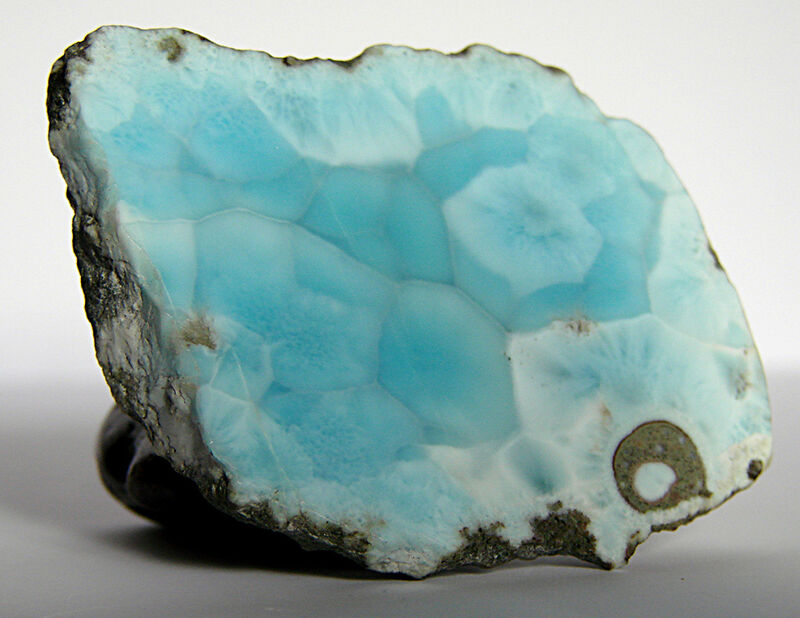
Almost everything pectolite is used for comes down to one blue stone. The sky-blue variety sold as Larimar is a prized gemstone, cut and polished for jewellery. Its colour sets it apart: where ordinary pectolite is white or grey, Larimar turns a volcanic blue because copper takes the place of some of the calcium in the crystal.
The cut stones are usually set in silver; the finest grades are sometimes set in gold. Quality is judged by the colour and by the crystal pattern visible in the stone. Larimar comes from a single source — a mountainside at Los Chupaderos near Barahona, in the Dominican Republic, now pierced by roughly 2,000 vertical mine shafts. That one deposit supplies the world.
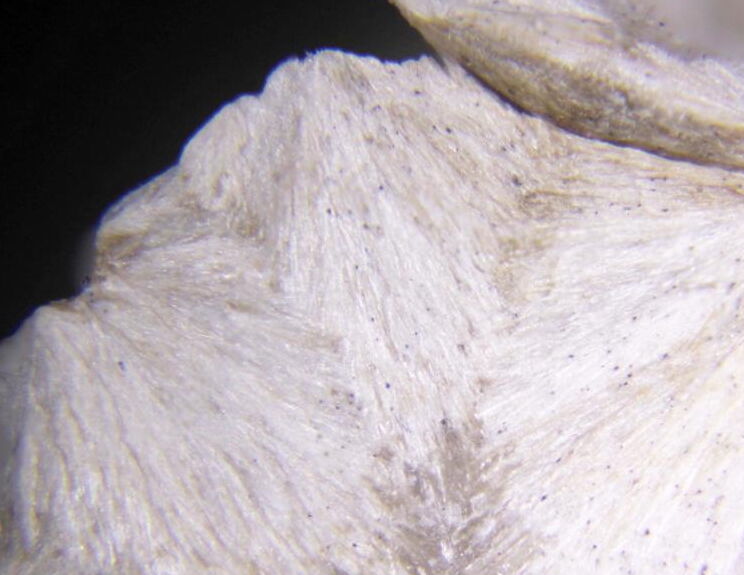
Beyond Larimar, pectolite has no industrial use. White and grey pectolite, with its needle-like radiating crystals, is collected and shown as mineral specimens, but it is not mined for any commercial purpose.
Where it forms, where it's found
- Geological setting
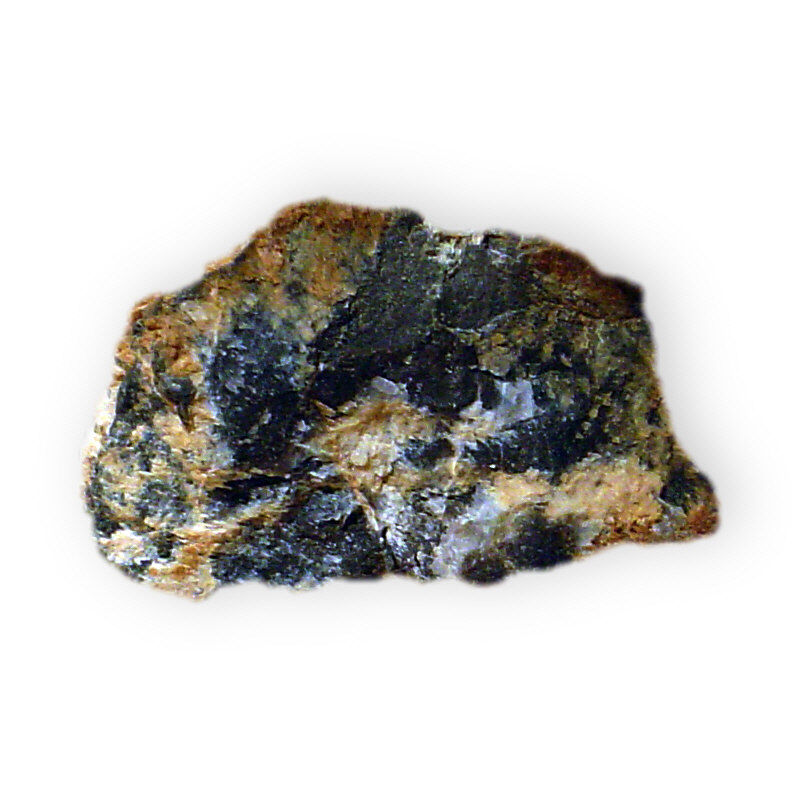
Primary mineral in nepheline syenites. Hydrothermal mineral in cavities in basalts and diabases. In serpentinites and peridotites.
- Type locality
- Monzoni-Vallaccia Mountains
- Trento Province
- Trentino-Alto Adige/Südtirol
- Italy
Varieties
Physical
- Hardness
- 1Talc
- 2Gypsum
- 3Calcite
- 4Fluorite
- 5Apatite
- 6Orthoclase
- 7Quartz
- 8Topaz
- 9Corundum
- 10Diamond
- Transparency
- Transparent · Translucent
- Colour
- Colourless · white · pale pink · greenish · pale blue
- Streak
- White
- Tenacity
- brittle
- Cleavage
- Perfect
on (100) and (001)
Tough when compact.
- Fracture
- Irregular/Uneven
- Density
- 2.84 g/cm³
Optical
- Optical type
- Biaxial (+) · 2V measured = 50 – 63° · 2V calc = 42 – 60°
- Refractive index
- 1.594 – 1.642
- Surface relief
- Moderate
- Principal indices
- nα 1.594 – 1.61 · nβ 1.603 – 1.614 · nγ 1.631 – 1.642
- Dispersion
- r > v weak to very strong
- Extinction
- X ∧ c = 10°-19°; Y ∧ a = 10°-16°; Z ∧ b = 2°.
Crystallography
- Cell parameters
- a = 7.99 Å · b = 7.03 Å · c = 7.03 Å
- Cell angles
- α = 90.51 ° · β = 95.21 ° · γ = 102.53 °
- Ratio a:b:c
- 1 : 0.880 : 0.880
- Z
- 2
- Morphology
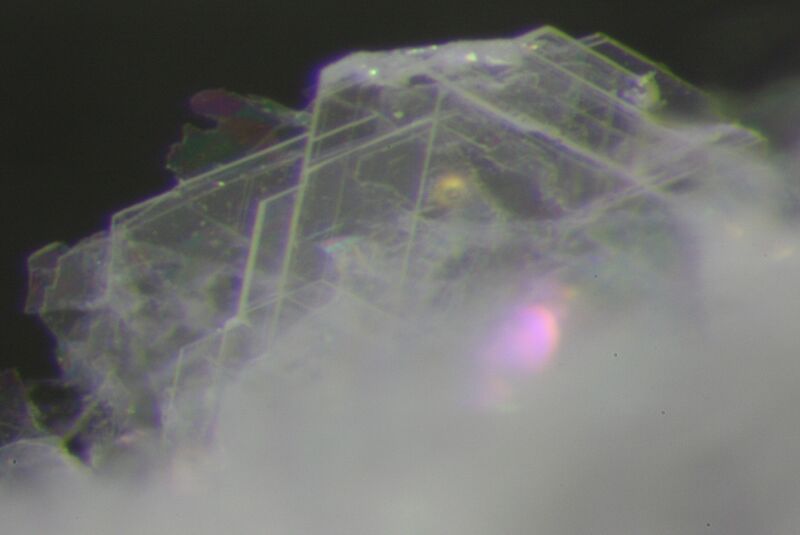
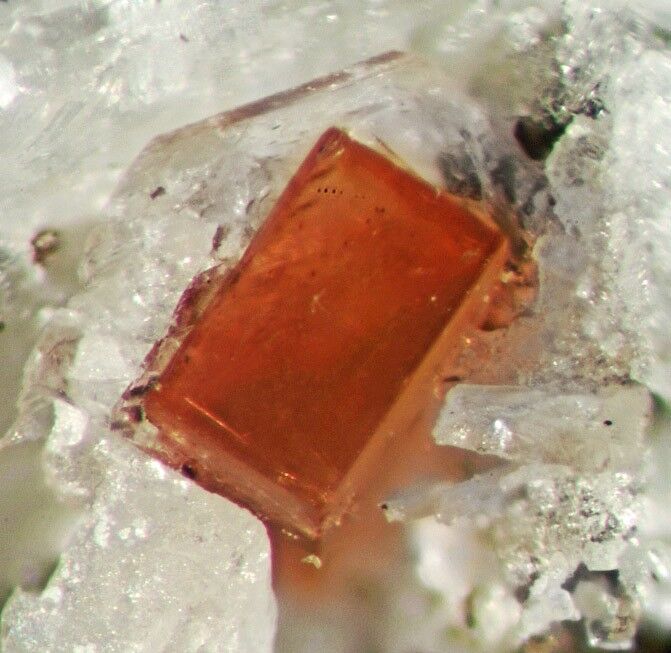
Crystals tabular, acicular. Radiating fibrous, spheroidal, columnar, fine-grained, massive.
- Twinning
Common with twin axis [010], composition plane (100)
Chemical composition
- Impurities
- K
- Fe
- Mg
- Al
- H2O
Synonyms
- Alaska Jade
- Gonsogolit
- Gonsogolita
- Gonsogolite
- Osmelite
- Osmelith
- Pecktolit
- Pecktolita
- Pecktolite
- Pectolit
- Ratholite
- Stellite
In other languages
- French
- Gonsogolite · Jade d'Alaska · pectolite
- German
- Larimar · Pektolith
- Spanish
- Pectolita
- Italian
- Pectolite
- Japanese
- ペクトライト
- Chinese
- 針鈉鈣石 · 针钠钙石
- Simplified Chinese
- 针钠钙石
- Traditional Chinese
- 針鈉鈣石
Classification
9.DG.05
- 9SilicatesClass
- 9.DInosilicatesDivision
- 9.DGInosilicates with 3-periodic single and multiple chainsGroup
- 9.DG.05PectoliteSpecies
65.02.01.4a
- 65Inosilicates Single-width, Unbranched Chains, (w=1)Class
- 65.02Single-Width Unbranched Chains, W=1 with chains P=3Type
- 65.02.01Wollastonite groupGroup
- 65.02.01.4aPectoliteSpecies
14.6.2
- 14Silicates not Containing AluminumClass
- 14.6Silicates of Ca with alkali or Mg or bothGroup
- 14.6.2PectoliteSpecies
Group, growth & confusion
- Barrydawsonite-(Y)Na1.5Y0.5CaSi3O9HMineral—
 BustamiteMn2Ca2MnCa(Si3O9)2Mineral—
 CascanditeCaScSi3O8(OH)Mineral—
 DalnegorskiteCa5Mn(Si3O9)2Mineral—
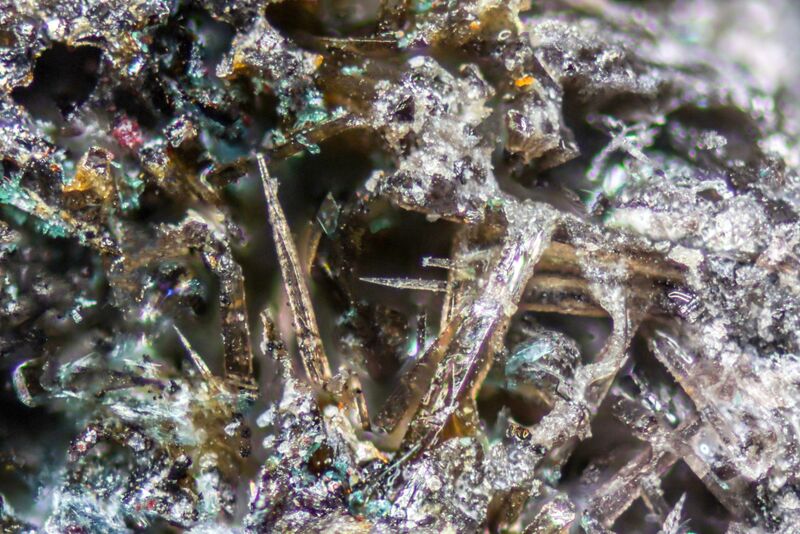 FerrobustamiteCaFe2+Si2O6Mineral—
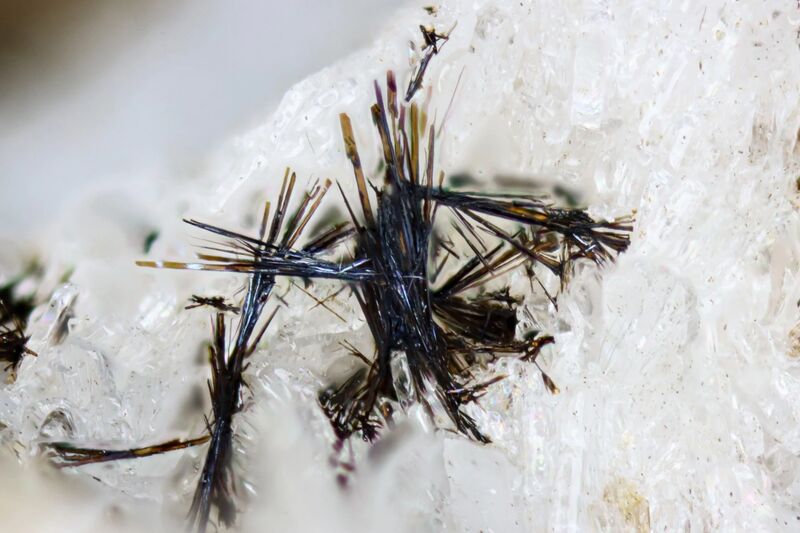 MendigiteMn2Mn2MnCa(Si3O9)2Mineral—
- MurakamiiteCa2LiSi3O8(OH)Mineral—
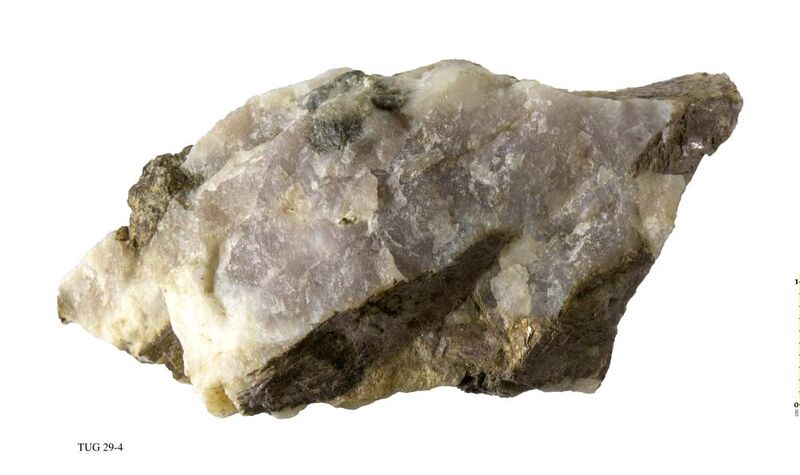 SchizoliteNaCaMnSi3O8(OH)Mineral—
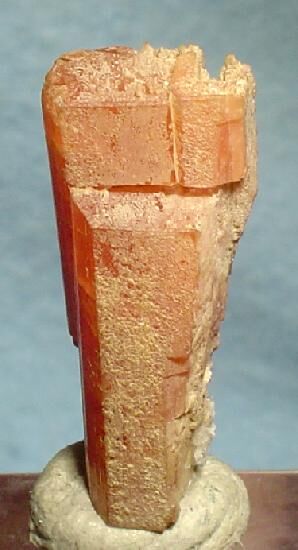 SeranditeNaMn2+2Si3O8(OH)Mineral—
- TanohataiteLiMn2Si3O8(OH)Mineral—
Literature, links & citation
- 1828von Kobell, F. (1828) Ueber den Pektolith. Archiv für die Gesammte Naturlehre: 13: 385-393.
- 1860Whitney, J.D. (1860) On the Chemical Composition of Pectolite. American Journal of Science and Arts: 29(86): 205.
- 1893Forster-Heddle, M. (1893) On Pectolite and Okenite from New Localities: the former with New Appearances. Transactions of the Geological Society of Glasgow: 9(2): 241–255.
- 1899Clarke, F.W., Steiger, G. (1899) Experiments relative to the Constitution of Pectolite, Pyrophyllite, Calamine, and Analcite. American Journal of Science: 8(46): 245-257.
- 1935Peacock, M. A. (1935) On Pectolite. Zeitschrift für Kristallographie , 90 (1-6). 97-111 doi:10.1524/zkri.1935.90.1.97DOI: 10.1524/zkri.1935.90.1.97
Entry last updated
@misc{mineral2026,
  author    = {Mineral Index editorial board},
  title     = {Pectolite — Mineral Index},
  year      = {2026},
  url       = {https://mineralindex.org/minerals/pectolite-3141}
}