Where it forms, where it's found
- Geological setting
veins in trap rock
- Type locality
- Bergen Hill
- Bergen County & Hudson County
- New Jersey
- USA
52recorded occurrences
Physical
Optical
- Optical type
- Biaxial (+)
- Refractive index
- 1.5 – 1.57
- Surface relief
- Moderate
- Principal indices
- nα 1.50 – 1.56 · nβ 1.50 – 1.56 · nγ 1.51 – 1.57 · n 1.50 – 1.51
- Birefringence
- 0.01
- Pleochroism
- Non-pleochroic
- Dispersion
- none
- Extinction
- May be isotropic
- UV response
- under LW: light brown<br /> see for example https://www.mindat.org/photo-1254364.html
- Notes
High refractive indices may be due to dehydration or transition to nontronite, etc.
Δ = 0Δmax
PPLpleochroism per grain
XPLindependent extinctions · rotate the stage
PPLpleochroism only · colour blends on rotation
XPLinterference colour · extinct every 90°
Retardation100 nm
Order1st order
XPL colour
Crystallography
- Cell parameters
- a = 5.26 Å · b = 9.108 Å · c = 15.3 Å
- Ratio a:b:c
- 1 : 1.732 : 2.909
- Z
- 2
- Morphology
Usually clay-sized particles
- Type-locality form
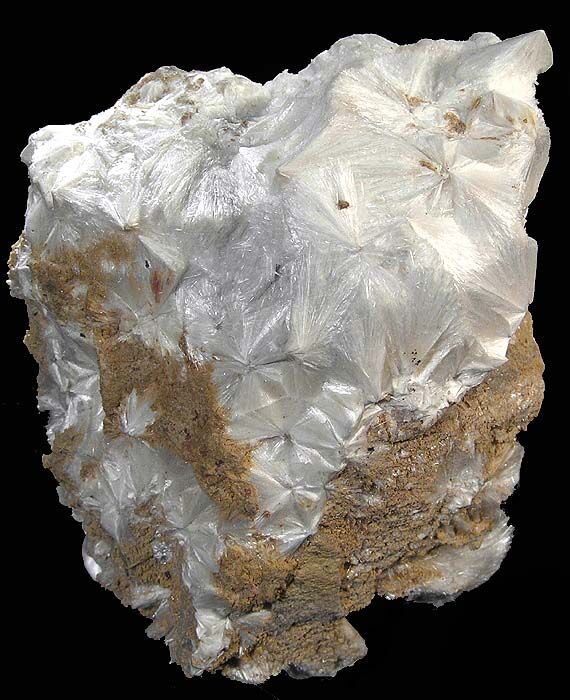
radiate, forming arrow-headed masses
- Comment
Disordered
Chemical composition
- Impurities
- Ti
- Al
- Fe
- Mn
- Na
- K
- H2O
Synonyms
- Afrodita
- Afrodite
- Aphrodit
- Aphrodita
- Aphrodite
- Ghassoulite
- Stevensiet
In other languages
- German
- Stevensit
- Italian
- stevensite
Classification
Strunz
10th ed.9.EC.45
- 9SilicatesClass
- 9.EPhyllosilicatesDivision
- 9.ECPhyllosilicates with mica sheets, composed of tetrahedral and octahedral netsGroup
- 9.EC.45StevensiteSpecies
Dana
8th ed.71.03.1b.06
- 71Phyllosilicates Sheets of Six-membered RingsClass
- 71.03Sheets of 6-membered rings with 2:1 claysType
- 71.03.1b— unnamed intermediate level —Group
- 71.03.1b.06StevensiteSpecies
CIM
—14.4.14
- 14Silicates not Containing AluminumClass
- 14.4Silicates of MgGroup
- 14.4.14StevensiteSpecies
Group, growth & confusion
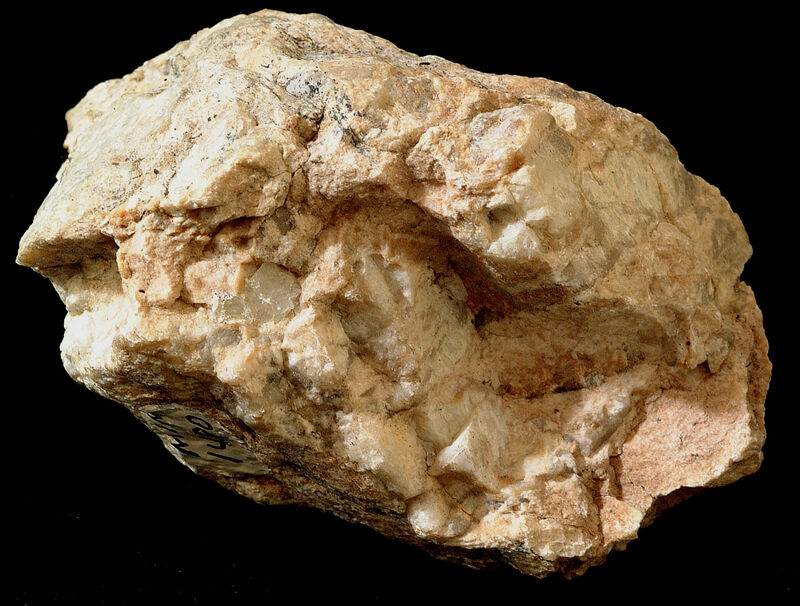 Beidellite(Na,Ca)0.3Al2(Si,Al)4O10(OH)2 · nH2OMineral—
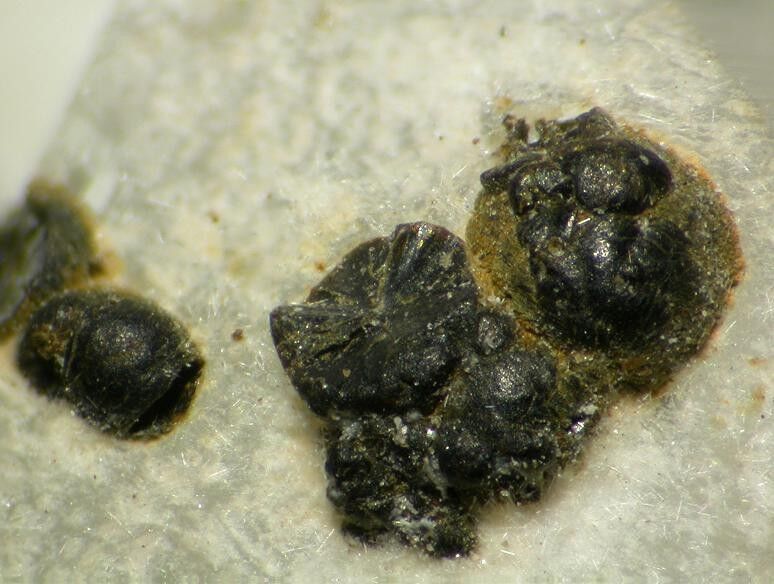 FerrosaponiteCa0.3(Fe2+,Mg,Fe3+)3(Si,Al)4O10(OH)2 · 4H2OMineral—
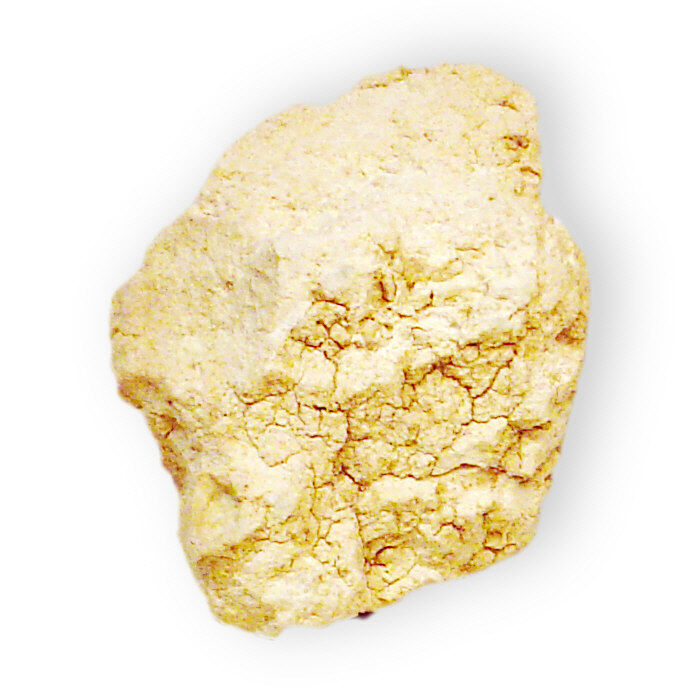 HectoriteNa0.3(Mg,Li)3Si4O10(F,OH)2 · nH2OMineral—
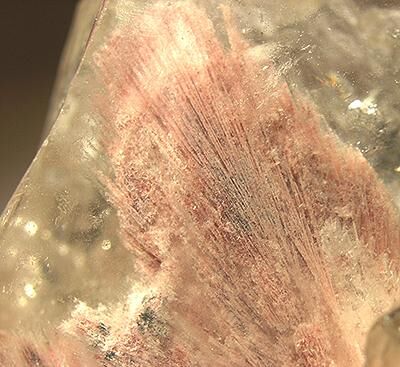 Montmorillonite(Na,Ca)0.3(Al,Mg)2Si4O10(OH)2 · nH2OMineral—
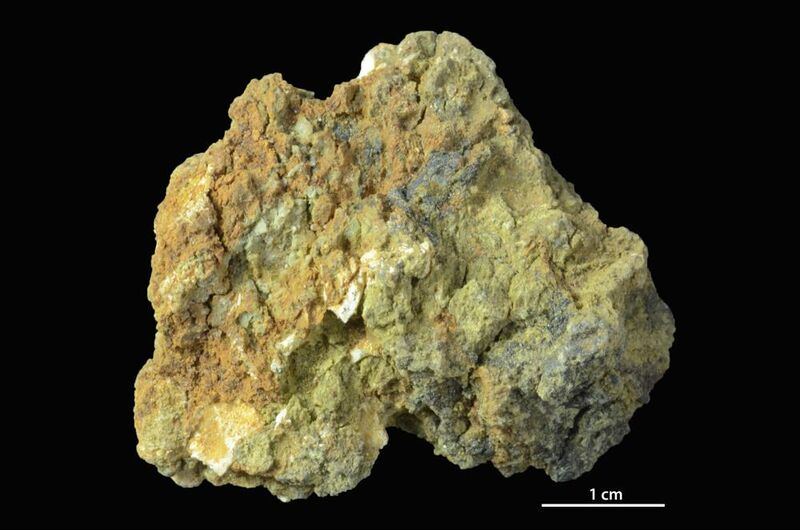 NontroniteNa0.3Fe3+2(Si,Al)4O10(OH)2 · nH2OMineral—
- Saliotite(Li,Na)Al3(Si3Al)O10(OH)5Mineral—
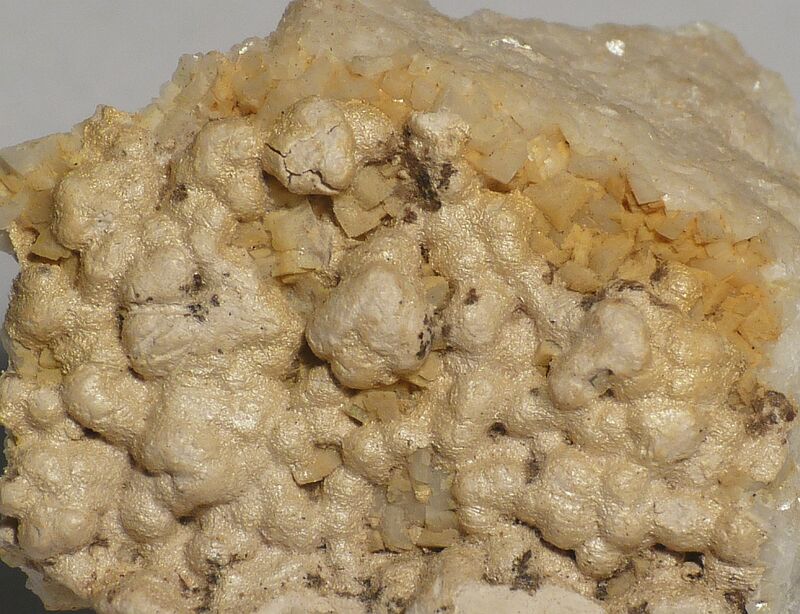 Saponite(Ca,Na)0.3(Mg,Fe)3(Si,Al)4O10(OH)2 · 4H2OMineral—
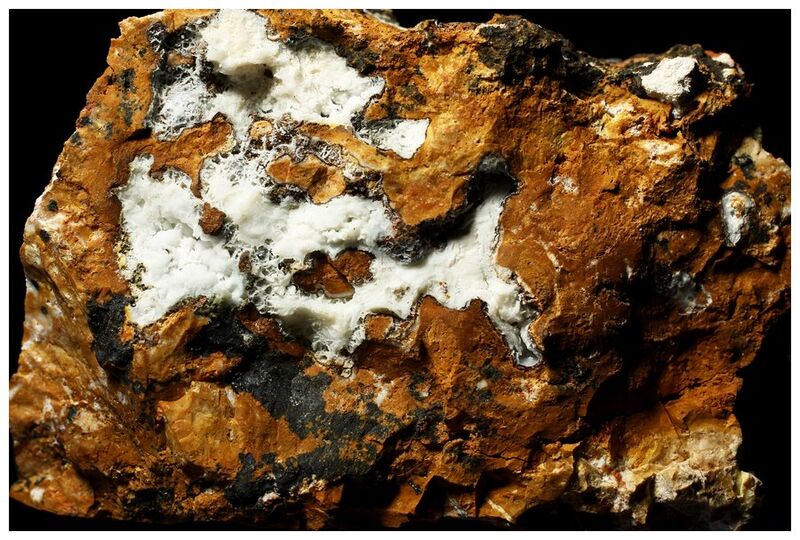 SauconiteNa0.3Zn3(Si,Al)4O10(OH)2 · 4H2OMineral—
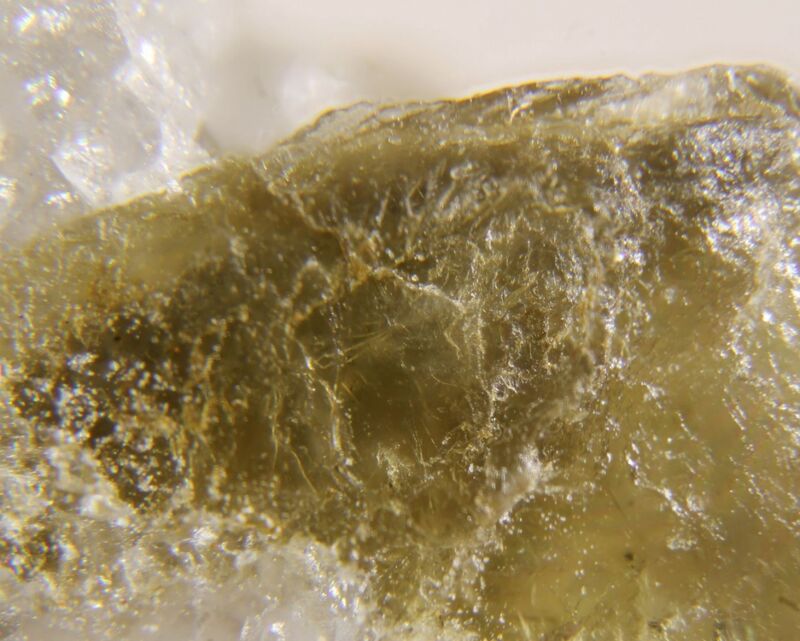 SwineforditeCa0.2(Li,Al,Mg,Fe)3(Si,Al)4O10(OH,F)2 · nH2OMineral—
 VolkonskoiteCa0.3(Cr,Mg)2(Si,Al)4O10(OH)2 · 4H2OMineral—
Literature, links & citation
Citations
- 1873Leeds, A.R. (1873) Contributions to mineralogy. American Journal of Science and Arts: 6: 23-24.
- 1896Chester, A.H. (1896) Stevensite. in: A Dictionary of the Names of Minerals including their History and Etymology, John Wiley and Sons (New York) 257-257.
- 1953Faust, George T., Murata, K. J. (1953) Stevensite, redefined as a member of the montmorillonite group. American Mineralogist, 38 (11-12) 973-987
- 1959Faust, G. T., Hathaway, J. C., Millot, G. (1959) A restudy of stevensite and allied minerals. American Mineralogist, 44 (3-4) 342-370
- 1962Bradley, W.H.; Fahey, Jos. J. (1962) Occurrence of stevensite in the Green River formation of Wyoming. American Mineralogist, 47 (7-8). p.996-997.
Cite this entry
Entry last updated
@misc{mineral2026,
  author    = {Mineral Index editorial board},
  title     = {Stevensite — Mineral Index},
  year      = {2026},
  url       = {https://mineralindex.org/minerals/stevensite-3770}
}