History
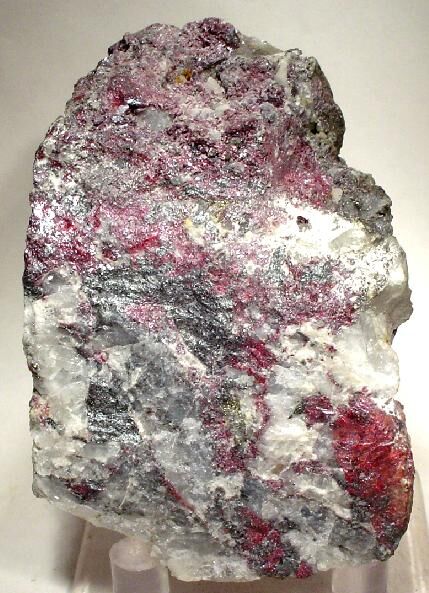
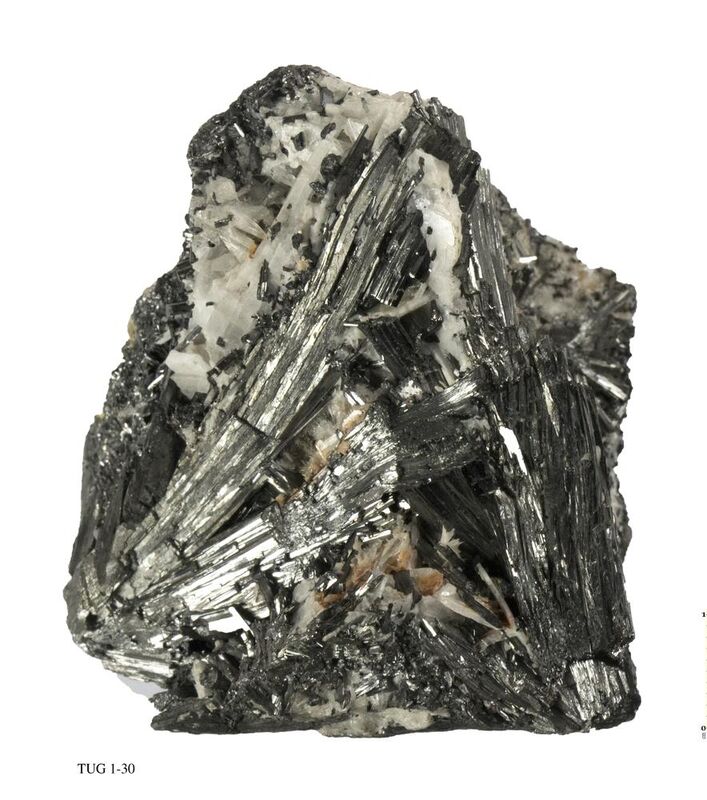
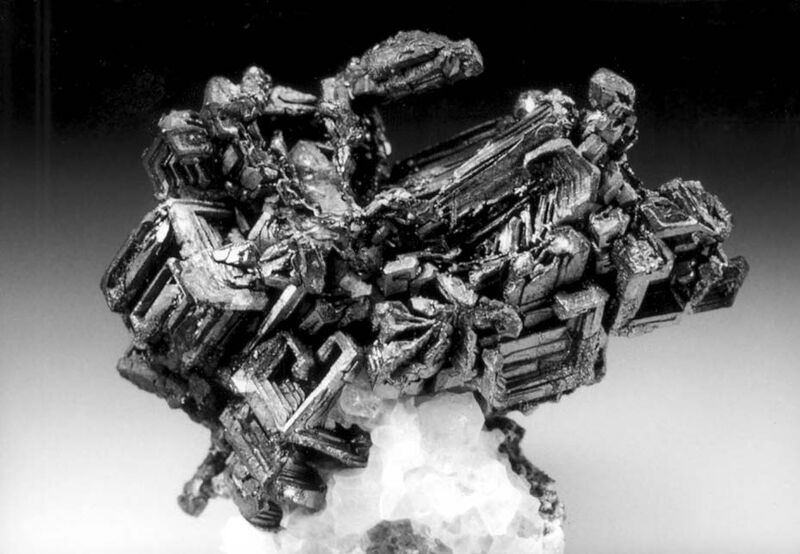
Broken into thin slivers, this mineral glows a translucent ruby red — the colour that earned it the old miners' name light ruby silver. It is the brighter, more transparent of two scarlet silver ores. The darker, more opaque one is pyrargyrite, the dark ruby silver, in which antimony stands where proustite holds arsenic.
The name honours the French chemist Joseph-Louis Proust, who lived from 1754 to 1826. In 1804 his careful chemical analyses separated this arsenic-bearing silver ore from its antimony twin, telling the two ruby silvers apart for the first time. Proust is best remembered for the law of definite proportions — the rule that a chemical compound always combines its elements in the same fixed ratio.
The mineral itself was named for him in 1832 by the French mineralogist François Sulpice Beudant. The ending -ite marks it, in the modern fashion, as a mineral species in its own right.
For centuries before and after, miners dug it for one thing: the silver locked inside it. Magnificent groups of large crystals came from Chañarcillo in Chile, and fine specimens from Freiberg and Marienberg in Saxony, from Joachimsthal in Bohemia, and from Sainte-Marie-aux-Mines in Alsace.
Industrial & practical applications
Proustite is valued today first as an ore of silver — the metal makes up most of its weight, and where the mineral is abundant it is worked for that silver. But its great brittleness and scarcity mean it is rarely a mine's main target. Its larger modern role is as a collector's mineral.
A fine scarlet crystal is among the most prized objects a silver-mineral collector can own. High-quality crystals are sought by enthusiasts and command high prices, and museums display them for their aesthetic value.
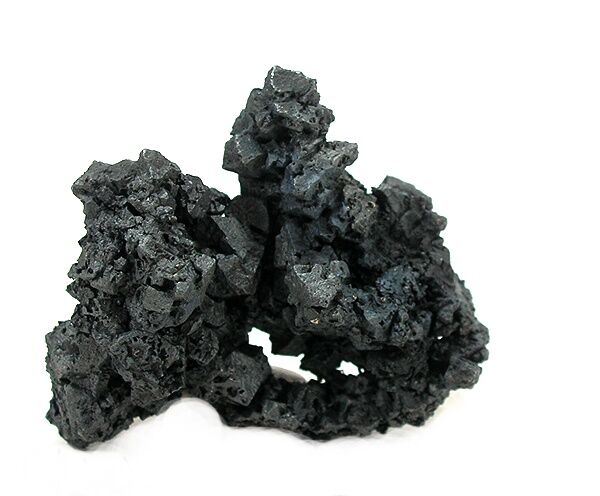
That beauty comes with a catch. Proustite is photosensitive: its translucent red darkens to a dull, opaque grey-black under prolonged light. Collectors and curators keep the finest specimens covered or stored in the dark, bringing them into the light only briefly.
A purer use draws on the crystal's optics. Grown synthetically, proustite is transparent across a wide band of infrared — the invisible light just beyond red, used in heat sensing and laser work — roughly from 0.6 to 13 micrometres. That transparency, paired with a strong nonlinear optical response, lets the crystal mix two light beams into a third of a different colour. It has been studied for converting long-wavelength infrared up into visible light, by laboratories including Hughes Research Laboratories, Bell Telephone Laboratories, and Britain's Royal Radar Establishment.
Where it forms, where it's found
- Geological setting
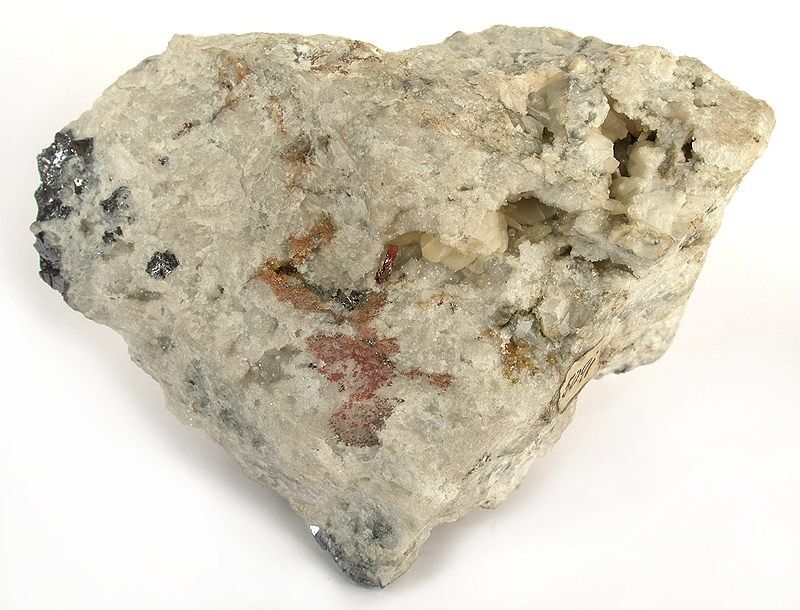
A late forming mineral in hydrothermal veins, also in the supergene zone.
- Type locality
- Jáchymov
- Karlovy Vary District
- Karlovy Vary Region
- Czech Republic
50.3661°, 12.9233°
Safety & handling
Physical
Optical
- Optical type
- Uniaxial (-)
- Refractive index
- 2.7924 – 3.088
- Surface relief
- Very high
- Principal indices
- nω 3.087 – 3.088 · nε 2.7924
- Pleochroism
- Visible
Cochineal red to blood red
- Anisotropism
- Strong
- Tropism
- Anisotropic
- Reflectance R%
- (36.9,39.6) 400, (36.8,39.5) 420, (36.7,39.4) 440, (35.8,38.2) 460, (34.0,36.8) 480, (32.5,35.0) 500, (31.2,33.5) 520, (30.0,32.3) 540, (29.0,31.2) 560, (28.2,30.3) 580, (27.5,29.6) 600, (26.9,29.0) 620, (26.3,28.5) 640, (25.9,28.2) 660, (25.4,27.9) 680, (25.0,27.6) 700
- Luminescence
- None
Crystallography
- Space group
- R-3c
- Cell parameters
- a = 10.79 Å · c = 8.69 Å
- Z
- 6
- Morphology
Prismatic crystals to 8 cm, also scalenohedral crystals.
- Twinning
On (104) to produce trillings, also on (101)(0001)(012)
Chemical composition
Synonyms
- Argent rouge arsenicale
- Argentum rudum rubrum
- Arsenical Red Silver
- Arsenical Silver Blende
- Arseniksilberblende
- Arsensilberblende
- Durchsichtig Rodtguldenerz
- Lichtes Rotgültigerz
- Lichtes Rothgültigerz
- Light red silver ore
- Plata roja clara
- Rosicler claro
- Rotgülden
In other languages
- French
- Proustite
- German
- Arsensilberblende · Lichtes Rotgültigerz · Proustit · Rubinblende
- Spanish
- proustita
- Italian
- Proustite
- Japanese
- 淡紅銀鉱
- Chinese
- 淡红银矿
- Russian
- Мышьяковая серебряная обманка · Прустит
- Arabic
- بروستيت
Classification
2.GA.05
- 2Sulfides and SulfosaltsClass
- 2.GSulfarsenites, sulfantimonites, sulfbismuthitesDivision
- 2.GANeso-sulfarsenites, etc. without additional SGroup
- 2.GA.05ProustiteSpecies
03.04.01.01
- 03SulfosaltsClass
- 03.04ø = 3Type
- 03.04.01Proustite Group (Ruby Silver)Group
- 03.04.01.01ProustiteSpecies
5.2.3
- 5Sulphosalts - Sulpharsenites and Sulphobismuthites (those containing Sn, Ge,or V are in Section 6)Class
- 5.2Sulpharsenites etc. of AgGroup
- 5.2.3ProustiteSpecies
Group, growth & confusion
Literature, links & citation
- 1795Klaproth, M. H. (1795) IX. Untersuchung der Silbererze, Rothgültigerz . In Beiträge zur chemischen Kenntniss der Mineralkörper Vol. 1. Rottmann. p.141-145.
- 1830Beudant, François-Sulpice (1830) Traité élémentaire de minéralogie. Deuxiéme Edition [Elementary Treatise on Mineralogy. Second Edition] (2nd ed.) Vol. 1 - Tome Premier [Volume One]. Chez Verdière.
- 1887Miers, H. A., Prior, G. T. (1887) On a Specimen of Proustite containing Antimony. Mineralogical Magazine and Journal of the Mineralogical Society, 7 (35) 196-200 doi:10.1180/minmag.1887.007.35.07 DOI: 10.1180/minmag.1887.007.35.07
- 1888Miers, H. A. (1888) Contributions to the Study of Pyrargyrite and Proustite. Mineralogical Magazine and Journal of the Mineralogical Society, 8 (37) 37-102 doi:10.1180/minmag.1888.008.37.01 DOI: 10.1180/minmag.1888.008.37.01
- 1910Ransome, Frederick Leslie (1910) Criteria of downward sulphide enrichment. Economic Geology, 5 (3) 205-220 doi:10.2113/gsecongeo.5.3.205DOI: 10.2113/gsecongeo.5.3.205
Entry last updated
@misc{mineral2026,
  author    = {Mineral Index editorial board},
  title     = {Proustite — Mineral Index},
  year      = {2026},
  url       = {https://mineralindex.org/minerals/proustite-3294}
}