History
Long before anyone could tell two red ores apart, miners in the silver districts of central Europe knew a deep red rock they called Rotgültigerz — ruby silver. The German mining scholar Georg Agricola mentioned it in 1546. But the name covered two different minerals that look almost identical. They were not told apart until chemists analysed both and found one held antimony where the other held arsenic.
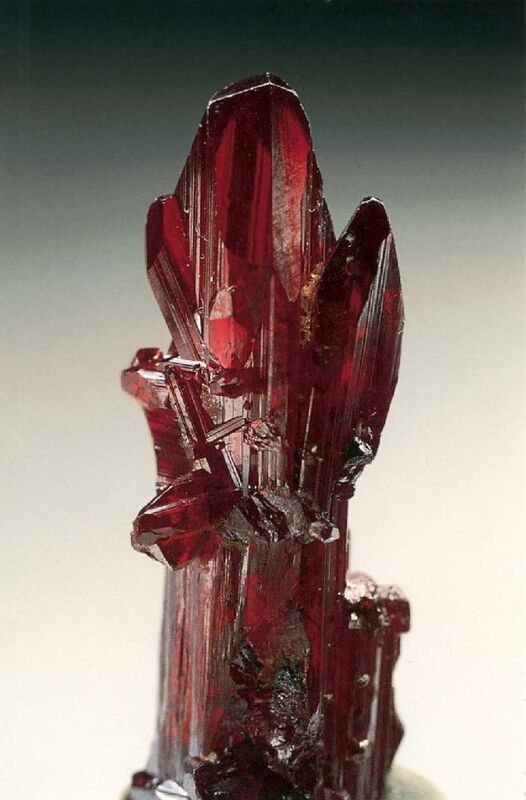
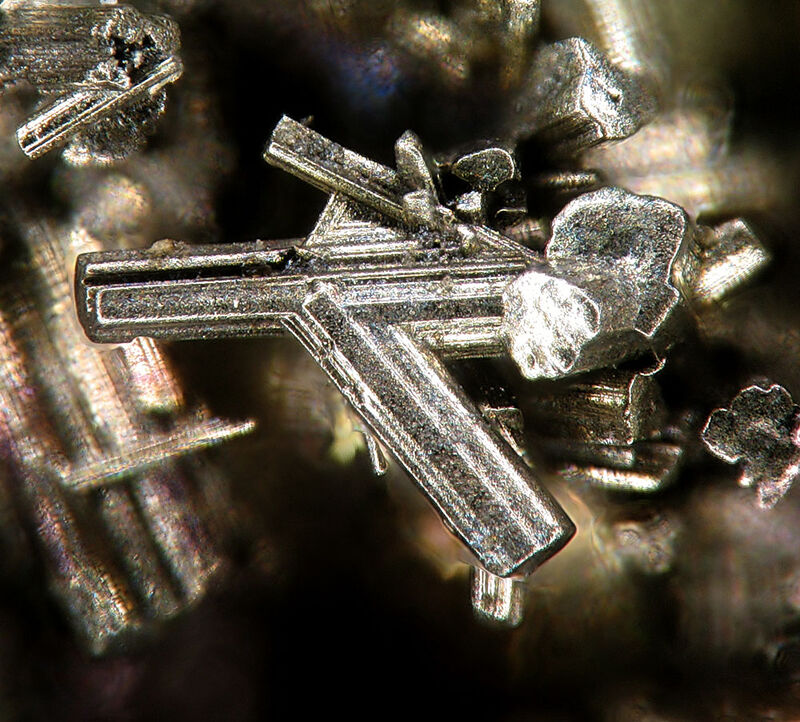
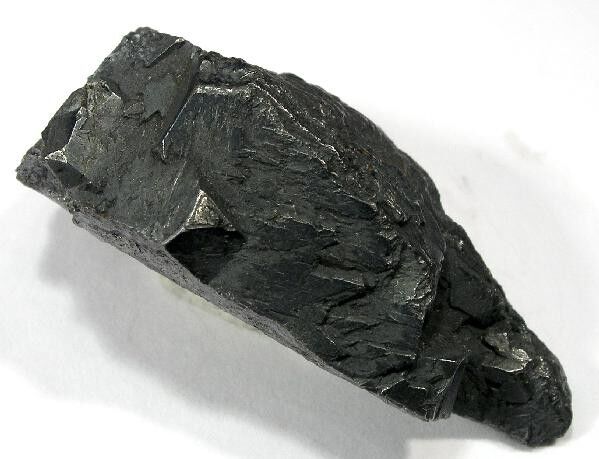
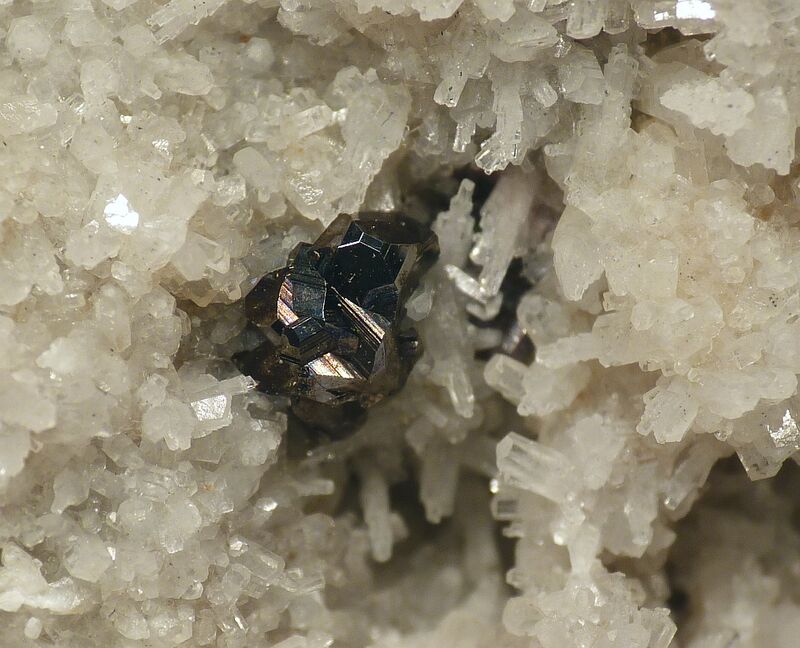
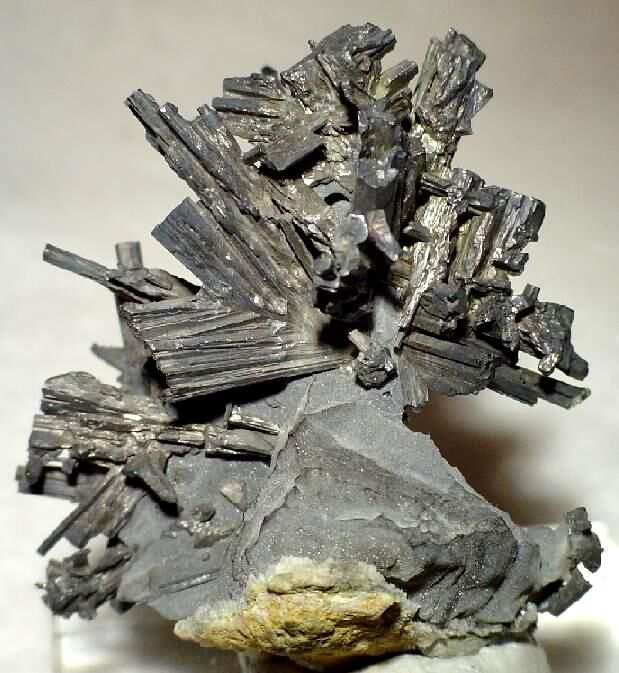
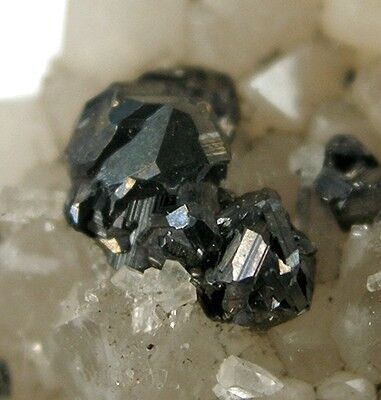
The antimony one is pyrargyrite. Its name was coined in 1831 from two Greek words — pyr, fire, and argyros, silver. It means "fire-silver", a nod to both its deep red colour and the silver locked inside it. Large crystals look greyish-black and opaque, but hold a thin sliver to the light and it glows ruby-red.
Its near-twin is proustite, the arsenic version of the same mineral — "light red silver ore" to pyrargyrite's "dark red silver ore". The two share the same crystal form yet rarely blend. The quickest way to separate them is the streak, the colour of the powder a mineral leaves when scraped. Pyrargyrite streaks purplish-red; proustite streaks a brighter scarlet.
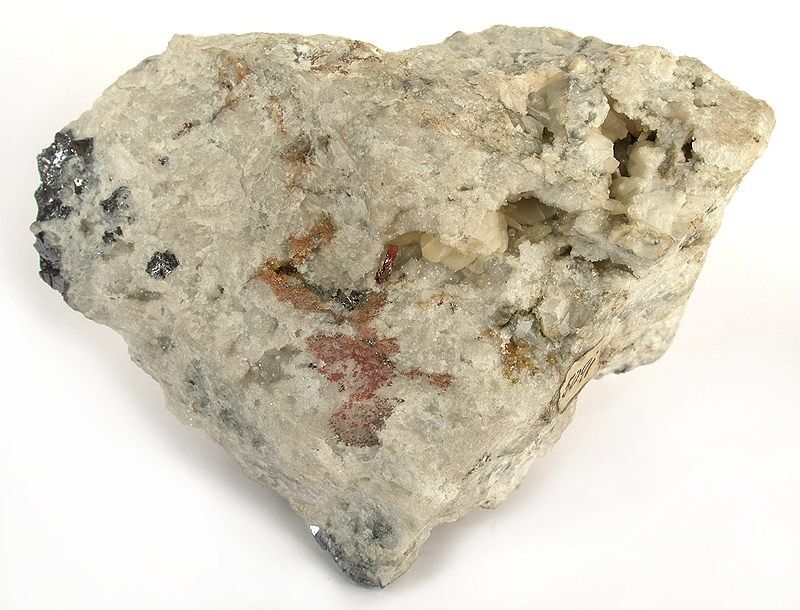
The finest crystals came from the old silver-mining heartlands — Sankt Andreasberg in the Harz mountains, Freiberg in Saxony, and Guanajuato in Mexico. Spanish mines at Guadalcanal and Hiendelaencina yielded specimens of unusual quality. In the United States the mineral turned up at Silver City in Idaho and was abundant at the Comstock Lode in Nevada.
Industrial & practical applications
Pyrargyrite is mined for one thing: the silver bound up inside it. The mineral is a source of silver, not of the antimony it also contains. Where it occurs in quantity, smelters recover the silver and leave the antimony aside.
Today that role is small. Pyrargyrite turns up in scattered amounts in silver veins rather than in the massive deposits that feed modern silver supply — it is common in only small amounts even in the silver mines of the western United States. The metal the world uses for coins, electronics and solar cells comes mostly from other, more abundant silver minerals and from the refining of lead, zinc and copper ores.
What demand the mineral still draws is mostly from collectors. Well-formed crystals — dark and metallic in bulk, glowing deep ruby-red where light passes through a thin edge — are sought as display specimens, especially the prized old-locality material from Sankt Andreasberg, Freiberg and Guanajuato.
Where it forms, where it's found
- Geological setting
Hydrothermal veins as a late stage, low-temperature mineral; also formed by secondary processes.
Physical
- Hardness
- 1Talc
- 2Gypsum
- 3Calcite
- 4Fluorite
- 5Apatite
- 6Orthoclase
- 7Quartz
- 8Topaz
- 9Corundum
- 10Diamond
- Lustre
- Sub Metallic
- Transparency
- Translucent
- Colour
- Deep red or red gray
- Streak
- Purplish red
- Tenacity
- brittle
- Cleavage
- Distinct/Good
Distinct on (101) very imperfect on (012)
- Fracture
- Irregular/Uneven · Conchoidal
- Density
- 5.82 g/cm³
Optical
- Optical type
- Uniaxial (-)
- Refractive index
- 2.881 – 3.084
- Surface relief
- Very high
- Principal indices
- nω 3.084 · nε 2.881
- Pleochroism
- Weak
- Anisotropism
- Strong in yellow white and grey blue
- Tropism
- Anisotropic
- Reflectance R%
- (35.0,41.0) 400, (34.8,40.8) 420, (34.6,40.6) 440, (34.0,40.2) 460, (32.8,39.5) 480, (31.0,37.4) 500, (29.6,35.4) 520, (28.2,34.0) 540, (27.2,32.7) 560, (26.4,31.7) 580, (25.6,30.9) 600, (25.0,30.2) 620, (24.4,29.6) 640, (23.8,29.0) 660, (23.4,28.5) 680, (22.9,28.1) 700
- Luminescence
- None
Crystallography
- Space group
- #85
- Cell parameters
- a = 11.047 Å · c = 8.719 Å
- Z
- 6
- Morphology
Prismatic crystals
- Twinning
On (104), less commonly on (101) (110), rarely (010).
Chemical composition
Synonyms
- Aerosit
- Aerosite
- Antimon-Rothgültigerz
- Antimonial Red Silver
- Antimonial Silver Blende
- Antimonrotgülden
- Antimonsilberblende
- Argent antimonié sulfuré
- Argent rouge antimoniale
- Argento rosso antimoniale
- Argyrythrose
- Dark Red Silver Ore
- Dunkles Rotgültigerz
- Gemein Rothguldenerz
- Mine d'argent rouge
- Petlanque acerado oscuro
- Plata roja oscura
- Pyrargirit
- Red Silver Ore
- Rosicler oscuro
- Rothgolderz
- Rothgylden
In other languages
- French
- pyrargyrite
- German
- Aerosit · Antimonsilberblende · Dunkles Rotgültigerz · Pyrargyrit
- Spanish
- pirargirita
- Italian
- pirargirite
- Japanese
- 濃紅銀鉱
- Chinese
- 浓红银矿
- Russian
- пираргирит
Classification
2.GA.05
- 2Sulfides and SulfosaltsClass
- 2.GSulfarsenites, sulfantimonites, sulfbismuthitesDivision
- 2.GANeso-sulfarsenites, etc. without additional SGroup
- 2.GA.05PyrargyriteSpecies
03.04.01.02
- 03SulfosaltsClass
- 03.04ø = 3Type
- 03.04.01Proustite Group (Ruby Silver)Group
- 03.04.01.02PyrargyriteSpecies
5.2.9
- 5Sulphosalts - Sulpharsenites and Sulphobismuthites (those containing Sn, Ge,or V are in Section 6)Class
- 5.2Sulpharsenites etc. of AgGroup
- 5.2.9PyrargyriteSpecies
Group, growth & confusion
Literature, links & citation
- 1795Klaproth, M. H. (1795) IX. Untersuchung der Silbererze, Rothgültigerz . In Beiträge zur chemischen Kenntniss der Mineralkörper Vol. 1. Rottmann. p.141-145.
- 1831Glocker, E.F. (1831) Rothgülben oder Pyrargyrit. in Handbuch der Mineralogie, Ben Johann Leonhard Schrag (Nürnberg), 388-392.
- 1888Miers, H. A. (1888) Contributions to the Study of Pyrargyrite and Proustite. Mineralogical Magazine and Journal of the Mineralogical Society, 8 (37) 37-102 doi:10.1180/minmag.1888.008.37.01 DOI: 10.1180/minmag.1888.008.37.01
- 1934Athanasiu, G. (1934) L'effet photoélectrique de quelques cristaux semiconducteurs - II. proustite, pyrargyrite, bournonite, molybdénite. Journal de Physique et le Radium, 5 (3). 132-140 doi:10.1051/jphysrad:0193400503013200DOI: 10.1051/jphysrad:0193400503013200
- 1944Palache, Charles, Berman, Harry, Frondel, Clifford (1944) The System of Mineralogy (7th ed.) Vol. 1 - Elements, Sulfides, Sulfosalts, Oxides. John Wiley and Sons, New York.
Entry last updated
@misc{mineral2026,
  author    = {Mineral Index editorial board},
  title     = {Pyrargyrite — Mineral Index},
  year      = {2026},
  url       = {https://mineralindex.org/minerals/pyrargyrite-3313}
}