Where it forms, where it's found
- Geological setting
Pegmatitic quartz-feldspar vein several hundred meters from outcrops of alkaline granite.
- Type locality
- Verkhnee Espe Massif (Verkhnee Espe deposit)
- Akzhaylyautas Mts (Akzhailyautas Mts
- Akjaylautas Mts
- Akzhalautas Mts)
- Tarbagatai Range
- Abai Region
- Kazakhstan
48.1000°, 81.4500°
1recorded occurrences
Physical
- Hardness
- 1Talc
- 2Gypsum
- 3Calcite
- 4Fluorite
- 5Apatite
- 6Orthoclase
- 7Quartz
- 8Topaz
- 9Corundum
- 10Diamond
- Transparency
- Transparent · Opaque
- Colour
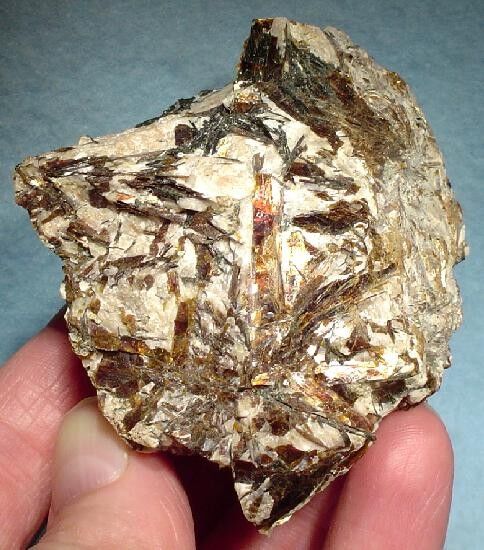
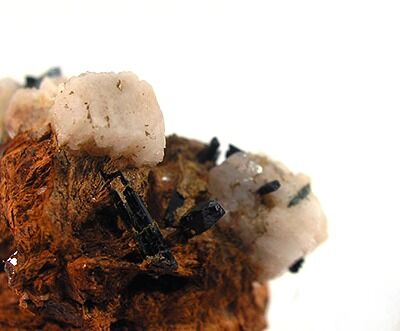
- Brown to pale golden brown
- Streak
- Colorless with a hint of yellow
- Tenacity
- elastic
- Cleavage
- Perfect
Perfect cleavage parallel to (001) and moderate cleavage parallel to (010).
- Density
- 3.263 g/cm³
Optical
- Optical type
- Biaxial (+) · 2V measured = 37° · 2V calc = 45°
- Refractive index
- 1.71 – 1.745
- Surface relief
- High
- Principal indices
- nα 1.710 · nβ 1.715 · nγ 1.745
- Pleochroism
- Visible
X = yellow brown; Y = orange red; Z = yellow orange (λ 589 nm).
- Dispersion
- not measured
- UV response
- None
- Notes
Absorption: X < Z < Y.
Δ = 0Δmax
PPLpleochroism per grain
XPLindependent extinctions · rotate the stage
PPLpleochroism only · colour blends on rotation
XPLinterference colour · extinct every 90°
Retardation350 nm
Order1st order
XPL colour
Crystallography
- Cell parameters
- a = 5.3868(3) Å · b = 11.9141(6) Å · c = 11.7171(6) Å
- Cell angles
- α = 112.978(2) ° · β = 94.641(2) ° · γ = 103.189(2) °
- Ratio a:b:c
- 1 : 2.212 : 2.175
- Z
- 1
- Type-locality form
Intimately associated with astrophyllite as lamellar intergrowths up to 10 × 3 × 0.2 mm.
Crystal structure
Synonyms
- IMA2010-048
- Tarbagataiet
In other languages
- German
- IMA 2010-048 · Tarbagatait
- Italian
- tarbagataite
Classification
Strunz
10th ed.9.DC.05
- 9SilicatesClass
- 9.DInosilicatesDivision
- 9.DCInosilicates with branched 2-periodic single chains; Si2O6 + 2SiO3 Si4O12Group
- 9.DC.05TarbagataiteSpecies
Group, growth & confusion
Literature, links & citation
Citations
- 2011Williams, P. A., Hatert, F., Pasero, M., Mills, S. J. (2011) New minerals and nomenclature modifications approved in 2010, CNMNC Newsletter No 7. Mineralogical Magazine, 75 (1) 27-31 doi:10.1180/minmag.2011.075.1.27 DOI: 10.1180/minmag.2011.075.1.27
- 2012Stepanov, A. V., Bekenova, G. K., Levin, V. L., Sokolova, E., Hawthorne, F. C., Dobrovol'skaya, E. A. (2012) Tarbagataite,(K,□)2(Ca,Na)(Fe2+,Mn)7Ti2(Si4O12)2O2(OH)4(OH,F), a new astrophyllite-group mineral species from the Verkhnee Espe deposit, Akjailyautas Mountains, Kazakhstan: description and crystal structure. The Canadian Mineralogist, 50 (1) 159-168 doi:10.3749/canmin.50.1.159 DOI: 10.3749/canmin.50.1.159
- 2012Sokolova, E. (2012) Further developments in the structure topology of the astrophyllite-group minerals. Mineralogical Magazine, 76 (4) 863-882 doi:10.1180/minmag.2012.076.4.04 DOI: 10.1180/minmag.2012.076.4.04
- 2015(2015) Tarbagataite. Handbook of Mineralogy. Mineralogical Society of America
- 2017Sokolova, Elena, Cámara, Fernando, Hawthorne, Frank C., Ciriotti, Marco E. (2017) The astrophyllite supergroup: nomenclature and classification. Mineralogical Magazine, 81 (1) 143-153 doi:10.1180/minmag.2016.080.077DOI: 10.1180/minmag.2016.080.077
Cite this entry
Entry last updated
@misc{mineral2025,
  author    = {Mineral Index editorial board},
  title     = {Tarbagataite — Mineral Index},
  year      = {2025},
  url       = {https://mineralindex.org/minerals/tarbagataite-41103}
}