History
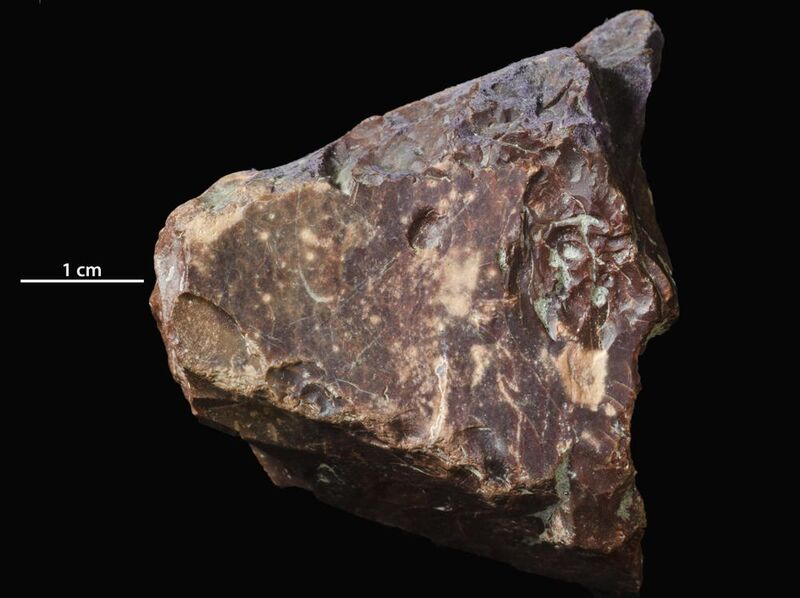
People had been working agate for thousands of years before anyone wrote its name down. Knives and arrowheads chipped from moss agate — a translucent variety threaded with dark dendritic markings — appear at Natufian sites in the Levant as early as 10000 BCE. Worked artefacts from around 7000 BCE turn up in Mongolia. Sumerian jewellery dating to about 2500 BCE includes polished agate beads. Ancient Egyptians, Mycenaeans, and Romans all wore agate set into rings, strung as beads, and carved into cameos and seal stones.
The first written description came from the Greek philosopher Theophrastus around 350 BCE. He named the stone after the River Achates in southwestern Sicily, where it was abundant. Pliny the Elder later repeated the same naming story in his Natural History. The link is so old that no one can now say which gave its name to the other — etymologists suspect the river was named after the mineral, not the other way around. The Latin achātēs travelled west into the Anglo-Norman French agathe, and from there into English.
The Idar-Oberstein cutting industry
By around 1375 CE, the German town of Idar-Oberstein had built an industry around agate, working local deposits in the surrounding hills. For five centuries its cutters lived on what the nearby streams and quarries gave them. Then, around 1900, the local deposits thinned out just as vast new agate fields opened in Brazil and Uruguay. The town did not collapse; it pivoted. Idar-Oberstein began importing Brazilian agate as ship's ballast — heavy stones loaded into empty hulls on the return voyage, then sold to the waiting cutters. The town remained the world's agate-cutting capital, on raw material from another continent.
The 19th century added a chemical chapter to the trade. The classical methods of staining agate were developed in Idar-Oberstein in the early 19th century. Polished slices were soaked for several days in an inorganic dye or sugar solution, depending on the desired colour. Organic aniline dyes derived from coal tar followed later in the century, opening up pinks and purples that no natural agate offers. Most commercial agate sold today has been stained in some form.
Industrial & practical applications
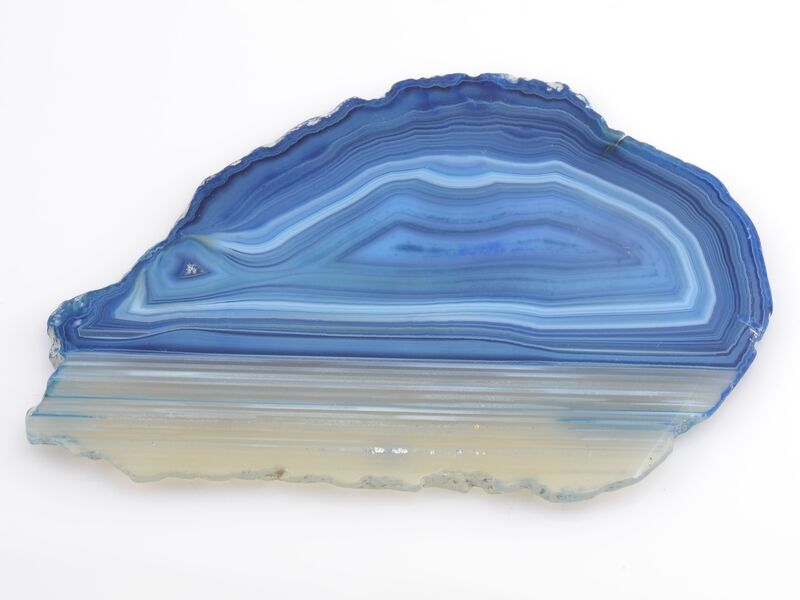
Most agate worked today is decorative. Its banded patterns, hardness, and high polish make it a staple of the lapidary trade — cabochons, beads, pendants, earrings, bracelets, carvings, and ornamental displays. The bulk of commercial material is dyed, stained in inorganic solutions or aniline colours to lift the dull grey stone into vivid bands.
The narrower industrial uses exploit three properties of the same mineral: its hardness, its ability to hold a high polish, and its resistance to chemical attack.
Agate mortars and pestles remain a standard tool in chemistry and pharmacology labs for grinding small samples of reagents and pharmaceuticals. The stone is hard enough to crush most materials and inert enough to leave the powder chemically untouched.
Precision laboratory balances have long used agate for bearings and knife edges. These are small wear surfaces that need to stay hard, smooth, and dimensionally stable over many years of use.
Where it forms, where it's found
- Geological setting
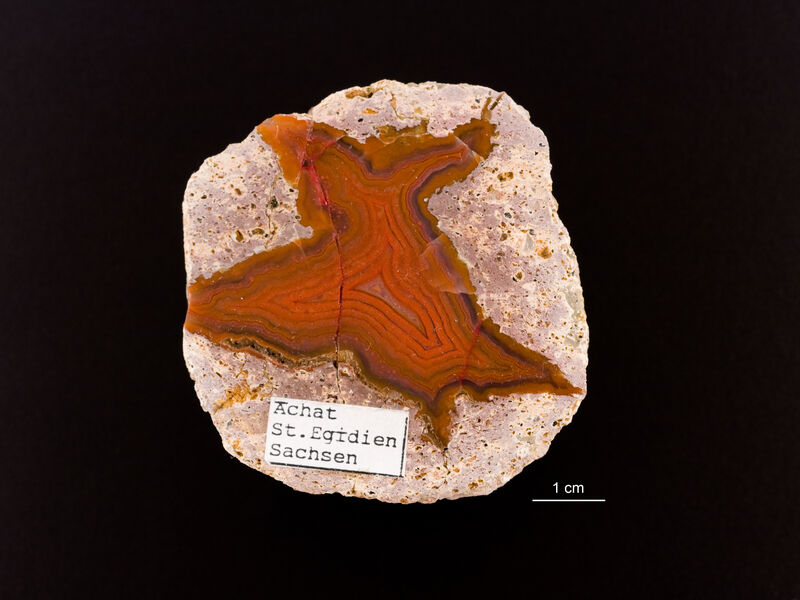
Very common. Outlining cavities in acidic and intermediate volcanic rocks. Cavities in epithermal chalcedonic veins. Less common in cavities of sedimentary and plutonic rocks.
Varieties
Physical
- Hardness
- 1Talc
- 2Gypsum
- 3Calcite
- 4Fluorite
- 5Apatite
- 6Orthoclase
- 7Quartz
- 8Topaz
- 9Corundum
- 10Diamond
- Transparency
- Translucent
- Colour
- Colourless · gray · red · white · any color due to embedded minerals · multicolored specimens not uncommon
- Streak
- white
- Tenacity
- brittle
- Cleavage
- None Observed
- Fracture
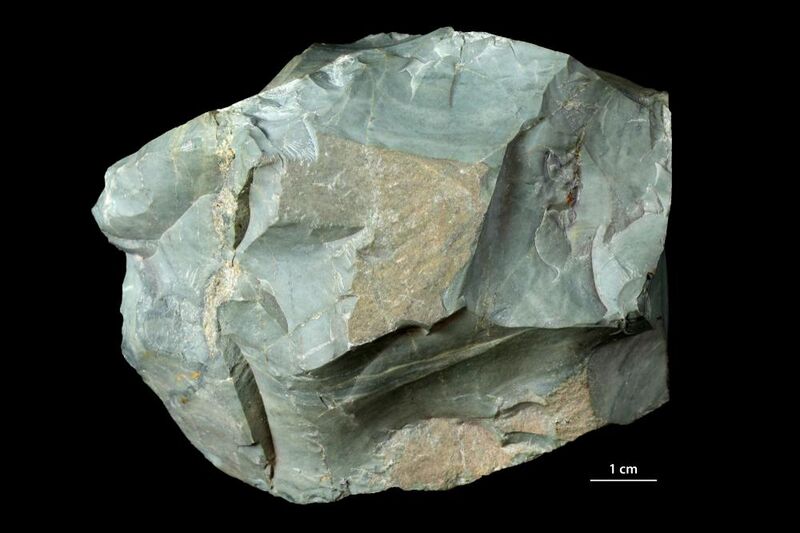
- Conchoidal · Sub-Conchoidal
- Density
- 2.6 g/cm³
Chemical composition
Synonyms
- Achat
- Achates
- Achates vix pellucida
- Agaat
- Agat
- Agata
- Agata-diasporo
- Agate grossière
- Agate orientale
- Agate périgone
- Agate rubanée
- Agate Versiclore
- Agate zonaire
- Agathe vixpellucida nebulosa colgriseo ore mixta
- Akaatti
- Oriental Agate
Group, growth & confusion
Literature, links & citation
- —http://www.achat-almanach.de [in English and German]
- 1892Lévy, Auguste Michel, Munier-Chalmas, Ernest (1892) Mémoire sur diverses formes affectées par le réseau élémentaire du quartz. Bulletin de la Société française de Minéralogie, 15 (7). 159-190
- 1927Bernauer, F. (1927) Über Zickzackbänderung (Runzelbänderung) und verwandte Polarisationserscheinungen an Kristallen und Kristallaggregaten. Neues Jahrbuch für Mineralogie, Geologie und Paläontologie, Beilageband: 55: 92-143.
- 1933Correns, Carl W.; Nagelschmidt, Günter (1933) Über Faserbau und optische Eigenschaften von Chalzedon. Zeitschrift für Kristallographie, 85 (1-6). 199-213 doi:10.1524/zkri.1933.85.1.199DOI: 10.1524/zkri.1933.85.1.199
- 1952Jones, Francis T. (1952) Iris agate. American Mineralogist, 37 (7-8) 578-587
Entry last updated
@misc{mineral2026,
  author    = {Mineral Index editorial board},
  title     = {Agate — Mineral Index},
  year      = {2026},
  url       = {https://mineralindex.org/minerals/agate-51}
}