History
Long before any written record, humans were grinding hematite to red powder. The earliest known human use comes from the Pinnacle Point caves in present-day South Africa, 164,000 years ago — possibly for social purposes. Hematite residues turn up in graves 80,000 years old. Near Rydno in Poland and Lovas in Hungary, red chalk mines worked by the Linear Pottery culture date to about 5000 BCE.
The mineral got its written name in classical Greece. Around 300–325 BCE, Theophrastus called it aematitis lithos — blood stone — for the colour of its ground powder. The name may be the first ever applied to a mineral with the now-familiar -ite suffix. In 79 CE, Pliny the Elder translated the Greek into Latin as haematites, meaning bloodlike, in allusion to that same red dust. The pigment ground from the mineral was also known as sil atticum, another Latin name for the dark-red colour.
The Latin name carried into medieval Europe as lapis haematites. By the 15th century it had reached French as hématite pierre, the immediate ancestor of the modern English name. Over the following centuries, writers simplified haematite by dropping the second a — a pattern that paralleled other words built on the same blood-root haeme-.
Industrial & practical applications
Hematite is, by an enormous margin, the world's primary iron ore. Its dominance comes from a high iron content of 70 percent and broad geological abundance. Major sources include the Lake Superior basin in North America, Brazil's Minas Gerais district, Venezuela's Cerro Bolívar, and the Labrador–Quebec deposits of Canada. From these deposits flows the iron that the modern steel industry consumes.
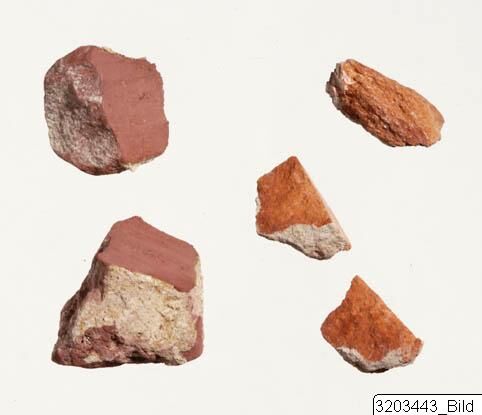
Ground to powder, the mineral remains in use as a pigment. Red ochre, the dark-red paint pigment, is still drawn from hematite for artist's colours and traditional finishes. A purified form, rouge, is used to polish plate glass.
The mineral's density gives it a second industrial role. With its high density, hematite is an effective barrier against X-rays and is often incorporated into radiation shielding.
Polished hematite is shaped into beads, tumbling stones, and other jewellery components.
Where it forms, where it's found
- Geological setting
Large ore bodies of hematite are usually of sedimentary origin; also found in high-grade ore bodies in metamorphic rocks due to contact metasomatism, and occasionally as a sublimate on igneous extrusive rocks ("lavas") as a result of volcanic activity. It is also usually the cause of red soils all over the planet.
Varieties
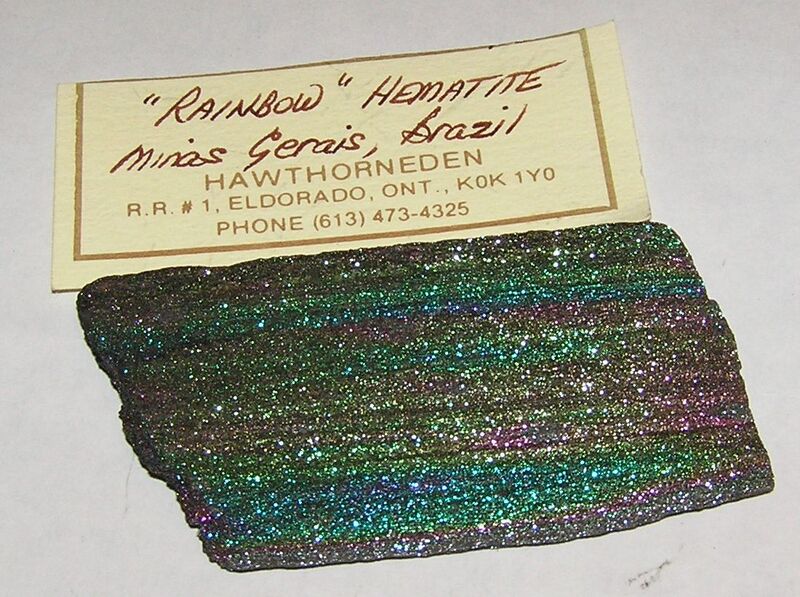
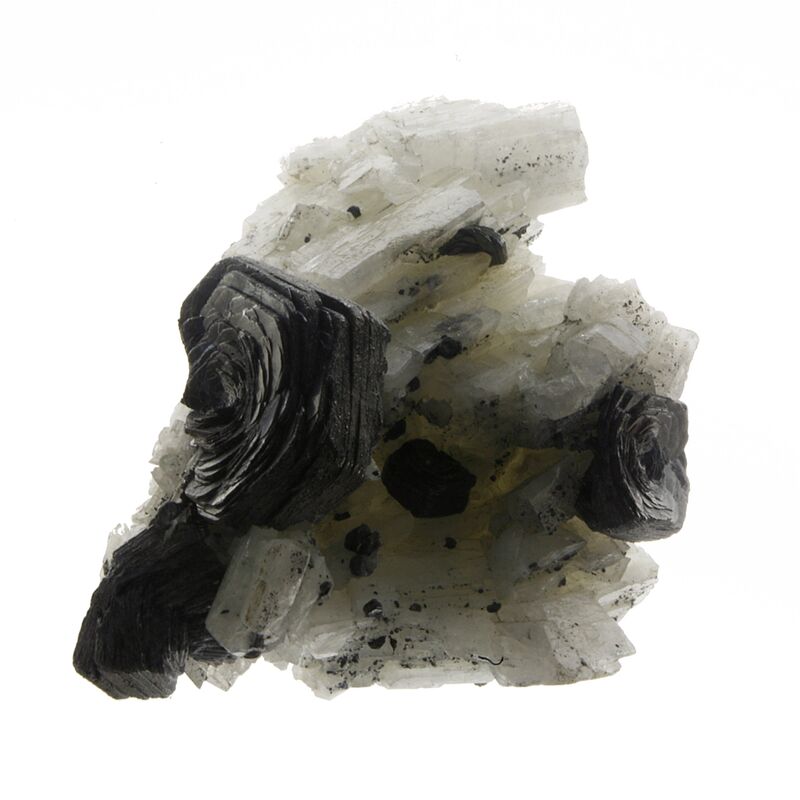
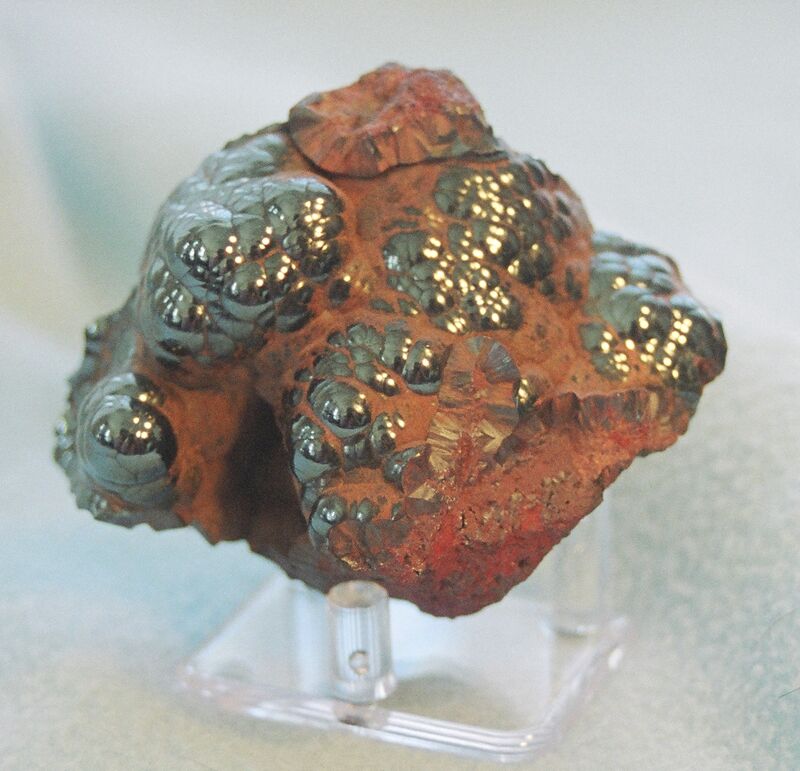
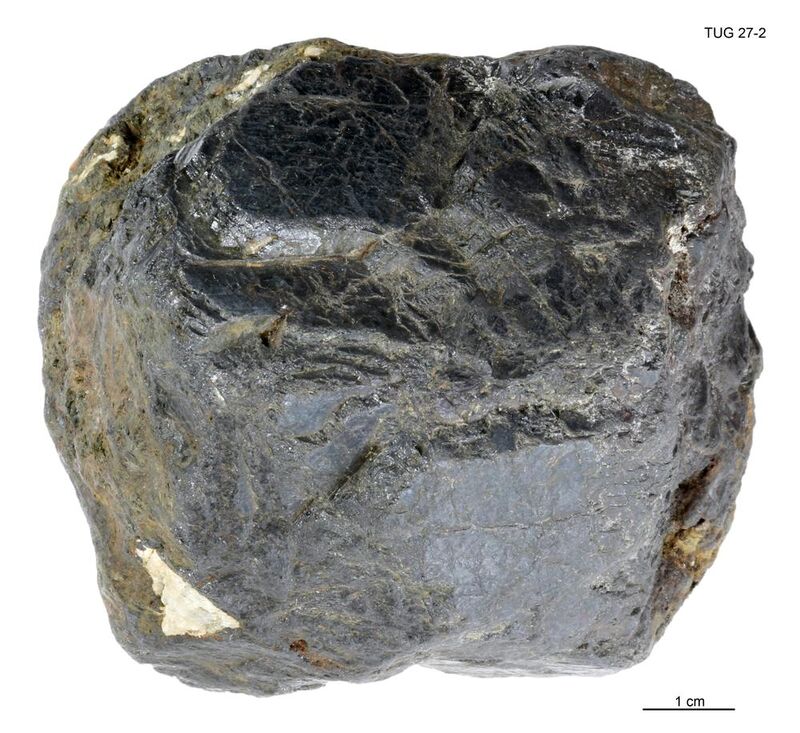
Physical
- Hardness
- 1Talc
- 2Gypsum
- 3Calcite
- 4Fluorite
- 5Apatite
- 6Orthoclase
- 7Quartz
- 8Topaz
- 9Corundum
- 10Diamond
- Lustre
- Metallic
- Transparency
- Opaque
- Colour
- Steel-grey to black in crystals and massively crystalline ores · dull to bright "rust-red" in earthy · compact · fine-grained material.
See Rossman, G. R. (1996) for cause of red colour.
- Streak
- Reddish brown ("rust-red"); blackish when Ti-bearing
- Tenacity
- brittle
- Cleavage
- None Observed
Elastic in thin lamellae
- Fracture
- Irregular/Uneven · Sub-Conchoidal
- Density
- 5.26 g/cm³
Optical
- Optical type
- Uniaxial (-)
- Refractive index
- 2.87 – 3.22
- Surface relief
- Very high
- Principal indices
- nω 3.15 – 3.22 · nε 2.87 – 2.94
- Pleochroism
- Weak
O = brownish red E = yellowish red
- Optical colour
- White to greyish white with bluish tint
- Anisotropism
- Distinct
- Tropism
- Anisotropic
- Reflectance R%
- (26.8,30.5,12.2,15.6) 400, (28.5,31.8,13.9,17.0) 420, (28.9,32.1,14.3,17.3) 440, (28.2,31.9,13.6,17.0) 460, (28.1,31.7,13.4,16.8) 470, (27.9,31.6,13.3,16.7) 480, (27.5,31.3,12.9,16.3) 500, (27.2,30.5,12.6,15.6) 520, (26.7,30.1,12.2,15.3) 540, (26.4,30.0,12.0,15.1) 546, (26.1,29.8,11.8,15.0) 560, (25.5,29.3,11.3,14.6) 580, (24.8,28.6,10.8,14.0) 600, (24.1,27.7,10.3,13.2) 620, (23.6,26.7,9.9,12.4) 640, (23.3,26.3,9.7,12.0) 650, (23.0,25.9,9.5,11.7) 660, (22.6,25.3,9.2,11.2) 680, (22.3,25.1,9.0,11.1) 700
- Luminescence
- None
- UV response
- None.
Crystallography
- Space group
- #98
- Cell parameters
- a = 5.038(2) Å · c = 13.772(12) Å
- Z
- 6
- Morphology
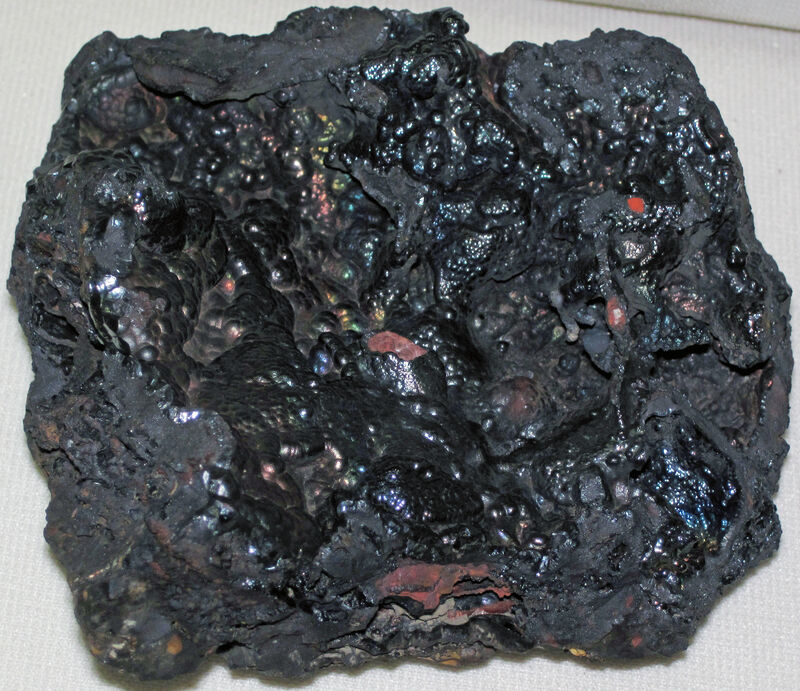
Crystals generally thick to thin tabular (0001), rarely prismatic [0001] or scalenohedral; also rarely rhombohedral (101), producing pseudo-cubic crystals. Often found in sub-parallel growths on (0001) or as rosettes ("iron roses.") Sometimes in micaceous to platy masses. May be compact columnar or fibrous masses, sometimes radiating, or in reniform masses with a smooth fracture ("kidney ore"), and botryoidal and stalactic. Frequently in earthy masses, also granular, friable to compact, concretionary and oolitic.
- Twinning
Penetration twins on (0001), or with (100) as a composition plane. Frequently exhibits a lamellar twinning on (101) in polished section.
- Parting
- Partings on (0001) and (101) due to twinning. Unique cubic parting in masses and grains at Franklin Mine, Franklin, NJ.
- Epitaxy
Examples of rutile epitaxial on hematite are widespread. Dramatic specimens have been found at <l id=5387>Novo Horizonte, Brazil</l>. Pseudobrookite on hematite with pseudobrookite (121)[210] parallel to hematite (0001)[1100].
Chemical composition
- Impurities
- Ti
- Al
- Mn
- H2O
Synonyms
- Alaska Black Diamond
- Anhydroferrit
- Anhydroferrite
- Blodsten
- Campanil
- Eisenglanz
- Ematite rossa
- Fer oligiste
- Fer oxydé rouge
- Haematit
- Haematites
- Haematites ruber
- Hematite rouge
- Hematites roja
- Hematitogelite
- Hematogelite (of Tućan)
- Hierro oligisto
- Iron Glance
- Järnmalm tritura rubra
- Jernglans
- Jernglanz
- Ochra rubra
- Oligisto
- Red Hematite
- Red Iron Ore
- Red Oxide of Iron
- Röd Jernmalm
- Rödmalm
- Roteisenerz
- Roteisenstein
- Rotheisenstein
- Rother Eisenrahm
- Ruddle
- Silbereisen
- Speglande Eisenglimmer
- Speglande Jernmalm
- Vena
In other languages
- French
- Anhydroferrite · Fer micacé · Fer oxydé rouge · Fer spéculaire · hématite · Hematitogelite · Oligiste · Spécularite
- German
- Eisenglanz · Hämatit · Hematit · Iserin · Roteisen · Roteisenerz · Roteisenstein
- Spanish
- Albin · Hematita · hematites · Ocre rojo · Oligisto
- Italian
- ematite
- Portuguese
- Hematita · hematite
- Japanese
- ヘマタイト · 赤鉄鉱 · 鏡鉄鉱 · 雲母鉄鉱
- Chinese
- 赤铁矿
- Simplified Chinese
- 赤铁矿
- Traditional Chinese
- 赤鐵礦
- Russian
- гематит · Железная слюда · Железная слюдка · Железный блеск · Красный железняк · Кровавик
- Arabic
- الحجر الهندي · الحديد الصيني · حجر الدم · حجر الطور · شادنج · شادنه · شاذنَج · هيماتيت
- Hindi
- हेमाटाइट
Classification
4.CB.05
- 4OxidesClass
- 4.CMetal: Oxygen = 2: 3,3: 5, and similarDivision
- 4.CBWith medium-sized cationsGroup
- 4.CB.05HematiteSpecies
04.03.01.02
- 04Simple OxidesClass
- 04.03A2X3Type
- 04.03.01Corundum-Hematite group (Rhombohedral: R-3c)Group
- 04.03.01.02HematiteSpecies
7.20.4
- 7Oxides and HydroxidesClass
- 7.20Oxides of FeGroup
- 7.20.4HematiteSpecies
Group, growth & confusion
Literature, links & citation
- —De natura fossilium - Lib. I-X
- 1904McKee, G.W. (1904) Prismatic crystals of hematite. American Journal of Science: s4-17(99): 241-242.
- 1925Pauling, Linus, Hendricks, Sterling B. (1925) The crystal structures of hematite and corundum. Journal Of The American Chemical Society, 47 (3). 781-790 doi:10.1021/ja01680a027DOI: 10.1021/ja01680a027
- 1929Biäsch (1929) Zs. Kr., 70, 1.
- 1944Palache, Charles, Berman, Harry, Frondel, Clifford (1944) The System of Mineralogy (7th ed.) Vol. 1 - Elements, Sulfides, Sulfosalts, Oxides. John Wiley and Sons, New York.
Entry last updated
@misc{mineral2026,
  author    = {Mineral Index editorial board},
  title     = {Hematite — Mineral Index},
  year      = {2026},
  url       = {https://mineralindex.org/minerals/hematite-1856}
}