History
Most of the old museum specimens labelled ankerite are not ankerite at all. The name has shifted under them.
The mineral was first recognised as a distinct species in 1825, by the Austrian mineralogist Wilhelm von Haidinger. He named it for a fellow mineralogist, Matthias Joseph Anker of Styria, who lived from 1771 to 1843. Anker is the person honoured in the name; the suffix -ite simply marks it as a mineral.
To 19th-century miners and geologists, the name mattered less than the look. They lumped ankerite and its close relatives under the broad, catch-all name brown spar — spar being an old miner's word for a bright, easily split mineral. The label fit a whole family. Ankerite sits at one end of a chemical run between dolomite and a fully iron-rich carbonate, and carries the most iron of the set.
That family resemblance is exactly what made the name slippery. Early definitions were loose. They asked only that iron make up more than a tenth of the carbonate, with no demand that iron outweigh magnesium. A 1955 scheme even reserved a separate name, ferrodolomite, for the pure iron-calcium endmember. The modern rule is stricter. True ankerite must have more iron than magnesium. The tightening had a quiet consequence: most specimens labelled ankerite in older collections are now reclassified as ferroan dolomite, and genuine ankerite turns out to be quite rare.
Industrial & practical applications
Ankerite is not a mineral anyone sets out to mine. No industrial use of it is recorded, and it is not an ore worth extracting on its own account.
Its only practical footprint is geological. It forms alongside siderite — an iron carbonate — in metamorphosed ironstones and in banded iron formations. Those are the layered iron-and-silica rocks that hold much of the world's iron ore. There ankerite is a minor, incidental component of the rock, not a target of the dig. Beyond that, it is sought only by mineralogists and collectors as a representative of its species — study and display, not industry.
Where it forms, where it's found
- Geological setting
In a massive siderite orebody
Low-grade metamorphism of ironstones and banded iron formation. Carbonatites and other carbonate-rich alkaline igneous rocks.
Varieties
Physical
- Hardness
- 1Talc
- 2Gypsum
- 3Calcite
- 4Fluorite
- 5Apatite
- 6Orthoclase
- 7Quartz
- 8Topaz
- 9Corundum
- 10Diamond
- Lustre
- Vitreous · pearly on cleavage surfaces.
- Transparency
- Translucent
- Colour
- Brown · white to grey · yellowish-brown · tan · fawn · greenish
- Streak
- White
- Tenacity
- brittle
- Cleavage
- Perfect
Perfect on (101)
- Fracture
- Hackly
- Density
- 2.93 g/cm³
Optical
- Optical type
- Uniaxial (-)
- Refractive index
- 1.51 – 1.75
- Surface relief
- Moderate
- Principal indices
- nω 1.69 – 1.75 · nε 1.51 – 1.548
- Dispersion
- Strong
- Luminescence
- May be fluorescent and/or triboluminescent.
Crystallography
- Space group
- #80
- Cell parameters
- a = 4.8312(2) Å · c = 16.1663(3) Å
- Z
- 3
- Morphology
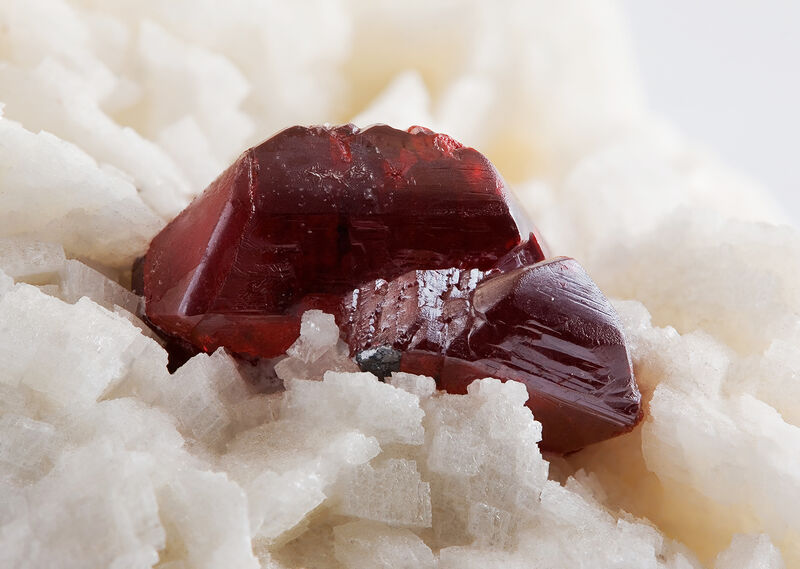
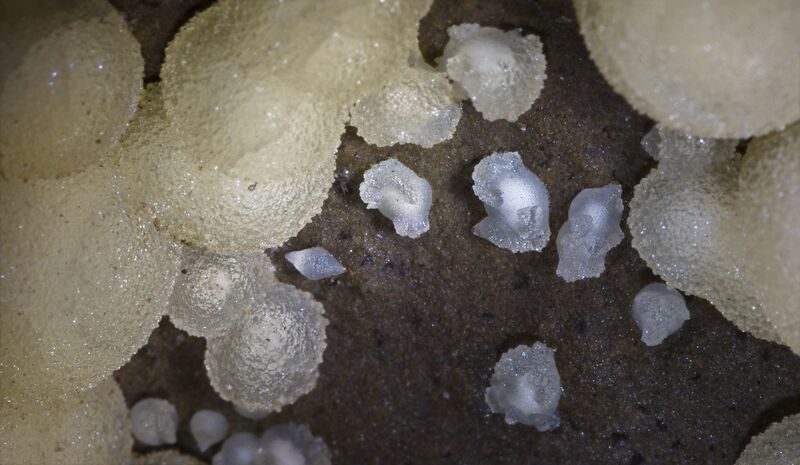
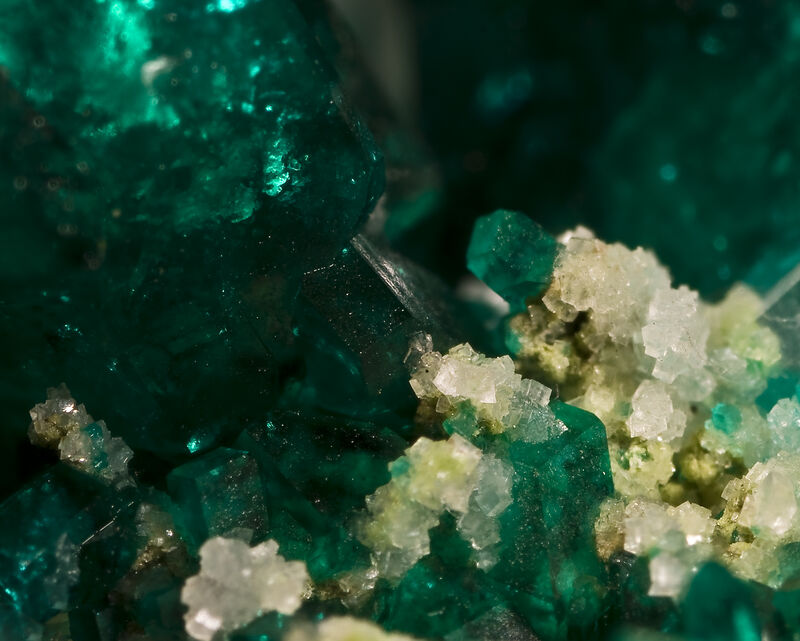
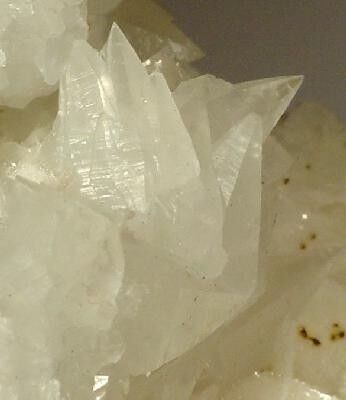
Crystals commonly rhombohedral with (101) or, less commonly, (404) dominant.
- Twinning
Simple twins on (0001), (100). (110)
- Type-locality form
Pale yellow-brown rhombohedral crystals
- Comment
For sample with 68 mol% CaFe(CO3)2 (Reeder & Dollase, 1989). A sample with ca. 70 mol% CaFe(CO3)2 has a = 4.836 and 16.186 A (Ross & Reeder, 1992).
Chemical composition
Synonyms
- Codazzite
- Eisendolomit
In other languages
- French
- Ankérite
- German
- Ankerit
- Spanish
- ankerita
- Italian
- ankerite
- Chinese
- 鐵白雲石
- Traditional Chinese
- 鐵白雲石
- Russian
- Анкерит
- Arabic
- أنكريت
Classification
5.AB.10
- 5CarbonatesClass
- 5.ACarbonates without additional anions, without H2ODivision
- 5.ABAlkali-earth (and other M2+) carbonatesGroup
- 5.AB.10AnkeriteSpecies
14.02.01.02
- 14Anhydrous Normal CarbonatesClass
- 14.02AB(XO3)2Type
- 14.02.01Dolomite Group (Trigonal: R-3)Group
- 14.02.01.02AnkeriteSpecies
11.13.6
- 11CarbonatesClass
- 11.13Carbonates of FeGroup
- 11.13.6AnkeriteSpecies
Group, growth & confusion
Literature, links & citation
- 1825Mohs, F. (1825) Paratomous lime-haloide. in Treatise on Mineralogy Vol II, translated by Haidinger, Archibald and Co. (Edinburgh), 100-101.
- 1825Mohs, F. (1825) Characters of the genera and species of the orders of class II. I. Order. Haloide. V. Lime-haloide. 4. Paratomous. Ankerite. in: Treatise on Mineralogy Vol I, translated by Haidinger, Archibald and Co. (Edinburgh), 411-411.
- 1857Luboldt, R. (1857) Ueber den Ankerit. Annalen der Physik: 178: 435-437.
- 1917Ford, W.E. (1917) Studies in the Calcite Group. In: Transactions of the Connecticut Academy of Arts and Sciences 22:211-248 (October 1917).
- 1926Rocza (1926) Zentralblatt Mineralien: 229.
Entry last updated
@misc{mineral2026,
  author    = {Mineral Index editorial board},
  title     = {Ankerite — Mineral Index},
  year      = {2026},
  url       = {https://mineralindex.org/minerals/ankerite-239}
}