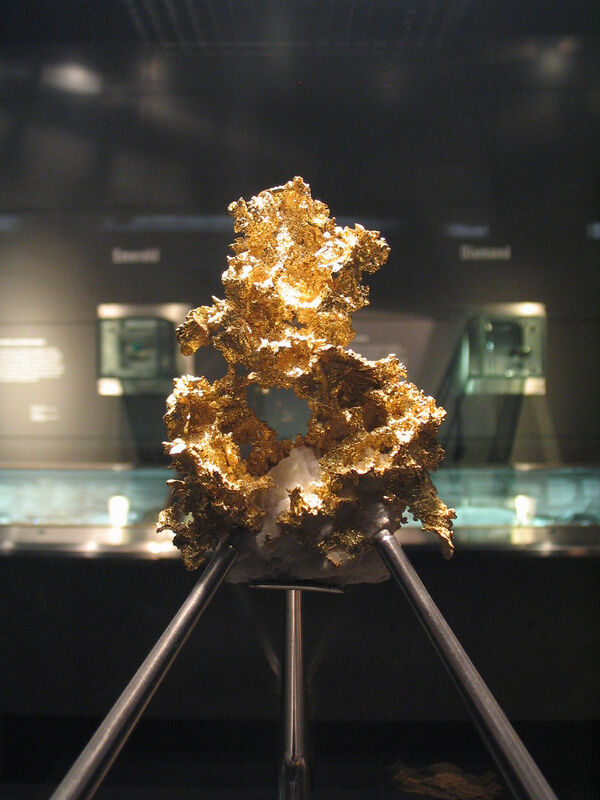
Where it forms, where it's found
Physical
- Hardness
- 1Talc
- 2Gypsum
- 3Calcite
- 4Fluorite
- 5Apatite
- 6Orthoclase
- 7Quartz
- 8Topaz
- 9Corundum
- 10Diamond
- Lustre
- Metallic
- Transparency
- Opaque
- Colour
- Pale yellow to white
As the Silver content increases, the colour pales
- Streak
- pale yellow to silver white
- Tenacity
- malleable
- Cleavage
- None Observed
Despite its malleability, electrum gold does break due to moderate bending, particularly when inclusions are present.
- Fracture
- Hackly
Optical
- UV response
- Not fluorescent in UV
Crystallography
- Space group
- Fm3m
- Cell parameters
- a = 4.0786 Å
- Z
- 4
- Morphology
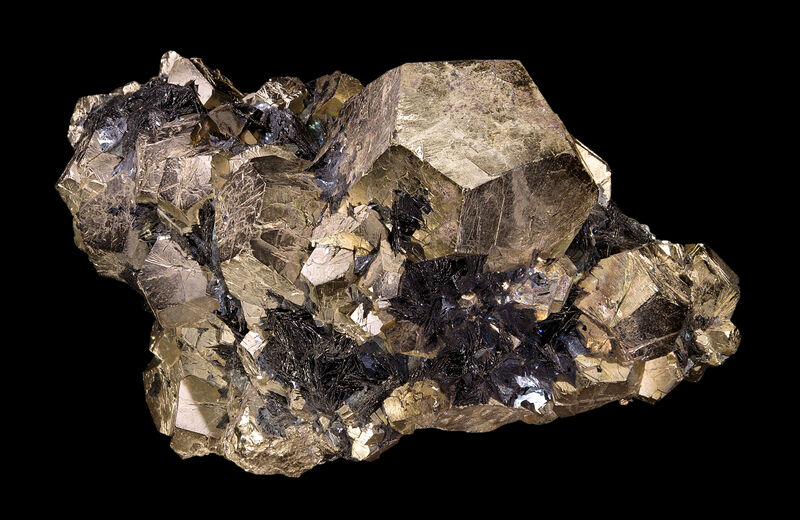
Generally found in grains, sheets, or wires. Dendritic growth is frequent in some mining districts though absent in most worldwide occurrences. Octahedral crystals are much more common than cubic crystals. Dodecahedral crystals are very uncommon and mostly found as distorted dendritic growths. Trapezohedral crystals are of exceptional occurrence. Twinning is not rare in dendritic growths, but dendritic growths are frequently much flattened, but may be expressed as arborescent, filiform, or wire-like. Skeletal crystal development is somewhat rare and mostly observed in octahedral crystals.
- Twinning
Frequently twinned on (111), especially in dendritic or reticulated growths
Chemical composition
Synonyms
- Argentian Gold
- Argentiferous Gold
- Chrysargyrit
- Chrysargyrita
- Chrysargyrite
- Elektrum
- Gold Argentide
- Oroche
Group, growth & confusion
Literature, links & citation
- —Pliny (77A.D.) 33: 23.
- 1944Palache, Charles, Berman, Harry, Frondel, Clifford (1944) The System of Mineralogy (7th ed.) Vol. 1 - Elements, Sulfides, Sulfosalts, Oxides. John Wiley and Sons, New York.
- 1986Alderton, David H. M. (1986) Hessite and electrum from the Ratagain intrusion, north-west Scotland. Mineralogical Magazine, 50 (355) 179 doi:10.1180/minmag.1986.050.355.25 DOI: 10.1180/minmag.1986.050.355.25
- 1986Stoffregen, Roger (1986) Observations on the behavior of gold during supergene oxidation at Summitville, Colorado, U.S.A., and implications for electrum stability in the weathering environment. Applied Geochemistry, 1 (5) 549-558 doi:10.1016/0883-2927(86)90062-4DOI: 10.1016/0883-2927(86)90062-4
- 1987Shikazono, N., Shimizu, M. (1987) The Ag/Au ratio of native gold and electrum and the geochemical environment of gold vein deposits in Japan. Mineralium Deposita, 22 (4) doi:10.1007/bf00204524DOI: 10.1007/bf00204524
Entry last updated
@misc{mineral2025,
  author    = {Mineral Index editorial board},
  title     = {Electrum — Mineral Index},
  year      = {2025},
  url       = {https://mineralindex.org/minerals/electrum-1365}
}