History
Long before stibnite had a name, it had a use. Crushed to a fine powder and mixed into fat, the soft grey crystals became kohl — the eye paint of predynastic Egypt, applied as early as about 3100 BCE. The cosmetic darkened the lashes and rimmed the eye, and the practice spread across the Mediterranean and beyond. The Greek physician Pedanius Dioscorides and the Roman naturalist Pliny the Elder both described how the powder was prepared.
The Romans found another use for it. Stibnite mined in Dacia — roughly modern Romania — was melted into the colourless glass of Roman workshops, a craft that ended when Rome lost the province.
The Greek name for the mineral was stibi, with the variants stimmi and platnopthalmos. Stibi passed into Latin as stibium, the word that medieval and early-modern Europe used for both the mineral and the metal it yielded. In 1430, the alchemist Basil Valentine introduced a second name — spiessglas — and showed that the mineral contained sulphur, the first clear glimpse of its chemistry. Other old labels, antimony glance, antimonite, and stibine, circulated in the European mineralogical literature for centuries afterwards.
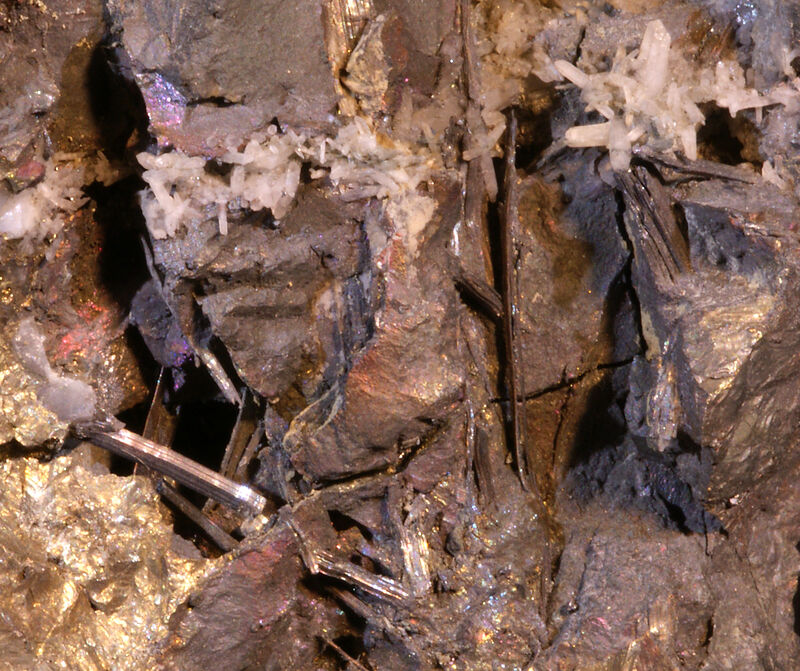
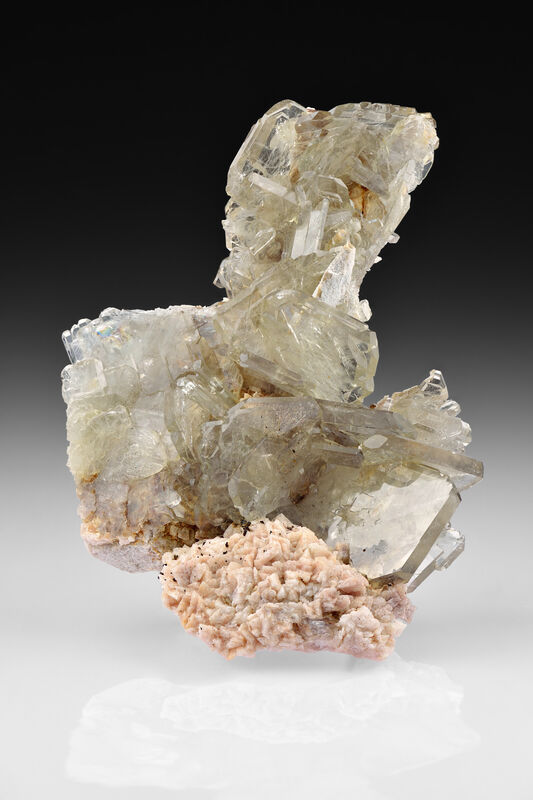
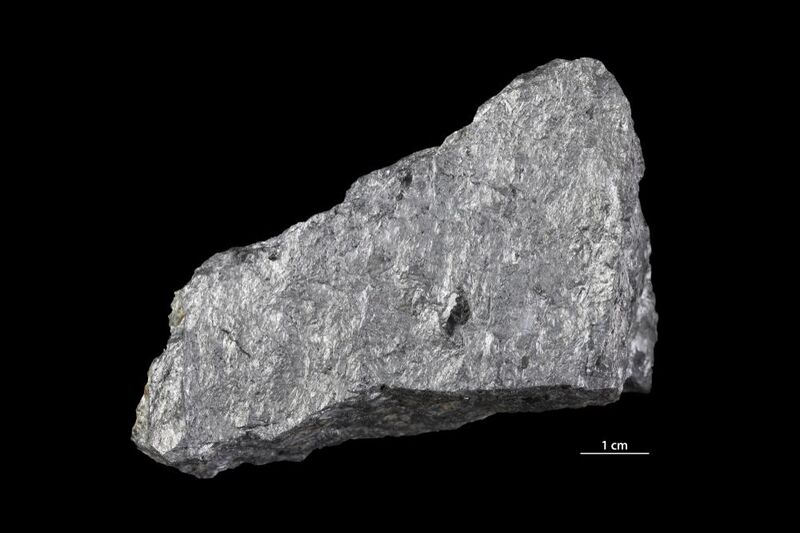
A long way from any of that, miners on the Japanese island of Shikoku had stumbled on antimony at Ichinokawa in 1679. The discovery is credited to Chikanobu Uemonnojo of the Sogabe family. The deposit would prove to hold the most spectacular stibnite crystals ever found. They were bladed prisms with mirror-bright faces, some approaching a metre in length.
The mineral's modern names were settled in the nineteenth century. The Swedish chemist Jöns Jakob Berzelius, devising the system of chemical symbols still in use today, drew the symbol for antimony — Sb — straight from stibium. In 1832, the French mineralogist François Sulpice Beudant gave the mineral itself its current label, stibnite, formed in the new scientific convention from the same Latin root.
Ichinokawa returned to view a generation later. Its bladed specimens were shown at the Kyoto Exhibition of 1871 and at the 1878 Paris World's Fair, where they were awarded silver medals. They reached museums and private collections around the world before the mine closed permanently in 1957.
Industrial & practical applications
Most of the world's stibnite is mined for what is inside it. The mineral is the predominant ore of the metalloid antimony, and almost everything the modern economy does with antimony begins by smelting stibnite.
The largest single use is fire safety. Antimony trioxide — Sb₂O₃, the oxide of antimony — is blended with halogenated compounds, meaning additives that contain chlorine or bromine. The combination makes plastics, textiles, and aircraft cabin materials resistant to flame. By one industry breakdown, flame retardants accounted for around 48% of antimony demand in 2017. Lead-acid batteries took another 33%, and plastics a further 8%.
The battery share points to antimony's second great use. Alloyed at low percentages with lead, the metal hardens the plates of storage batteries — its principal industrial application in metallic form. The same metal also finds use in solders and other alloys.
Stibnite still ships as the mineral itself for a handful of pyrotechnic uses. Needle-like crystals known as Chinese needles go into glitter compositions and white pyrotechnic stars. A darker grade sharpens the report of flash powders, and small quantities reach the heads of modern safety matches. These are the only common applications in which Sb₂S₃ is used directly, rather than first reduced to antimony metal or roasted to the oxide.
The supply side is narrow. In 2022, China accounted for 54.5% of total antimony production worldwide, with Russia second at 18.2%.
Where it forms, where it's found
Physical
Optical
- Optical colour
- white
- Anisotropism
- Strong
- Tropism
- Anisotropic
- Reflectance R%
- (31.1, 53.3) 400, (30.8, 53.2) 420, (30.6, 53.0) 440, (30.7, 52.8) 460, (31.0, 52.2) 480, (31.2, 51.1) 500, (31.4, 49.7) 520, (31.2, 48.5) 540, (30.8, 47.2) 560, (30.3, 45.8) 580, (29.7, 44.5) 600, (29.3, 43.5) 620, (29.2, 42.6) 640, (29.4, 41.8) 660, (29.6, 41.1) 680, (29.4, 40.3) 700
Crystallography
- Cell parameters
- a = 11.234(3) Å · b = 11.314(2) Å · c = 3.837(2) Å
- Ratio a:b:c
- 1 : 1.007 : 0.342
- Z
- 4
- Morphology
Slender to stout crystals
- Twinning
Rare (130)(120)(310)
- Comment
Space Group: P bnm.
Chemical composition
Synonyms
- Alcohol
- Antimonglans
- Antimonglanz
- Antimonio grigio
- Antimonio gris
- Antimonita
- Antimonite
- Antimony Glance
- Estibnita
- Grauspiessglanzerz
- Grauspiessglaserz
- Grey Antimony
- Lupus Metallorum
- Platyophthalmit
- Platyophthalmite
- Spiessglas
- Stibi
- Stibina
- Stibnita
- Stimmi
- Πλατνόφθαλμον
- Στιβι
- Στιμμι
In other languages
- French
- 1345-04-6 · Antimoine gris · Antimoine sulfuré · Mine d'antimoine grise · Mine d'antimoine sulfureuse · Mine d'antimoine sulfurueuse · Platyophthalmite · Sb2S3 · Stibine · Stibnite
- German
- Antimonglanz · Antimonit · Antimonschwarz · Grauspießglanz · Sb2S3 · Schwefelantimon · Spießglas · Stibnit
- Spanish
- antimonita · estibina · estibinita · Sb2S3
- Italian
- antimonite · stibina · stibnite
- Portuguese
- Antimonita · estibina
- Japanese
- 輝安鉱
- Chinese
- 辉锑矿
- Simplified Chinese
- 辉锑矿
- Traditional Chinese
- 輝銻礦
- Russian
- Sb2S3 · антимоний · антимонит · стибнит
- Arabic
- إستبنيت
Classification
2.DB.05
- 2Sulfides and SulfosaltsClass
- 2.DMetal Sulfides, M: S = 3 :4 and 2:3Division
- 2.DBM:S = 2:3Group
- 2.DB.05StibniteSpecies
02.11.02.01
- 02SulfidesClass
- 02.11AmBnXp, with (m+n):p = 2:3Type
- 02.11.02Stibnite Group (Orthorhombic: Pbnm)Group
- 02.11.02.01StibniteSpecies
3.7.14
- 3Sulphides, Selenides, Tellurides, Arsenides and Bismuthides (except the arsenides, antimonides and bismuthides of Cu, Ag and Au, which are included in Section 1)Class
- 3.7Sulphides etc. of V, As, Sb and BiGroup
- 3.7.14StibniteSpecies
Group, growth & confusion
Literature, links & citation
- 1830Beudant, François-Sulpice (1830) Traité élémentaire de minéralogie. Deuxiéme Edition [Elementary Treatise on Mineralogy. Second Edition] (2nd ed.) Vol. 1 - Tome Premier [Volume One]. Chez Verdière.
- 1883Dana, E.S. (1883) On the stibnite from Japan. American Journal of Science: 26: 214-221.
- 1903Hutchinson, A. (1903) On the diathermancy of Antimonite. Mineralogical Magazine and Journal of the Mineralogical Society, 13 (62) 342-347 doi:10.1180/minmag.1903.013.62.09 DOI: 10.1180/minmag.1903.013.62.09
- 1907Hutchinson, A. (1907) The optical characters of Antimonite. Mineralogical Magazine and Journal of the Mineralogical Society, 14 (66) 199-203 doi:10.1180/minmag.1907.014.66.02 DOI: 10.1180/minmag.1907.014.66.02
- 1930Palache, Charles, Modell, David (1930) Crystallography of stibnite and orpiment from Manhattan, Nevada. American Mineralogist, 15 (8) 365-374
Entry last updated
@misc{mineral2026,
  author    = {Mineral Index editorial board},
  title     = {Stibnite — Mineral Index},
  year      = {2026},
  url       = {https://mineralindex.org/minerals/stibnite-3782}
}