Where it forms, where it's found
- Geological setting
Hydrothermal veins.
- Type locality
- Oktyabrsky Mine
- Talnakh Cu-Ni Deposit
- Norilsk-Talnakh Mining Region
- Taimyr Peninsula
- Taymyrskiy Autonomous Okrug
- Krasnoyarsk Krai
- Russia
69.5248°, 88.3401°
6recorded occurrences
Physical
- Hardness
- 1Talc
- 2Gypsum
- 3Calcite
- 4Fluorite
- 5Apatite
- 6Orthoclase
- 7Quartz
- 8Topaz
- 9Corundum
- 10Diamond
- Transparency
- Opaque
- Colour
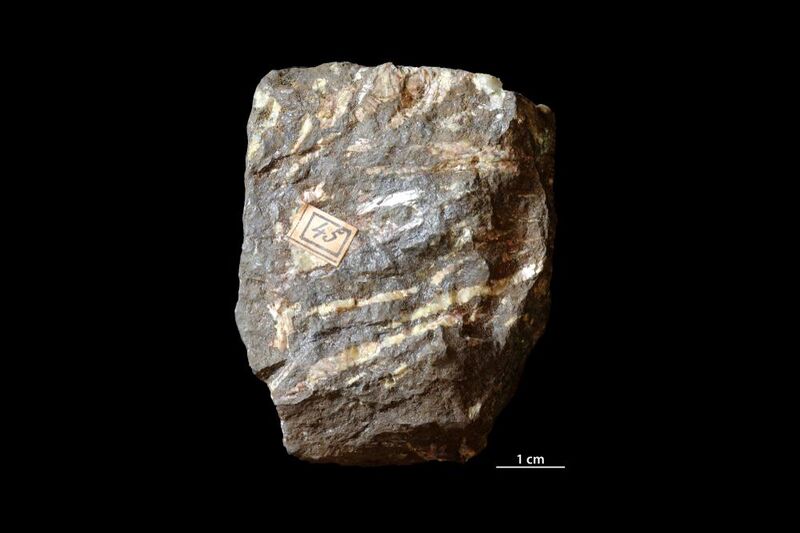
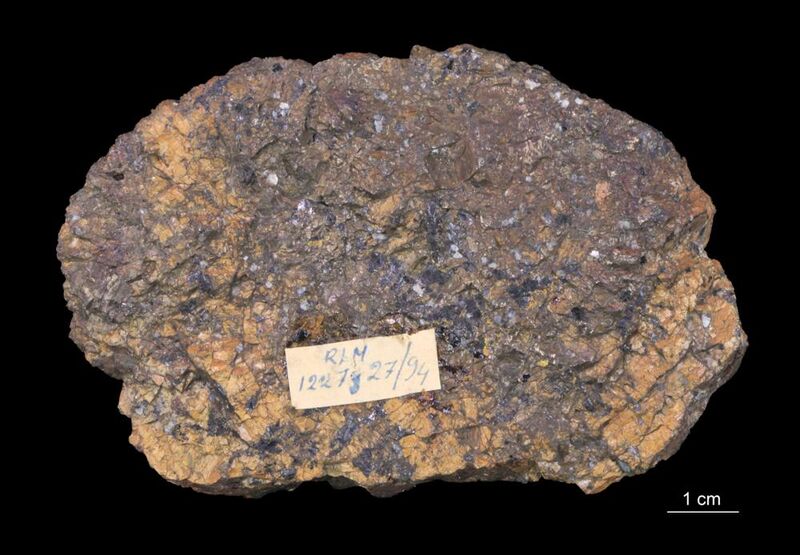
- Bronze-yellow
- Density
- 6.25 g/cm³
Optical
- Pleochroism
- Visible
- Anisotropism
- Weak
- Bireflectance
- Very weak
- Tropism
- Anisotropic
- Reflectance R%
- (37.8) 440, (41.7) 480, (44.8) 520, (47.0) 560, (48.8) 600, (49.6) 640, (50.5) 680, (51.2) 720
Reflected-light panel
R̄ 46.4 %isotropic · single curve
Specimen
White reference
Crystallography
- Space group
- P4/mmm
- Cell parameters
- a = 7.37 Å · c = 5.88 Å
- Z
- 1
- Morphology
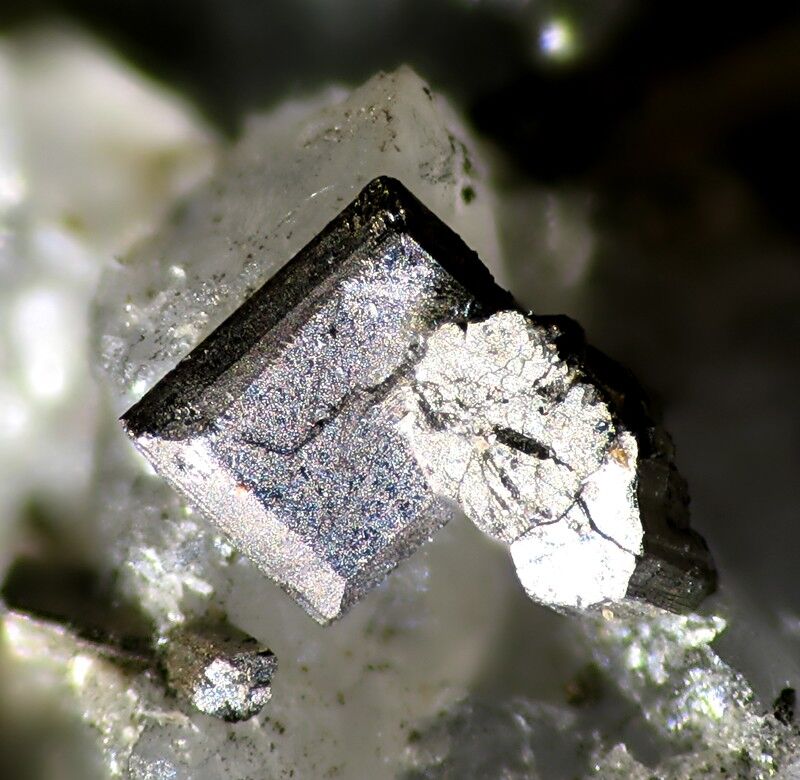
Elongated tabular crystals, grains, massive.
- Type-locality form
Elongated, sometimes tabular, rectangular crystals from 10x30 to 200x700 microns.
Chemical composition
- Impurities
- Fe
- Co
- Pb
- As
Synonyms
- Bismutohauchecorniet
- IMA1978-F
In other languages
- German
- Bismutohauchecornit
- Italian
- Bismutohauchecornite
- Chinese
- 硫双铋镍矿
Classification
Strunz
10th ed.2.BB.10
- 2Sulfides and SulfosaltsClass
- 2.BMetal Sulfides, M: S > 1: 1 (mainly 2: 1)Division
- 2.BBWith NiGroup
- 2.BB.10BismutohauchecorniteSpecies
Dana
8th ed.03.02.05.02
- 03SulfosaltsClass
- 03.02ø = 4Type
- 03.02.05Hauchecornite Group, Complex Ni sulfides (Tetragonal: P4/nnn or I4/mmm)Group
- 03.02.05.02BismutohauchecorniteSpecies
CIM
—5.8.13
- 5Sulphosalts - Sulpharsenites and Sulphobismuthites (those containing Sn, Ge,or V are in Section 6)Class
- 5.8Sulpharsenites etc. of Mn, Fe, Co and NiGroup
- 5.8.13BismutohauchecorniteSpecies
Group, growth & confusion
Literature, links & citation
Citations
- 1975Soeda, A., Hirowatari, F. (1975) On the parageneses and chemical compositions of hauchecornites from the Tsumo and Mihara mines. 1975 Ann. Meeting abstracts, Mineralogical Society of Japan, June, 10-12. Tokyo: 36. (in Japanese)
- 1975Watkinson, D. H., Heslop, J. B., Ewert, W. D. (1975) Nickel sulphide-arsenide assemblages associated with uranium mineralization, Zimmer Lake area, Northern Saskatchewan. The Canadian Mineralogist, 13 (2) 198-204
- 1978Kovalenker, V.A., Evstigneeva, T.L., Begizov, V.D., Vyal'sov, L.N., Smirnov, A.V., Krakovetskii, Y.K. and Balbin, V.S. (1978) Hauchecornite from copper-nickel ores of the Oktyabr'skoe deposit. Trudy Mineralogicheskogo Muzeya Fersman Akademiya Nauk SSSR: 26: 201–205. (in Russian)
- 1980Just, J. (1980) Bismutohauchecornite—new name: hauchecornite redefined. Mineralogical Magazine, 43 (331) 873-876 doi:10.1180/minmag.1980.043.331.08 DOI: 10.1180/minmag.1980.043.331.08
- 1981Fleischer, Michael, Pabst, Adolf (1981) New Mineral Names. American Mineralogist, 66 (3-4) 436-439
Cite this entry
Entry last updated
@misc{mineral2025,
  author    = {Mineral Index editorial board},
  title     = {Bismutohauchecornite — Mineral Index},
  year      = {2025},
  url       = {https://mineralindex.org/minerals/bismutohauchecornite-658}
}