History
Hold a piece of pyrrhotite near a compass and the needle twitches. Among the sulfide minerals — those built around sulfur bonded to a metal — this kind of magnetism is rare, and for a long time it was the property that distinguished pyrrhotite from its more familiar cousin, pyrite.
That cousinship is also why the mineral spent decades without a name of its own. Miners called it magnetic pyrite, grouping it with the brassy iron sulfide pyrite even though it behaved differently. The name acknowledged the resemblance — both are bronze-yellow, both are iron and sulfur — and the resemblance is why early mineralogists struggled to pull the two apart.
The species was first described in 1835, but its modern name came twelve years later. In 1847, the French mineralogist Ours-Pierre-Armand Petit-Dufrénoy coined pyrrhotite from the Greek root for flame-coloured, in reference to the bronze-to-reddish tarnish the mineral develops on exposed surfaces. The naming fits a 19th-century habit of formalising older trade names with the -ite suffix borrowed from Greek.
The reason behind the magnetism took much longer to work out. Pyrrhotite is iron-deficient — its formula Fe₁₋ₓS records the fact that some of the iron sites in the crystal are empty. The remaining iron atoms are not randomly placed. They order themselves around the vacancies, and that ordering leaves an imbalance of magnetic moments that does not cancel out. What 19th-century miners read as a quirk of one variety of iron pyrites was the structural fingerprint of a separate species.
Industrial & practical applications
Pyrrhotite is a poor iron ore — too much sulfur, too little iron — so it is rarely mined for the metal it contains. It is mined for what it travels with. In magmatic sulfide deposits, formed when a sulfide-rich melt separates from a cooling magma, pyrrhotite forms masses. Alongside it sit pentlandite, a nickel-iron sulfide, and chalcopyrite, a copper-iron sulfide. Pentlandite is the world's main source of nickel and cobalt. Stripping the pyrrhotite is how you get to it.
The Sudbury Basin in Ontario is one of the planet's defining examples. The basin is a 1.85-billion-year-old meteorite-impact crater, and pyrrhotite occurs there in masses associated with the copper and nickel mineralisation. Comparable deposits at Norilsk in Russia and the Bushveld complex in South Africa supply much of the world's nickel and platinum-group elements.
The mineral's worst-known appearance, though, is in the foundations of houses. Pyrrhotite-bearing rock cannot be used as concrete aggregate. The iron sulfide it contains reacts with oxygen and water, breaks down into sulfuric acid, and produces secondary minerals — ettringite, thaumasite, gypsum — that occupy more space than the parent grain. The expansion cracks the concrete from inside.
The damage has played out at scale in three regions where local quarries supplied aggregate without screening for pyrrhotite: northeastern Connecticut, Trois-Rivières in Quebec, and County Donegal in Ireland. In northeastern Connecticut alone, as many as 34,000 homes built between 1983 and 2000 may have foundations containing the mineral.
Beyond the mine and the cautionary tale, pyrrhotite is a workhorse of laboratory research into magnetism. It is one of the few naturally magnetic sulfides. The link between its iron-vacancy ordering and its magnetic behaviour makes it a model system for materials science.
Where it forms, where it's found
- Geological setting
Ore deposits.
Varieties
Physical
Optical
- Pleochroism
- Weak
- Anisotropism
- Strong
- Tropism
- Anisotropic
- Reflectance R%
- (27.9,31.0) 400, (28.6,32.2) 420, (29.4,33.6) 440, (30.3,34.8) 460, (31.4,36.2) 480, (32.4,37.6) 500, (33.4,38.6) 520, (34.5,39.6) 540, (35.5,40.4) 560, (36.5,41.2) 580, (37.4,42.0) 600, (38.3,42.6) 620, (39.1,43.0) 640, (39.9,43.5) 660, (40.7,43.9) 680, (41.4,44.1) 700
- Luminescence
- None
- UV response
- Not fluorescent in UV
Crystallography
- Cell parameters
- a = 11.88 Å · b = 6.87 Å · c = 22.79 Å
- Cell angles
- β = 90.47 °
- Ratio a:b:c
- 1 : 0.578 : 1.918
- Morphology
Tabular or platy.
- Twinning
On (102)
- Parting
- Distinct on (0001)
- Epitaxy
Usually, the pyrrhotite is on the galena, but codepositing intergrowths are known. The "six-fold" axis of pyrrhotite is parallel to the three-fold axis (octahedral axis) in galena.
- Comment
There are monoclinic and hexagonal polytypes. Clinopyrrhotite (F2/d) Fe7S8 will give Fe0.87S formula. Hexapyrrhotite (P63/mmc) is Fe1-xS where 0 < x < 0.1.
Chemical composition
- Impurities
- Ni
- Co
- Cu
Synonyms
- Dipyrite (of Readwin)
- Kroeberite
- Magnetic Iron Pyrites
- Magnetic Pyrite
- Magnetic Pyrites
- Magnetischer-Kies
- Magnetkies
- Magnetopirita
- Magnetopyrit
- Magnetopyrite
- Pirita Magnética
- Pyrrhotine
- Pyrrhotit
- Pyrrohotit
- Pyrrohotite
- Vattenkies
In other languages
- French
- Magnétopyrite · Pyrrhotite
- German
- Magnetkies · Magnetopyrit · Pyrrhotin · Pyrrhotit
- Spanish
- pirrotina · pirrotinta · pirrotita
- Italian
- Pirrotina · pirrotite · Pyrrhotite
- Portuguese
- Pirrotita · pirrotite
- Japanese
- 磁硫鉄鉱
- Chinese
- 磁黃鐵礦 · 磁黄铁矿
- Simplified Chinese
- 磁黄铁矿
- Traditional Chinese
- 磁黃鐵礦
- Russian
- Магнитный колчедан · Магнитопирит · Пиротит · Пирротин · Троилит
- Arabic
- بيروتيت · حكار
Classification
2.CC.10
- 2Sulfides and SulfosaltsClass
- 2.CMetal Sulfides, M: S = 1: 1 (and similar)Division
- 2.CCWith Ni, Fe, Co, PGE, etc.Group
- 2.CC.10PyrrhotiteSpecies
02.08.10.01
- 02SulfidesClass
- 02.08AmXp, with m:p = 1:1Type
- 02.08.10— unnamed intermediate level —Group
- 02.08.10.01PyrrhotiteSpecies
3.9.1
- 3Sulphides, Selenides, Tellurides, Arsenides and Bismuthides (except the arsenides, antimonides and bismuthides of Cu, Ag and Au, which are included in Section 1)Class
- 3.9Sulphides etc. of FeGroup
- 3.9.1PyrrhotiteSpecies
Group, growth & confusion
 AltaitePbTeMineral—
 AlthausiteMg4(PO4)2(OH,O)(F,◻)Mineral—
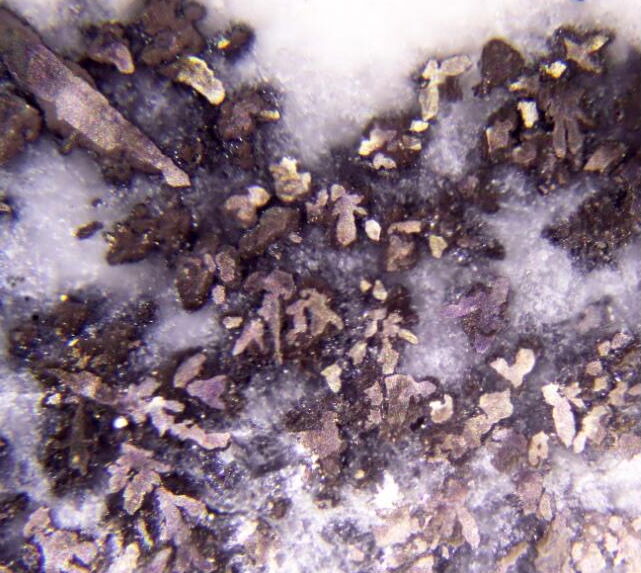 ArgentopentlanditeAg(Fe,Ni)8S8Mineral—
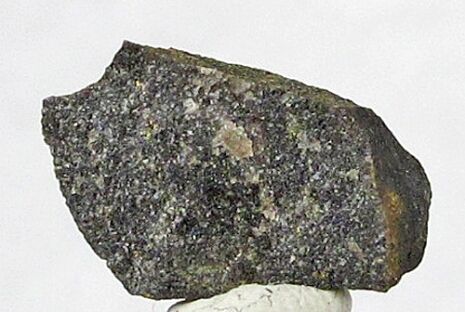 ArsenohauchecorniteNi18Bi3AsS16Mineral—
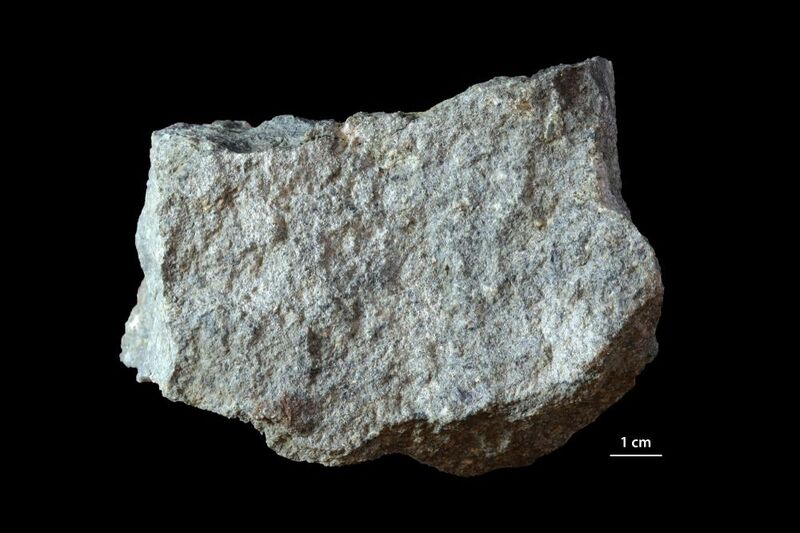 ArsenopyriteFeAsSMineral—
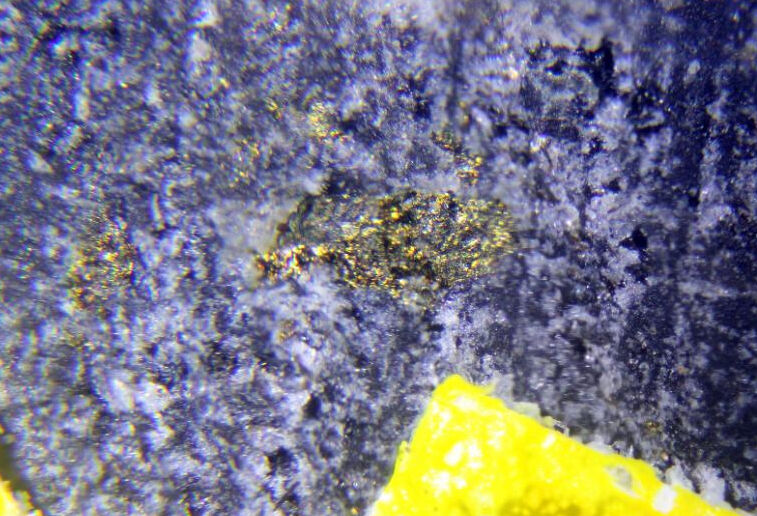 BismutohauchecorniteNi9Bi2S8Mineral—
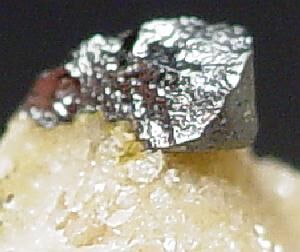 CanfielditeAg8SnS6Mineral—
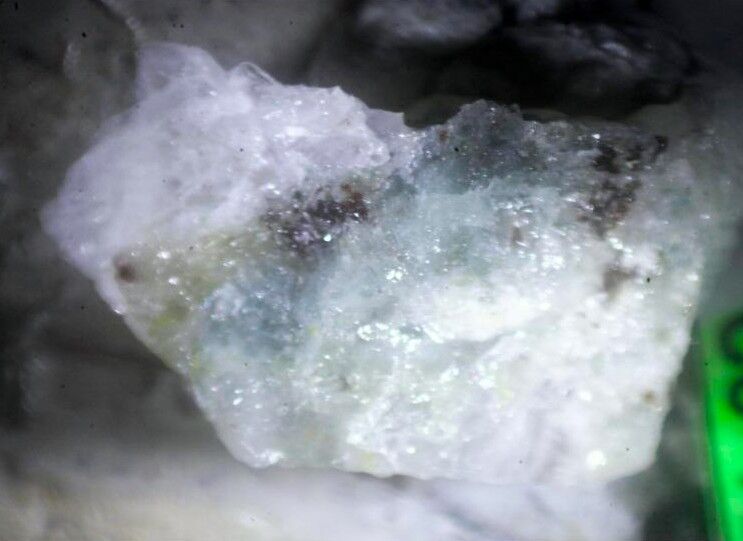 Cerchiaraite-(Al)Ba4Al4(Si4O12)O2(OH)4Cl2[Si2O3(OH)4]Mineral—
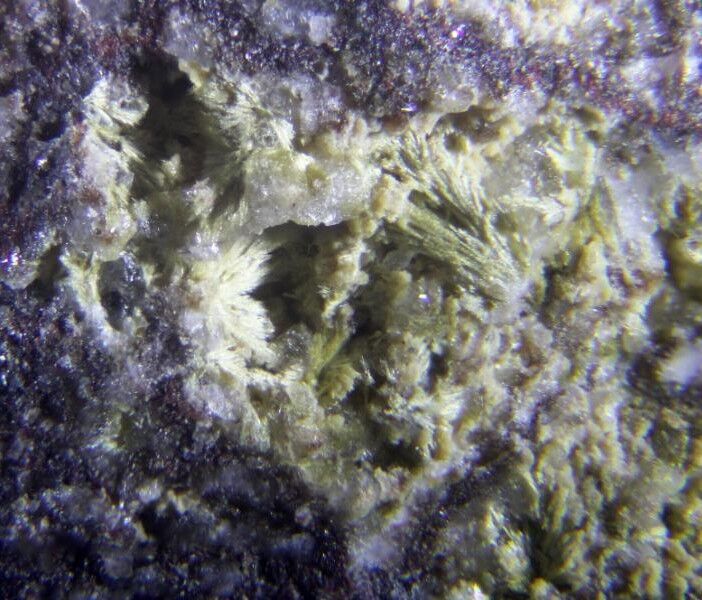 Cerchiaraite-(Fe)Ba4Fe3+4(Si4O12)O2(OH)4Cl2[Si2O3(OH)4]Mineral—
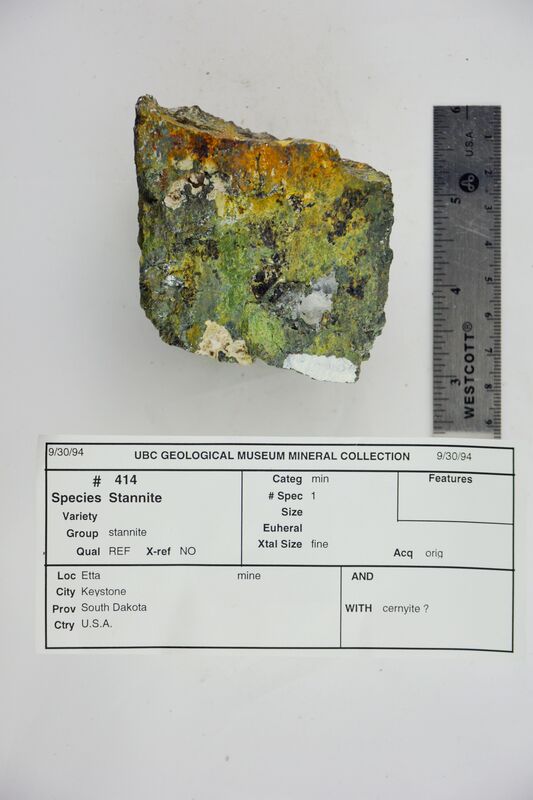 ČernýiteCu2CdSnS4Mineral—
Literature, links & citation
- —Kiskyras, D. A. (1943): Magnetic properties of the minerals of the system FeS-FeS2. Beiträge zur Angewandten Geophysik 10, 308-311.
- 1892Emmens, S. H. (1892) THE CONSTITUTION OF NICKELIFEROUS PYRRHOTITE. Journal Of The American Chemical Society, 14 (10) 369-375 doi:10.1021/ja02123a027DOI: 10.1021/ja02123a027
- 1932Ehrenberg, H. (1932) Orientierte Verwachsungen von Magnetkies und Pentlandit. Zeitschrift für Kristallographie, 82 (1-6). 309-315 doi:10.1524/zkri.1932.82.1.309DOI: 10.1524/zkri.1932.82.1.309
- 1941Heiremann, Fr. (1941) Die isomorphen Beziehungen von Μn, Zn, Co, Ni und Cu zu Pyrit und Magnetkies. Zeitschrift für Kristallographie, 103 (1-6). 168-177 doi:10.1524/zkri.1941.103.1.168DOI: 10.1524/zkri.1941.103.1.168
- 1944Palache, Charles, Berman, Harry, Frondel, Clifford (1944) The System of Mineralogy (7th ed.) Vol. 1 - Elements, Sulfides, Sulfosalts, Oxides. John Wiley and Sons, New York.
Entry last updated
@misc{mineral2026,
  author    = {Mineral Index editorial board},
  title     = {Pyrrhotite — Mineral Index},
  year      = {2026},
  url       = {https://mineralindex.org/minerals/pyrrhotite-3328}
}