History
The name chalcocite comes from the Greek khalkos — copper — and the mineral is, by weight, almost four-fifths copper. That copper content explains why every name the mineral has worn has been a name about copper.
The French mineralogist François Sulpice Beudant first formalised it in 1832, calling it chalcosine. In 1868, James Dwight Dana and George Jarvis Brush renamed it to chalcocite, the spelling that has stuck. Older labels survived into mineralogy textbooks for decades: vitreous copper, copper glance, and redruthite — the last after Redruth in Cornwall, where the mineral had become a familiar sight at the mine face.
In Cornwall
Cornwall is where chalcocite first earned its industrial reputation. From the 1730s, steam engines pumped water out of the deep shafts around Redruth, and the region's copper output climbed. By the 1790s, Cornwall produced three-quarters of all copper mined in Britain, with four of its five most productive mines clustered north and east of Redruth. In the early 19th century the area was supplying two-thirds of the world's copper. Chalcocite was one of the principal ores being pulled out of those workings — abundant enough that the obsolete name redruthite was minted for it on the spot.
In the Americas
A second chapter opened across the Atlantic. In 1798 a farmer named Theophilus Botsford traced a greenish spring at the foot of Zack's Mountain, near Bristol, Connecticut, and uncovered a copper deposit. Commercial mining at the Bristol Copper Mine began in 1837 and ran intermittently until 1953. The crystals it produced — especially during the late 1840s — rivalled the finest from Cornwall and remain prized museum pieces today. Charles M. Wheatley, the mine manager, and the chemist Benjamin Silliman Jr. argued against grinding the best crystals into ore, and the specimens that survive owe their existence to that argument.
The most consequential turn came later. Late in the 19th century, geologists realised that many low-grade copper deposits in the American West and in Chile carried a near-surface blanket of secondary copper sulphides — chalcocite chief among them. Rainwater leaches copper from oxidised ore at the top of a deposit and carries it down to the water table, where it reacts with the deeper sulphides and reprecipitates as chalcocite. The result is an enriched layer, often several times richer than the host rock below. That enrichment is what made the great open-pit porphyry mines — Butte in Montana, Bingham Canyon in Utah, Morenci in Arizona, Chuquicamata in Chile — worth digging at industrial scale around the start of the 20th century.
Industrial & practical applications
Chalcocite is mined today for one reason: copper. Almost four-fifths of its weight — 79.85 % — is the metal itself, which puts it among the richest copper sulphides a mining operation can hope to find. That single fact governs everything else about its current use.
The mineral is extracted as one of the principal ores of copper, alongside chalcopyrite and bornite. It is most economically important where it forms a near-surface enriched blanket above lower-grade primary sulphides — the supergene zone, a layer that rainwater builds at the top of porphyry copper deposits as it leaches copper downward. The great open-pit operations that still draw copper from this kind of geology — Butte in Montana, Morenci in Arizona, Ely in Nevada, Tsumeb in Namibia — are where most chalcocite is mined. From the pit, the ore is crushed and then concentrated by froth flotation, the standard process that uses air bubbles to lift sulphide grains away from waste rock. The concentrate is smelted and electrorefined into the pure copper cathodes that the market trades.
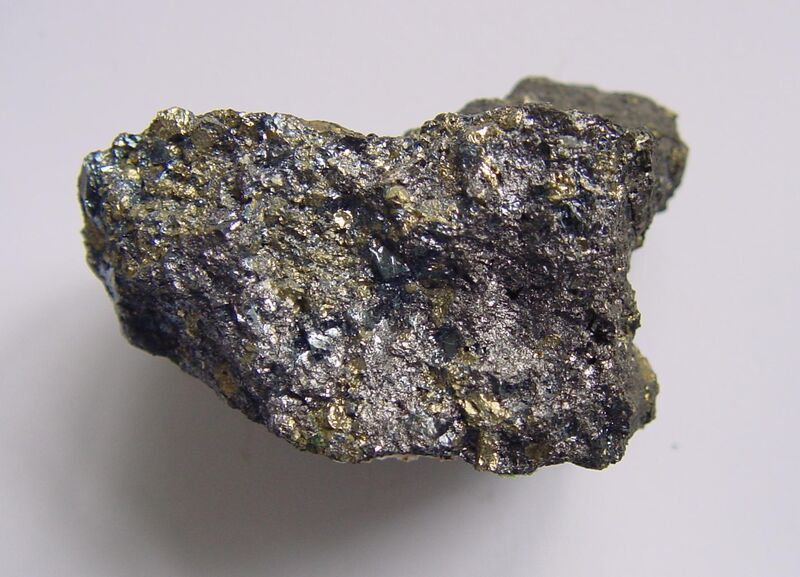
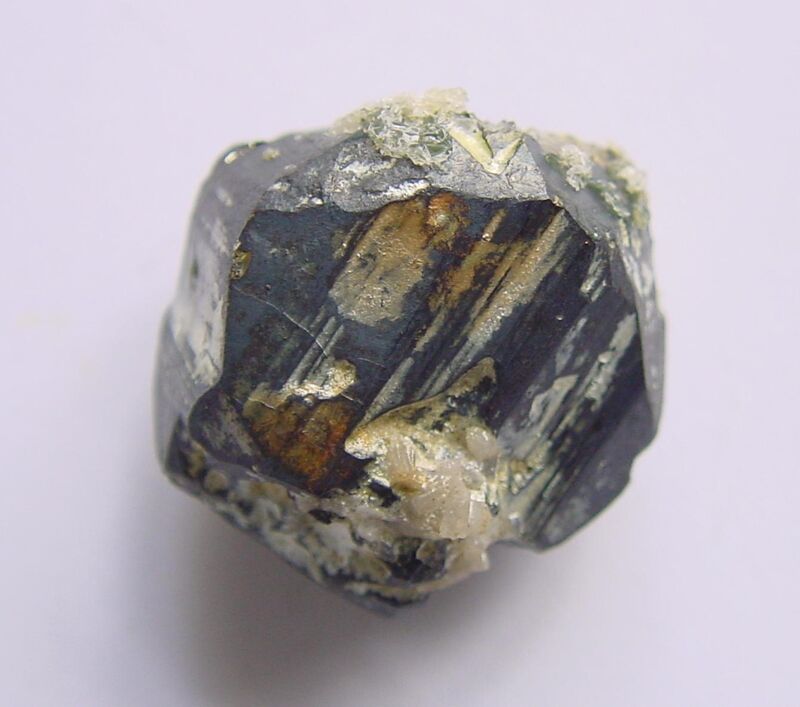
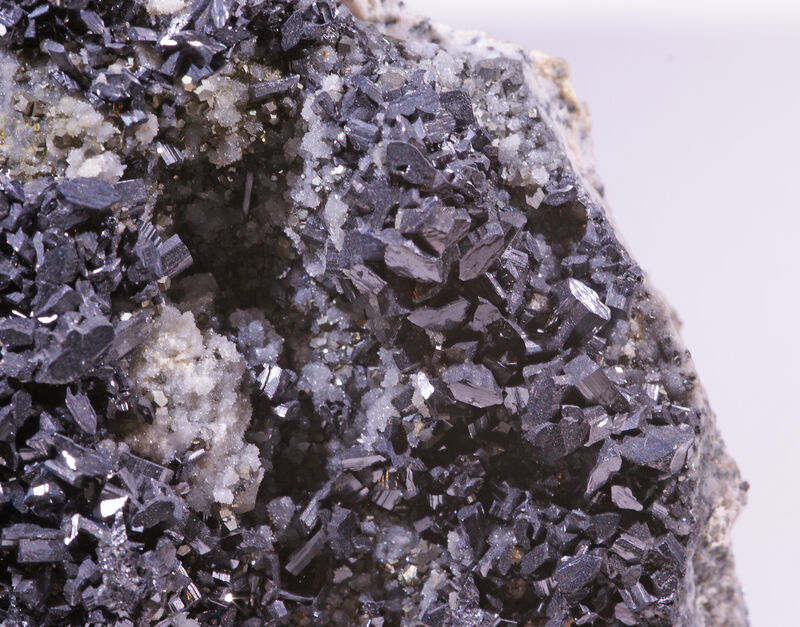
Outside the smelter, chalcocite has a smaller but steady second life as a collector and museum mineral. Well-crystallised specimens — most famously from Cornwall and from the Bristol mine in Connecticut — are sought after for their sharp, often twinned, dark-grey crystals.
Where it forms, where it's found
Varieties
Physical
- Hardness
- 1Talc
- 2Gypsum
- 3Calcite
- 4Fluorite
- 5Apatite
- 6Orthoclase
- 7Quartz
- 8Topaz
- 9Corundum
- 10Diamond
- Lustre
- Metallic
- Transparency
- Opaque
- Colour
- Blue black · gray · black · black gray · or steel gray
- Streak
- Blackish lead gray
- Tenacity
- brittle
- Cleavage
- Poor/Indistinct
Indistinct on (110)
Somewhat sectile
- Fracture
- Conchoidal
- Density
- 5.5 g/cm³
Optical
- Anisotropism
- Weak
- Tropism
- Anisotropic
- Reflectance R%
- (37.0,36.8) 400, (37.8,37.4) 420, (37.7,37.6) 440, (37.0,37.2) 460, (36.2,36.2) 480, (35.6,35.4) 500, (34.7,34.4) 520, (33.7,33.5) 540, (32.5,32.5) 560, (32.1,31.8) 580, (31.3,31.2) 600, (30.8,30.7) 620, (30.0,30.0) 640, (29.5,30.0) 660, (29.2,29.7) 680, (29.0,29.6) 700
- Luminescence
- None
- UV response
- Not fluorescent in UV
Crystallography
- Space group
- P21/c
- Cell parameters
- a = 15.246(4) Å · b = 11.884(2) Å · c = 13.494(3) Å
- Cell angles
- β = 116.35(1) °
- Ratio a:b:c
- 1 : 0.779 : 0.885
- Z
- 48
- Twinning
Common on (110) yielding pseudohexagonal stellate forms. Also on (032), (112).
- Comment
May be point group m and space group Pc; other monoclinic cell given: a = 11.82, b = 27.05, c = 13.43, β = 90°.
Chemical composition
Synonyms
- Aes cyprium apud plinium appellatur cuprum
- Aes rude plumbei coloris
- Chalcocine
- Chalcosin
- Chalcosine
- Chalcosit
- Chalcosite
- Chalkozit
- Copper Glance
- Cuivre Spiciforme
- Cuivre Sulfuré Spiciforme
- Cuivre Vitreux
- Cuprein
- Cupreine
- Cyprit
- Cyprite
- Kobberglans
- Koppar-Glas (of Wallerius)
- Kupferglanz
- Kupferglanz-β
- Kupferglasertz
- Kupferglaserz
- Kuprein
- Lecherz
- Low chalcocite
- Rame grigio
- Redruthit
- Redruthite
- Vitreous Copper
In other languages
- French
- chalcocite
- German
- Chalkosin · Kupferglanz · Kupferglas
- Spanish
- calcosina
- Italian
- calcocite
- Portuguese
- calcocita
- Japanese
- 輝銅鉱
- Chinese
- 輝銅礦
- Russian
- Халькозин
- Arabic
- كالكوسيت
Classification
2.BA.05
- 2Sulfides and SulfosaltsClass
- 2.BMetal Sulfides, M: S > 1: 1 (mainly 2: 1)Division
- 2.BAWith Cu, Ag, AuGroup
- 2.BA.05ChalcociteSpecies
02.04.07.01
- 02SulfidesClass
- 02.04AmBnXp, with (m+n):p = 2:1Type
- 02.04.07Chalcocite Group ([Cu]2-x S] formulae)Group
- 02.04.07.01ChalcociteSpecies
3.1.1
- 3Sulphides, Selenides, Tellurides, Arsenides and Bismuthides (except the arsenides, antimonides and bismuthides of Cu, Ag and Au, which are included in Section 1)Class
- 3.1Sulphides etc. of CuGroup
- 3.1.1ChalcociteSpecies
Group, growth & confusion
 AzuriteCu3(CO3)2(OH)2Mineral—
 BalkaniteAg5Cu9HgS8Mineral—
 DigeniteCu1.8SMineral—
 DjurleiteCu31S16Mineral—
 EnargiteCu3AsS4Mineral—
 GalliteCuGaS2Mineral—
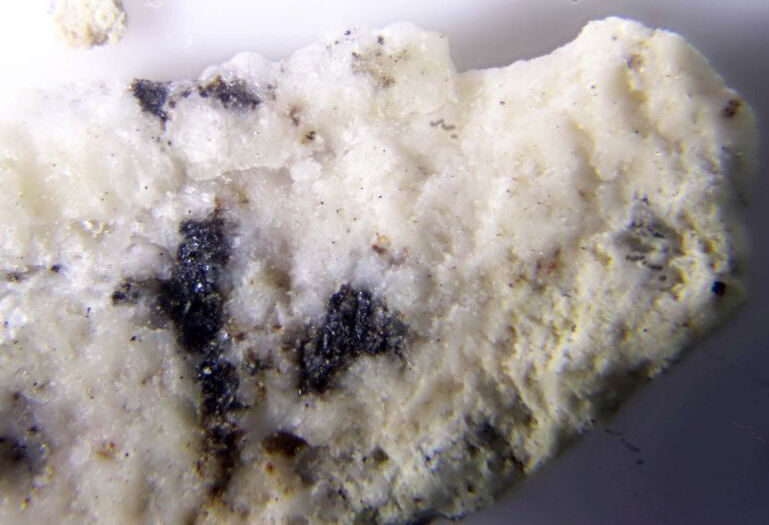 HarkeriteCa48Mg16[AlSi4O15(OH)]4(BO3)16(CO3)16 · 2(H2O,HCl)Mineral—
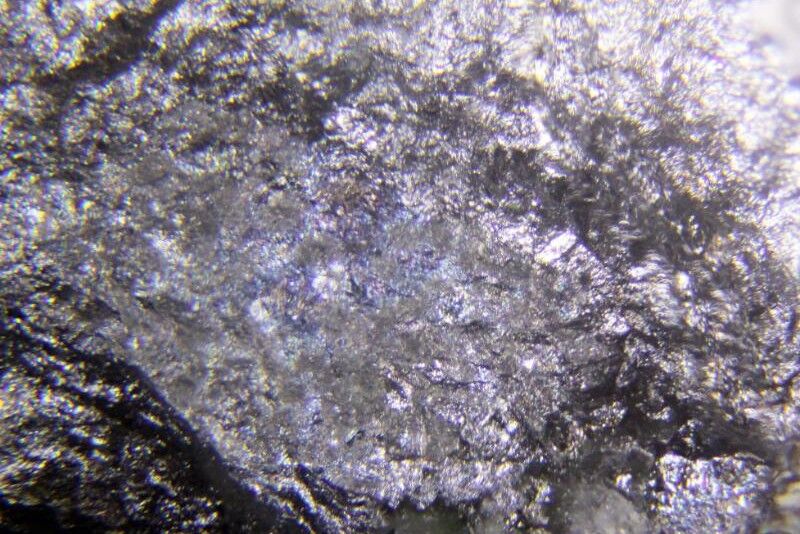 KoutekiteCu5As2Mineral—
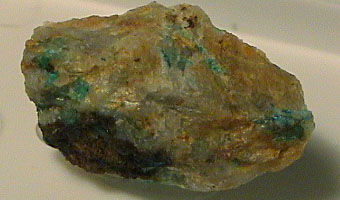 MrázekiteBi2Cu3(PO4)2O2(OH)2 · 2H2OMineral—
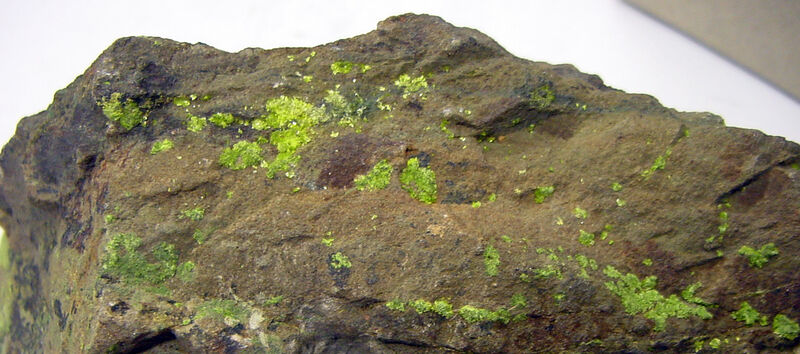 TangeiteCaCu(VO4)(OH)Mineral—
Literature, links & citation
- 1928Schwartz, George Melvin (1928) Experiments bearing on bornite-chalcocite intergrowths. Economic Geology, 23 (4) 381-397 doi:10.2113/gsecongeo.23.4.381DOI: 10.2113/gsecongeo.23.4.381
- 1929Bateman, Alan Mara (1929) Some covellite-chalcocite relationships. Economic Geology, 24 (4) 424-439 doi:10.2113/gsecongeo.24.4.424DOI: 10.2113/gsecongeo.24.4.424
- 1932Bateman, Alan Mara, Lasky, Samuel Grossman (1932) Covellite-chalcocite soild solution and exsolution. Economic Geology, 27 (1) 52-86 doi:10.2113/gsecongeo.27.1.52DOI: 10.2113/gsecongeo.27.1.52
- 1939Schwartz, George Melvin (1939) Significance of bornite-chalcocite microtextures. Economic Geology, 34 (4) 399-418 doi:10.2113/gsecongeo.34.4.399DOI: 10.2113/gsecongeo.34.4.399
- 1944Buerger, M. J., Buerger, Newton W. (1944) Low-chalcocite and high-chalcocite. American Mineralogist, 29 (1-2) 55-65
Entry last updated
@misc{mineral2026,
  author    = {Mineral Index editorial board},
  title     = {Chalcocite — Mineral Index},
  year      = {2026},
  url       = {https://mineralindex.org/minerals/chalcocite-962}
}