History
The mineral's name carries the memory of a volcano. The first specimens of covellite came out of Mount Vesuvius, and the indigo crystals were studied there by an Italian who never lived to see them carry his name.
Nicola Covelli (1790–1829) was a professor of botany and chemistry, but his real preoccupation was geology — and above all the eruptions of Vesuvius. He worked through the volcano's lava, picking out unfamiliar minerals as he went. Several new species turned up in those studies. Covellite was one of them.
The formal naming came three years after Covelli's death. In 1832, the French mineralogist François Sulpice Beudant published the name in honor of his late Italian colleague. By convention of the time, Beudant used Covelli's surname with the -ite suffix that nineteenth-century mineralogy was making standard. The type locality stayed Vesuvius, where the original crystals had been picked out of fumarolic deposits — the encrusted vents through which a volcano breathes out gas.
Industrial & practical applications
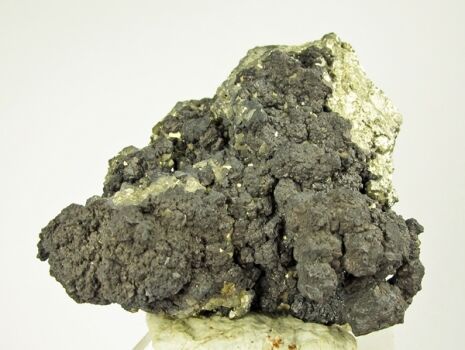
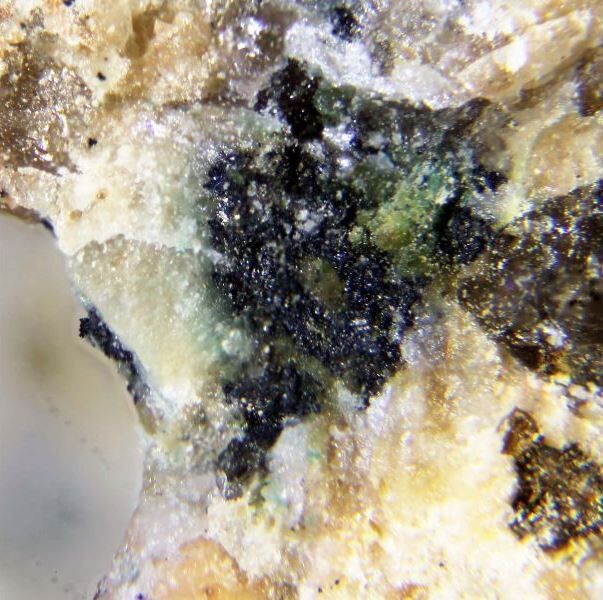
Covellite is mined as a copper ore — sometimes as a major one, more often as a lesser contributor alongside the other copper sulfides it travels with. Its industrial weight depends on where it sits in a deposit. The mineral is typically a secondary phase, formed in zones of supergene enrichment — the near-surface reworking of primary copper sulfides by descending oxygen-rich water. In that process, copper is leached from rock above and re-deposited as a richer blanket below. The blanket commonly coats earlier sulfides — chalcocite, chalcopyrite, bornite, enargite, pyrite. The covellite goes into the smelter with them, rather than as a stand-alone target.
Outside the mine, covellite is studied for a clutch of physical properties that have little to do with copper supply. It is a superconductor — a material that conducts electricity with no resistance — below a critical temperature of 1.6 K, close to absolute zero. It is also a fast electrical conductor at room temperature, at 10×10⁻³ siemens per centimetre. That conductivity has drawn battery researchers, who are testing covellite as a lithium-ion electrode with a theoretical capacity of 560 milliampere-hours per gram.
A third line of research uses covellite at the nanoscale. Particles a few tens of nanometres across show localized surface plasmon resonances — collective oscillations of the particle's free electrons in response to light. The band gap that controls those resonances shifts with how the copper-to-sulfur ratio is tuned during synthesis. That tunability is what makes covellite nanoplatelets and nanocrystals attractive to the optics and photonics laboratories now exploring them.
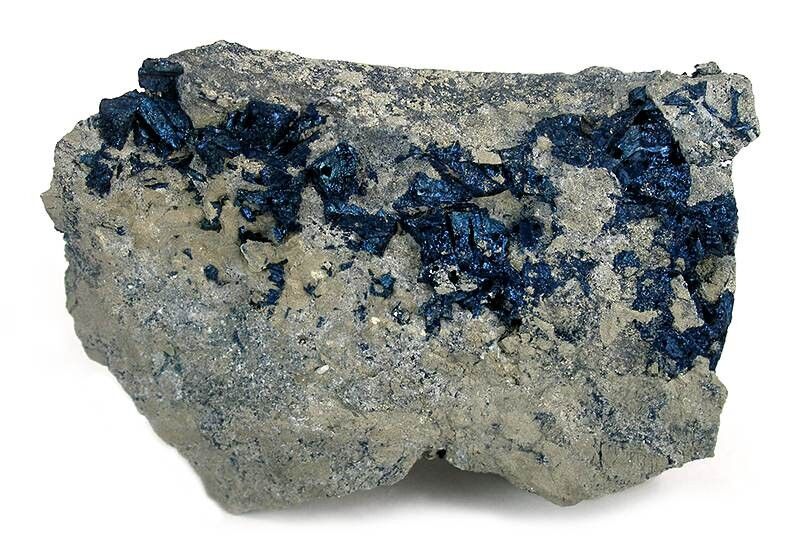
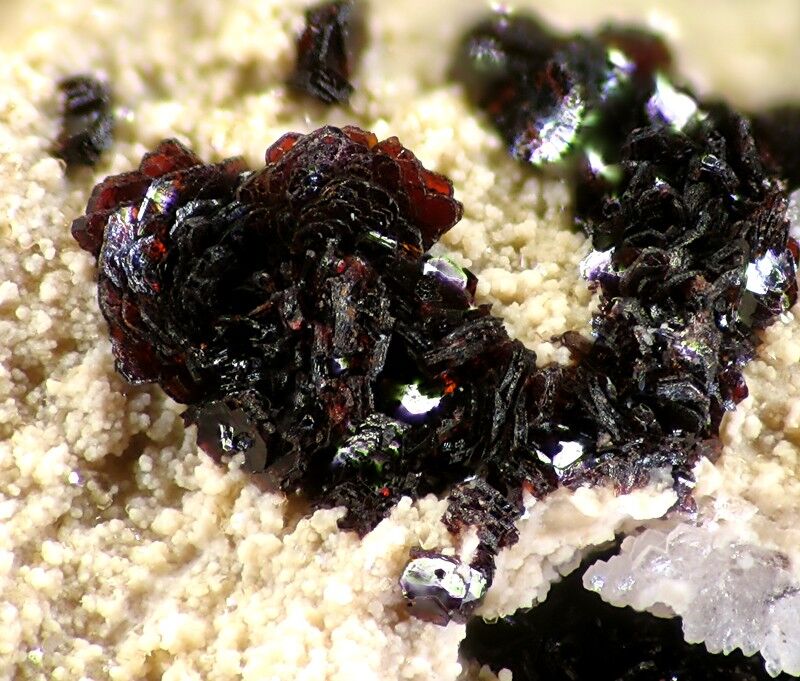
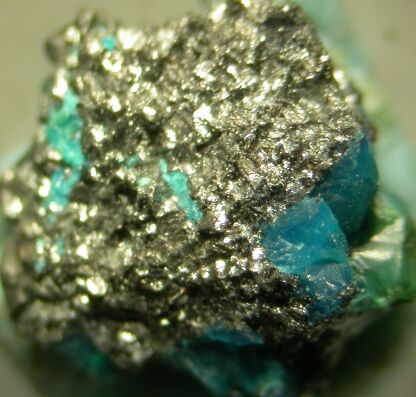
Beyond all of that, covellite has a steady demand it has never lost. Its indigo-blue colour, often broken across the crystal face into brassy and red iridescence, makes it sought after by mineral collectors.
Where it forms, where it's found
- Geological setting
Igneous extrusive, as a volcanic sublimate on Mount Vesuvius.
Usually found as a secondary copper mineral in copper deposits, more rarely as a primary mineral of such deposits, and only very rarely as a volcanic sublimate (such as at Mount Vesuvius.)
- Type locality
- Mount Vesuvius
- Metropolitan City of Naples
- Campania
- Italy
Physical
- Hardness
- 1Talc
- 2Gypsum
- 3Calcite
- 4Fluorite
- 5Apatite
- 6Orthoclase
- 7Quartz
- 8Topaz
- 9Corundum
- 10Diamond
- Lustre
- Sub-Metallic
- Transparency
- Opaque
- Colour
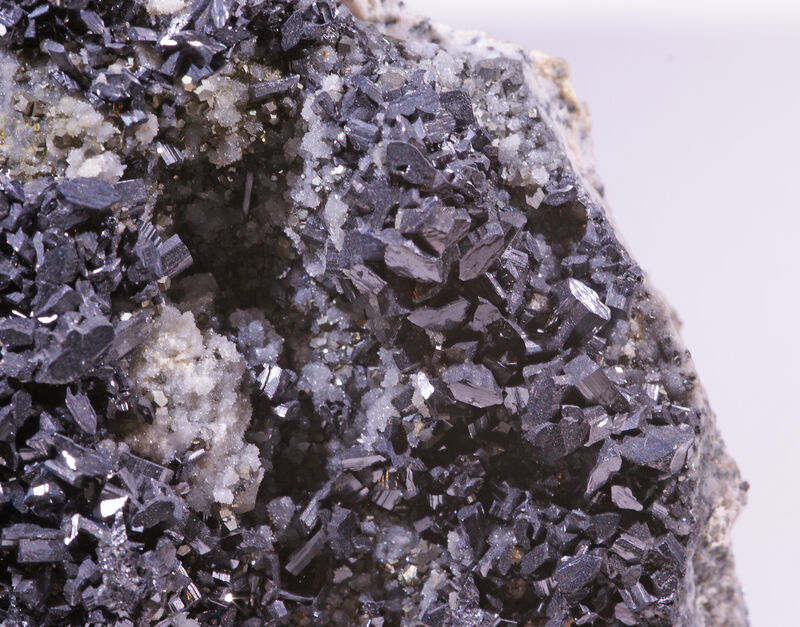
- Indigo-blue or darker · inclining towards blue-black · often iridescent with purplish · deep red · and brassy-yellow reflections.
- Streak
- Shiny metallic, lead-grey to black
- Tenacity
- flexible
- Cleavage
- Perfect
Perfect on (0001).
- Fracture
- Irregular/Uneven · Hackly
- Density
- 4.6 g/cm³
Optical
- Optical type
- Uniaxial (+)
- Refractive index
- 1.45 – 2.62
- Surface relief
- Very high
- Principal indices
- nω 1.45 · nε 2.62
- Pleochroism
- Visible
Deep blue to blue-white
- Dispersion
- Strong
- Anisotropism
- Strong
- Tropism
- Anisotropic
- Reflectance R%
- (14.5,32.0) 400, (14.7,31.5) 420, (14.3,30.3) 440, (13.3,29.0) 460, (11.7,27.6) 480, (10.1,26.2) 500, (8.5,24.7) 520, (6.9,23.4) 540, (5.5,22.1) 560, (4.2,21.1) 580, (3.3,21.1) 600, (3.3,21.6) 620, (4.9,22.3) 640, (9.8,22.7) 660, (16.4,22.6) 680, (24.9,22.4) 700
- Luminescence
- None
Crystallography
- Space group
- #126
- Cell parameters
- a = 3.7938 Å · c = 16.341 Å
- Unit cell volume
- 203.7 ų
- Z
- 6
- Morphology
Hexagonal plates (001), with pyramidal faces striated horizontally and hexagonal striations on the base. Common forms: (001), (104), (103), (308), (102), {9/0/16}, {5.08}, (101) and (201). Less common to rare: {1.0.16}, {1.0.12}, {3.0.32}, (108), (106), {3.0.16}, (105), (205), (203), (304), {15.0.16} and (908).
- Twinning
None reported.
Chemical composition
- Impurities
- Fe
- Se
- Ag
- Pb
Synonyms
- Blaues Kupferglas
- Blue Copper
- Breithauptite (of Chapman)
- Copper Indigo
- Covelita
- Covelline
- Covellinit
- Covellinita
- Covellinite
- Covellonit
- Covellonita
- Covellonite
- Indigo Copper
- Kupferindig
In other languages
- French
- Cantonite · Coveline · Covelline · Covellinite · covellite · Covellonite
- German
- Blaues Kupferglas · Covellin · Covellinit · Covellit · Covellonit · Kupferindig
- Spanish
- Covelina · Covelita · Covellina
- Italian
- covellite
- Japanese
- コベリン · 銅藍
- Chinese
- 銅藍 · 靛铜矿
- Simplified Chinese
- 铜蓝
- Traditional Chinese
- 銅藍
- Russian
- Ковеллин · Ковеллит
- Arabic
- كوفيلليت · كوفيليت
Classification
2.CA.05a
- 2Sulfides and SulfosaltsClass
- 2.CMetal Sulfides, M: S = 1: 1 (and similar)Division
- 2.CAWith CuGroup
- 2.CA.05aCovelliteSpecies
02.08.12.01
- 02SulfidesClass
- 02.08AmXp, with m:p = 1:1Type
- 02.08.12Covellite GroupGroup
- 02.08.12.01CovelliteSpecies
3.1.8
- 3Sulphides, Selenides, Tellurides, Arsenides and Bismuthides (except the arsenides, antimonides and bismuthides of Cu, Ag and Au, which are included in Section 1)Class
- 3.1Sulphides etc. of CuGroup
- 3.1.8CovelliteSpecies
Group, growth & confusion
Literature, links & citation
- 1815Freiesleben (1815) 3: 129 (as Blaues Kupferglas).
- 1817Breithaupt (1817) In: Hoffmann: 4b: 178 (as Kupferindig).
- 1826Vesuve (1826) Ann. Chim. Vol. XXXV, 105-111, Paris.
- 1827Covelli, N. (1827) Sur le Bisulfure de Cuivre qui se forme actuellement dans le
- 1827Covelli., N. (1827) Über das gegenwärtig am Vesuv sich bildende Doppelt-Schwefelkupfer, Annalen der Physik und Chemie: 86: 494-498.
Entry last updated
@misc{mineral2026,
  author    = {Mineral Index editorial board},
  title     = {Covellite — Mineral Index},
  year      = {2026},
  url       = {https://mineralindex.org/minerals/covellite-1144}
}