Where it forms, where it's found
- Geological setting
Usually of hydrothermal origin in conjunction with veins, derived in part from the alteration of aluminosilicate minerals; also occurs as an authigenic sedimentary phase.
- Type locality
- Pant-y-Gaseg Mine
- Amlwch
- Isle of Anglesey
- Wales
- UK
53.4231°, -4.3901°
735recorded occurrences
Physical
Optical
- Optical type
- Biaxial (+) · 2V measured = 50 – 80° · 2V calc = 72 – 80°
- Refractive index
- 1.5608 – 1.57
- Surface relief
- Moderate
- Principal indices
- nα 1.5608 – 1.564 · nβ 1.561 – 1.566 · nγ 1.566 – 1.570
- Dispersion
- none
Δ = 0Δmax
PPLpleochroism per grain
XPLindependent extinctions · rotate the stage
PPLpleochroism only · colour blends on rotation
XPLinterference colour · extinct every 90°
Retardation56 nm
Order1st order
XPL colour
Crystallography
- Cell parameters
- a = 5.150 Å · b = 8.940 Å · c = 14.424 Å
- Cell angles
- β = 96.8 °
- Ratio a:b:c
- 1 : 1.736 : 2.801
- Z
- 4
- Morphology
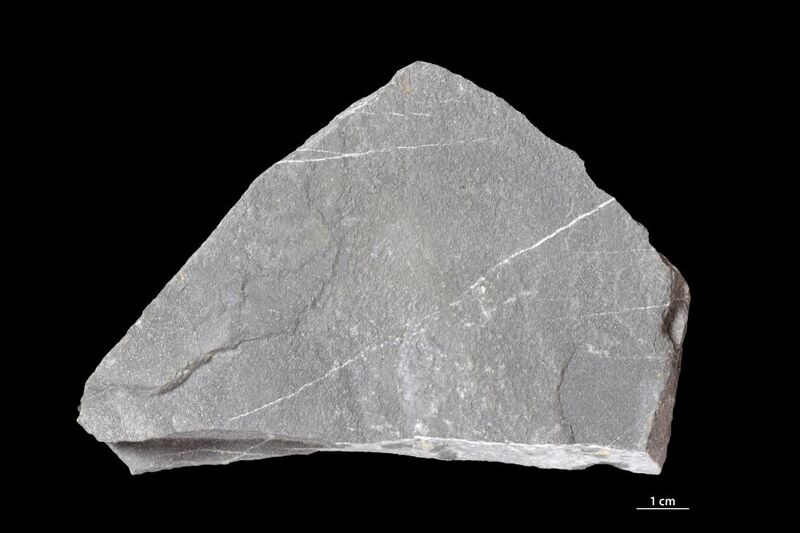
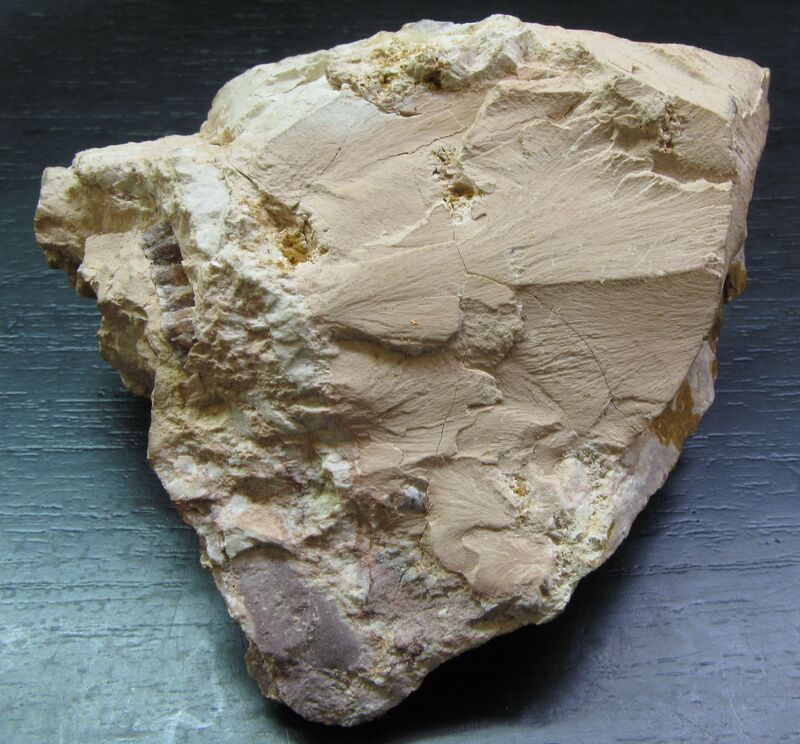
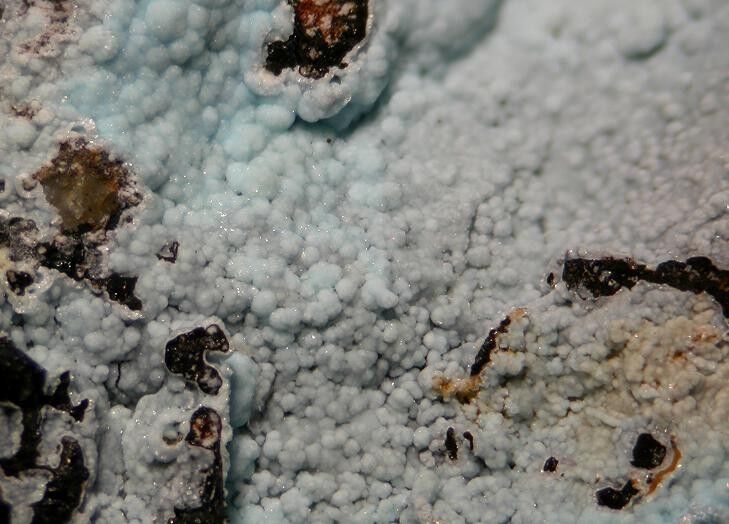
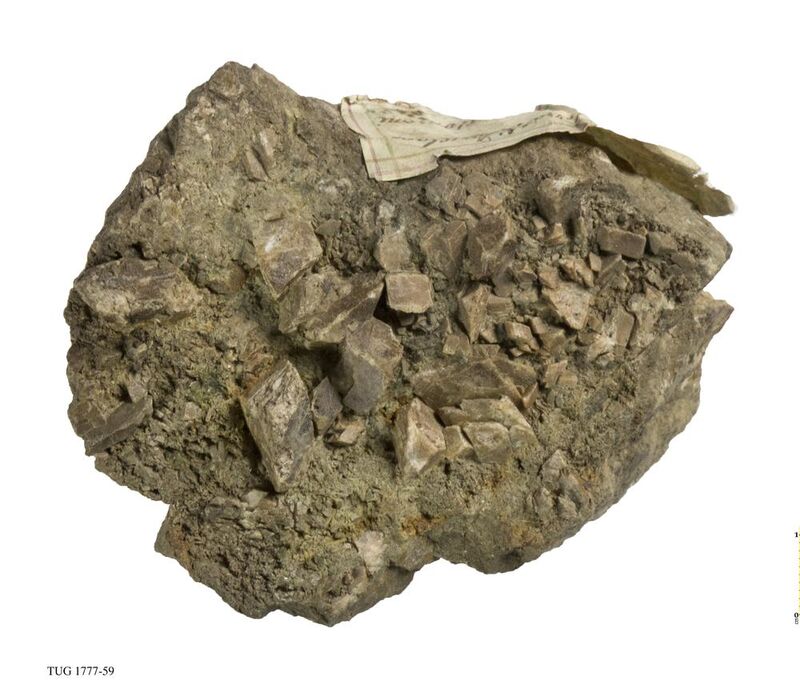
Crystals pseudohexagonal, elongated [100] at times. As aggregates of platelets resembling books. Masses of microscopic crystals.
Crystal structure
Chemical composition
- Impurities
- Ti
- Fe
- Mg
- Ca
- Na
- K
In other languages
- French
- Dickite
- German
- Dickit
- Spanish
- Dickita · Piedra Changhua · Piedra Gaoshan
- Italian
- Dickite
- Chinese
- 地开石 · 地開石 · 狄克石 · 迪开石
- Simplified Chinese
- 迪开石
- Traditional Chinese
- 迪開石
Classification
Strunz
10th ed.9.ED.05
- 9SilicatesClass
- 9.EPhyllosilicatesDivision
- 9.EDPhyllosilicates with kaolinite layers composed of tetrahedral and octahedral netsGroup
- 9.ED.05DickiteSpecies
Dana
8th ed.71.01.01.01
- 71Phyllosilicates Sheets of Six-membered RingsClass
- 71.01Sheets of 6-membered rings with 1:1 layersType
- 71.01.01Kaolinite groupGroup
- 71.01.01.01DickiteSpecies
CIM
—15.6
- 15Silicates of AluminumClass
- 15.6— unnamed intermediate level —Group
- 15.6DickiteSpecies
Group, growth & confusion
Literature, links & citation
Citations
- 1930Ross, Clarence S., Kerr, Paul F. (1930) Dickite, a kaolin mineral. American Mineralogist, 15 (1) 34-39
- 1932Gruner, John W. (1932) The Crystal Structure of Dickite. Zeitschrift für Kristallographie, 83 (1). 394-404 doi:10.1524/zkri.1932.83.1.394DOI: 10.1524/zkri.1932.83.1.394
- 1953Grim, R.E. (1953) Clay Mineralogy. McGraw Hill: 370.
- 1961Newnham, Robert E. (1961) A refinement of the dickite structure and some remarks on polymorphism in kaolin minerals. Mineralogical Magazine and Journal of the Mineralogical Society, 32 (252) 683-704 doi:10.1180/minmag.1961.032.252.03 DOI: 10.1180/minmag.1961.032.252.03
- 1963Bailey, S. W. (1963) Polymorphism of the kaolin minerals. American Mineralogist, 48 (11-12) 1196-1209
Cite this entry
Entry last updated
@misc{mineral2026,
  author    = {Mineral Index editorial board},
  title     = {Dickite — Mineral Index},
  year      = {2026},
  url       = {https://mineralindex.org/minerals/dickite-1287}
}