History
The name comes from a hill. Kaolinite — the white clay mineral behind porcelain — is named after Kao-ling, a ridge in southern China that was mined for the raw material for centuries. The Chinese term means "high ridge".
Long before chemists had a name for the mineral itself, the clay it forms was prized for making fine porcelain. The clay took the place name of its source. In 1637 the Chinese scholar Song Yingxing recorded the name for the type locality, Kaoling, meaning high ridge.
The word reached Europe through the porcelain trade. It was borrowed into English in 1727, from the 1712 French reports of the Jesuit missionary François Xavier d'Entrecolles. He had described how the kilns at Jingdezhen made their porcelain. For two centuries "kaolin" named the clay, not a single mineral.
The mineral species itself was formalised later. In 1867 the American chemists Samuel William Johnson and James Manning Blake published On Kaolinite and pholerite in the American Journal of Science, separating the clay's dominant pure mineral and giving it the standard mineralogical name with the -ite suffix. That distinction still holds today: kaolinite is the mineral species; kaolin is the rock — the workable clay, also called china clay — that kaolinite dominates.
Industrial & practical applications
Open a glossy magazine and you are holding kaolinite. About 40 percent of all mined kaolin goes into the filling and coating of paper. As a filler, the clay is mixed into the cellulose fibre and becomes part of the sheet, giving it body, colour, opacity, and printability.
As a coating, it is spread with an adhesive across the paper's surface for gloss, opacity, and sharper printing. For coating, the clay is ground so finely that most particles are under two micrometres across — about a fortieth of the width of a human hair. Coating can make up a quarter of a sheet's weight; filler, about a sixth.
The second great use is ceramics. Kaolin fires white and melts only at high temperatures. That suits it to whiteware — the everyday name for china — along with porcelain and refractories, the heat-resistant materials that line furnaces. In a whiteware body the clay is blended with roughly equal amounts of silica and feldspar, plus a smaller share of a plastic, light-burning clay called ball clay. Kaolin can account for up to half the raw material in a whiteware mix.
The same fine white particles work as a cheap, inert filler elsewhere. Kaolin is mixed into rubber to improve its mechanical strength and resistance to abrasion. In paints it serves as an extender and a flattening agent, the additive that dulls an otherwise glossy finish. It is also a filler in plastics.
Medicine and cosmetics take the purest grades. Kaolin-based preparations are used to treat diarrhea. A kaolinite-derived material is woven into gauze to speed blood clotting. The United States Naval Medical Research Institute reported its successful use this way in 2008. In cosmetics the clay is a filler in facial masks and soap.
Paper, ceramics, and paint dominate the market: in 2016 they took 36, 31, and 7 percent of demand, the rest spread across other uses. Global kaolin production was estimated at about 45 million tonnes in 2021.
Where it forms, where it's found
- Geological setting
A primary constiuent of clay beds formed by the decomposition of feldspar-bearing rocks.
- Type locality
- Gaoling Mine (Kauling Mine)
- Gaoling village
- Ehu town
- Fuliang Co.
- Jingdezhen
- Jiangxi
- China
Varieties
Physical
- Hardness
- 1Talc
- 2Gypsum
- 3Calcite
- 4Fluorite
- 5Apatite
- 6Orthoclase
- 7Quartz
- 8Topaz
- 9Corundum
- 10Diamond
- Transparency
- Translucent · Opaque
- Colour
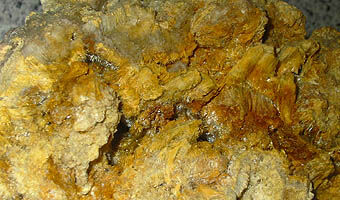
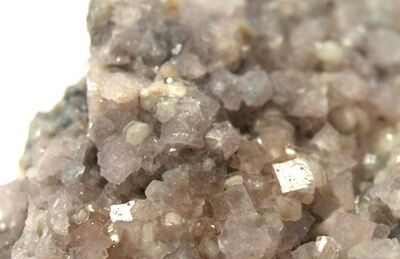
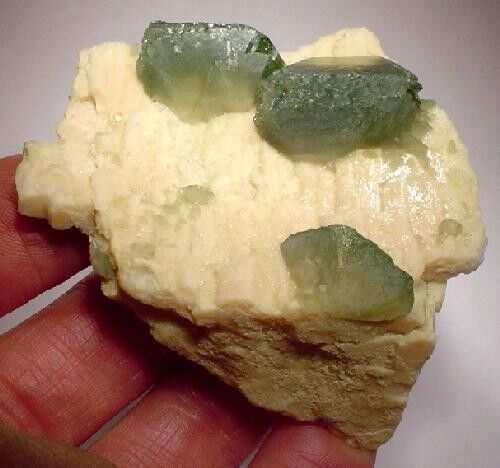
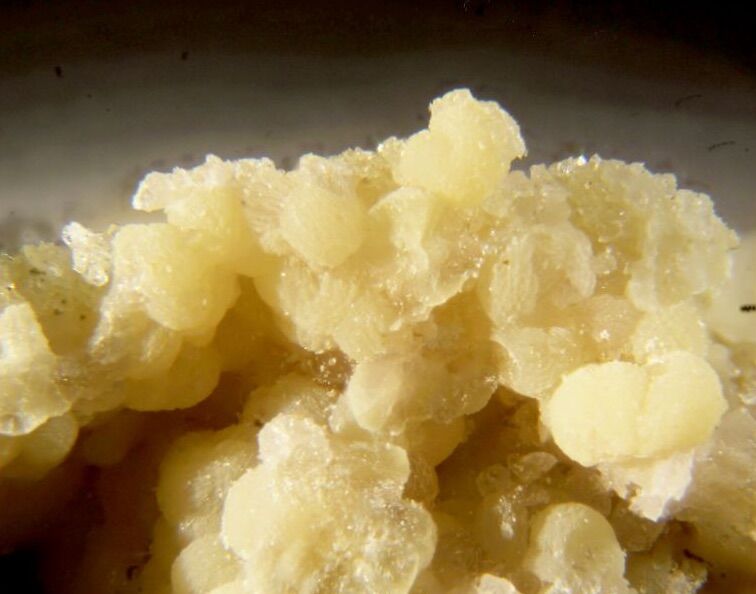
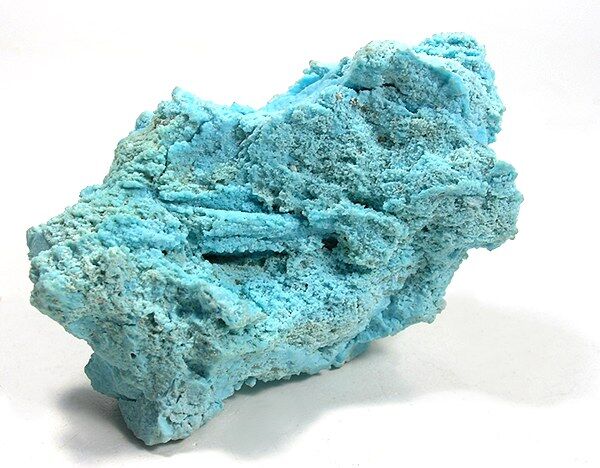
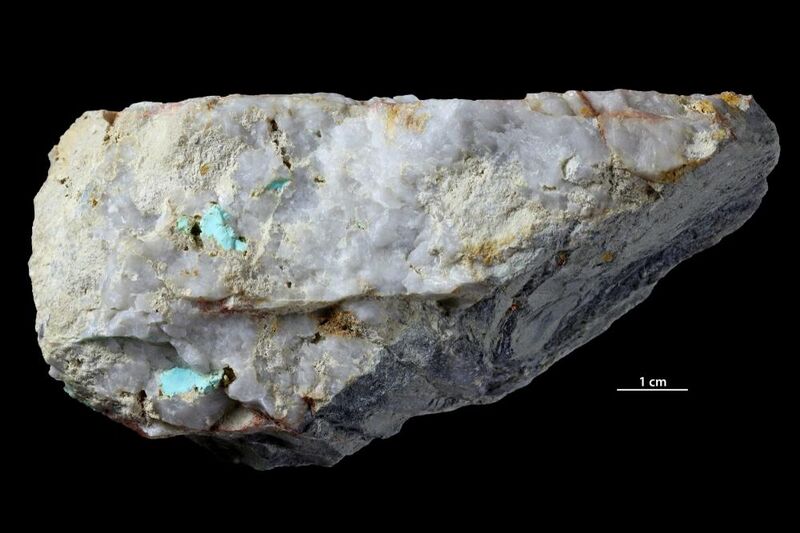
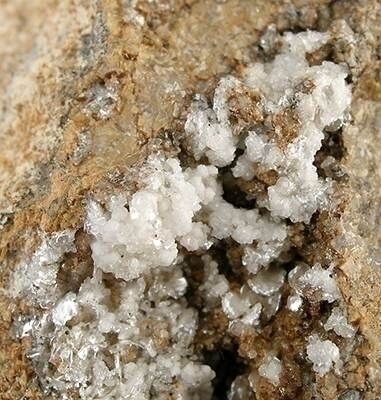
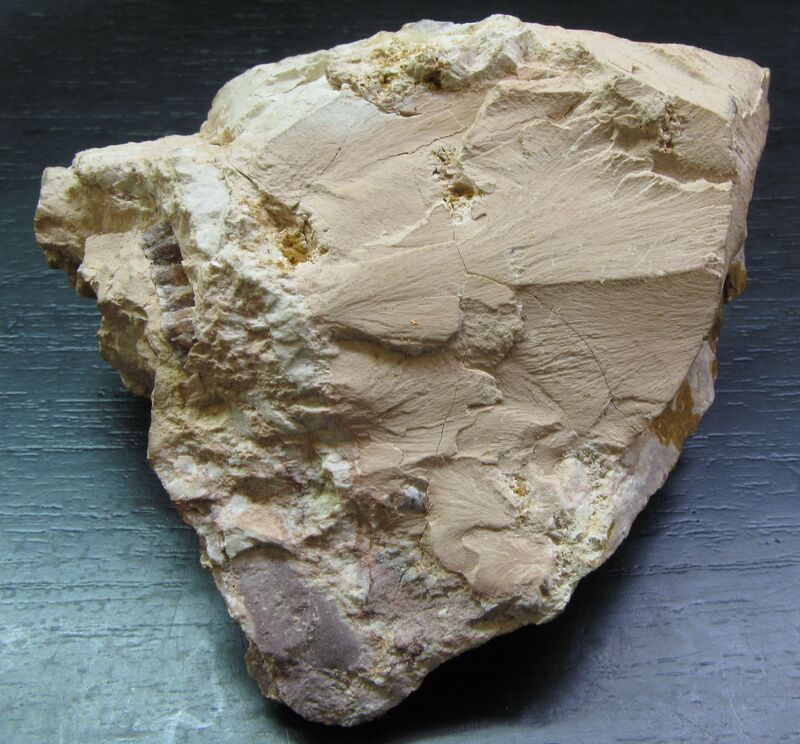
- White to cream and pale-yellow · also often stained various hues · tans and browns being common.
- Streak
- White, or paler than the sample.
- Tenacity
- sectile
- Cleavage
- Perfect
on (001).
- Fracture
- Irregular/Uneven · Conchoidal · Sub-Conchoidal · Micaceous
- Density
- 2.68 g/cm³
Optical
- Optical type
- Biaxial (-) · 2V measured = 24 – 50° · 2V calc = 44°
- Refractive index
- 1.553 – 1.57
- Surface relief
- Moderate
- Principal indices
- nα 1.553 – 1.563 · nβ 1.559 – 1.569 · nγ 1.560 – 1.570
- Birefringence
- 0.017
- Pleochroism
- Non-pleochroic
- Dispersion
- none
- UV response
- Not fluorescent in UV.
Crystallography
- Cell parameters
- a = 5.13 Å · b = 8.89 Å · c = 7.25 Å
- Cell angles
- α = 90 ° · β = 104.5 ° · γ = 89.8 °
- Ratio a:b:c
- 1 : 1.733 : 1.413
- Z
- 1
- Morphology
Visible crystals extremely rare, typically 2-5 nanometer range, but may be up to 1.5 mm across. Platy, pseudohexagonal. Fibers and spheres have been observed using SEM imaging.
Chemical composition
- Impurities
- Fe
- Mg
- Na
- K
- Ti
- Ca
- H2O
Synonyms
- Ancudit
- Ancudita
- Ancudite
- Cao lanh
- Carnat
- Clayite (of Mellor)
- Cleît
- Cleîte
- Collyrinum
- Collyrum
- Creniadit
- Creniadite
- Fire clay
- Kaoliini
- Leucargilla
- Lohestit
- Lohestite
- Marga Porcellana
- Myelin
- Neokaolin
- Pholerit
- Porcelain Clay
- Porcelain Earth
- Porzellanerde
In other languages
- French
- 1318-74-7 · Al2Si2O5(OH)4 · kaolinite
- German
- Kaolinit
- Spanish
- caolinita
- Italian
- caolinite · Kaolinite
- Portuguese
- Caulinita · caulinite
- Japanese
- カオリナイト · カオリン石 · 高陵土 · 高陵石
- Chinese
- 瓷土 · 觀音土 · 观音土 · 高岭土 · 高嶺石
- Simplified Chinese
- 高岭石
- Traditional Chinese
- 高嶺石
- Russian
- каолинит
- Arabic
- كاؤولين · كاولين · كاولينيت
- Hindi
- चीनी मिट्टी
Classification
9.ED.05
- 9SilicatesClass
- 9.EPhyllosilicatesDivision
- 9.EDPhyllosilicates with kaolinite layers composed of tetrahedral and octahedral netsGroup
- 9.ED.05KaoliniteSpecies
15.8
- 15Silicates of AluminumClass
- 15.8— unnamed intermediate level —Group
- 15.8KaoliniteSpecies
Group, growth & confusion
Literature, links & citation
- —Daou, I., Mocuta, C., Lecomte-Nana, G.L., Tessier-Doyen, N., Peyratout, C., Guinebretière, R., Thiaudière, D. (2023): Dehydroxylation of Kaolinite and Halloysite-Rich Samples: An In Situ Study of the Texture and Structural Evolutions. Minerals, 13, 1418.
- 1930Ross, C.S., Kerr, P.F. (1930) The kaolin minerals. USGS Professional Paper 165-E: 151-176.
- 1932Gruner, John W. (1932) The Crystal Structure of Kaolinite. Zeitschrift für Kristallographie, 83 (1). 75-88 doi:10.1524/zkri.1932.83.1.75DOI: 10.1524/zkri.1932.83.1.75
- 1932Schoep, A. (1932) Sur une forme curieuse de la kaolinite trouvée dans la houille. Bulletin de la Société belge de Géologie, 42, 271.
- 1959BRINDLEY, G. W.; NAKAHIRA, M. (1959) The Kaolinite-Mullite Reaction Series: I, A Survey of Outstanding Problems. Journal of the American Ceramic Society, 42 (7). 311-314 doi:10.1111/j.1151-2916.1959.tb14314.xDOI: 10.1111/j.1151-2916.1959.tb14314.x
Entry last updated
@misc{mineral2026,
  author    = {Mineral Index editorial board},
  title     = {Kaolinite — Mineral Index},
  year      = {2026},
  url       = {https://mineralindex.org/minerals/kaolinite-2156}
}