Where it forms, where it's found
- Type locality
- Långban Mine
- Långban Ore District
- Filipstad
- Värmland County
- Sweden
59.8554°, 14.2648°
1recorded occurrences
Safety & handling
Physical
- Hardness
- 1Talc
- 2Gypsum
- 3Calcite
- 4Fluorite
- 5Apatite
- 6Orthoclase
- 7Quartz
- 8Topaz
- 9Corundum
- 10Diamond
- Transparency
- Translucent
- Colour
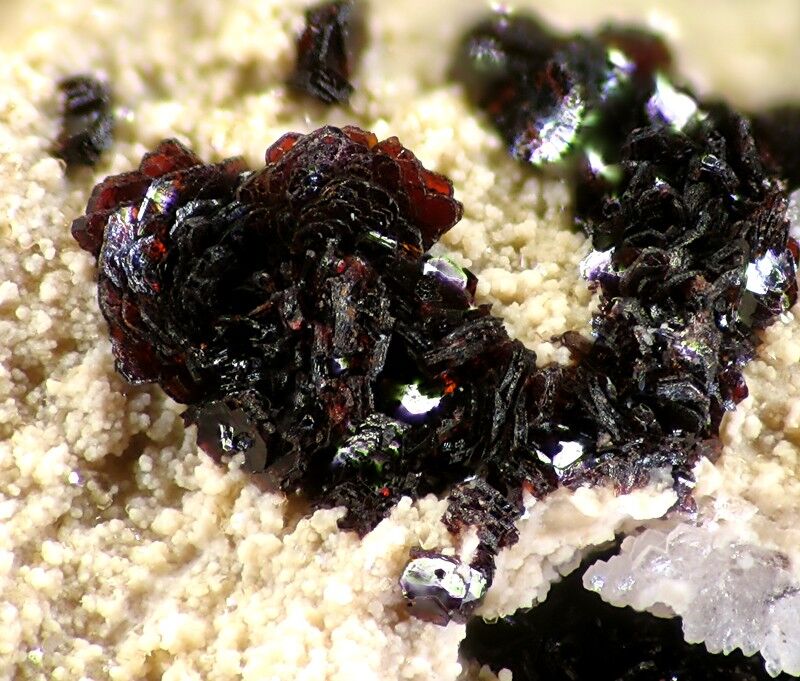
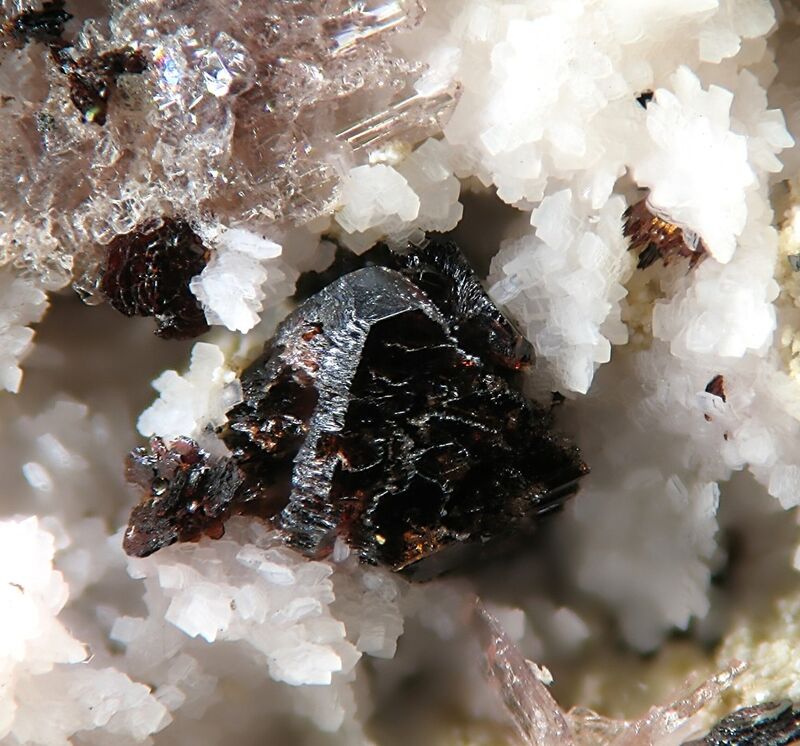
- Deep red-brown to nearly black
- Cleavage
- Perfect
basal micaceous
- Density
- 4.35 g/cm³
Optical
- Optical type
- Uniaxial (+)
- Refractive index
- 1.73 – 1.97
- Surface relief
- Very high
- Principal indices
- nω 1.97 · nε 1.73
- Pleochroism
- Non-pleochroic
Δ = 0Δmax
PPLpleochroism per grain
XPLindependent extinctions · rotate the stage
PPLpleochroism only · colour blends on rotation
XPLinterference colour · extinct every 90°
Retardation2400 nm
Order5th order
XPL colour
Crystallography
- Space group
- #78
- Cell parameters
- a = 8.233(4) Å · c = 37.499(1) Å
- Z
- 3
- Morphology
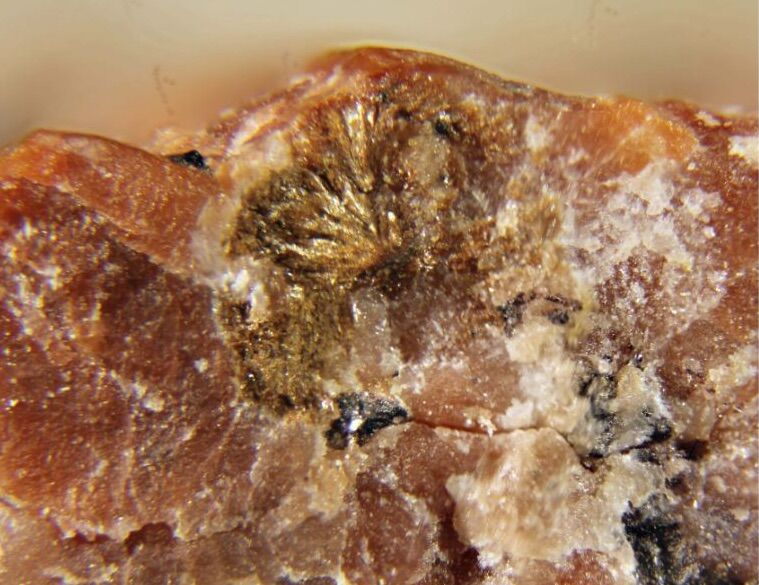
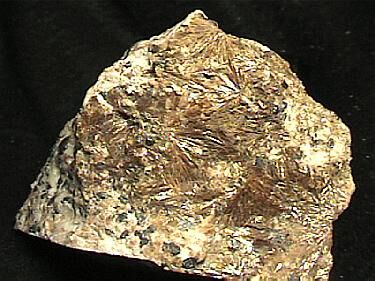
in aggregates of thin flakes, massive
- Type-locality form
Aggregates of thin flakes without crystal outlines.
Crystal structure
Chemical composition
- Impurities
- Mg
- Ca
- Na
- K
- P
Synonyms
- Dixeniet
In other languages
- German
- Dixenit
- Spanish
- dixenita
- Italian
- Dixenite
Classification
Strunz
10th ed.8.BE.45
- 8Phosphates, Arsenates, VanadatesClass
- 8.BPhosphates, etc., with additional anions, without H2ODivision
- 8.BEWith only medium-sized cations, (OH, etc.):RO4 > 2:1Group
- 8.BE.45DixeniteSpecies
Dana
8th ed.46.02.08.01
- 46Antimonites and Arsenites Containing Hydroxyl or HalogenClass
- 46.02MiscellaneousType
- 46.02.08Dixenite GroupGroup
- 46.02.08.01DixeniteSpecies
CIM
—17.7.8
- 17Silicates Containing other AnionsClass
- 17.7Silicates with vanadate, arsenate or antimonateGroup
- 17.7.8DixeniteSpecies
Group, growth & confusion
- ArakiiteZnMn2+12Fe3+2(As3+O3)(As5+O4)2(OH)23Mineral—
 Hematolite(Mn,Mg,Al)15(AsO4)2(AsO3)(OH)23Mineral—
 KraissliteZn3(Mn,Mg)25(Fe3+,Al)(As3+O3)2[(Si,As5+)O4]10(OH)16Mineral—
 McgoverniteZn3(Mn2+,Mg,Fe3+,Al)42(As3+O3)2(As5+O4)4[(Si,As5+)O4]8(OH)42Mineral—
 SynadelphiteMn2+9(AsO4)2(AsO3)(OH)9 · 2H2OMineral—
- TurtmanniteMn25O5(VO4)3(SiO4)3(OH)20Mineral—
Literature, links & citation
Citations
- 1920Flink, Gustaf (1920) Trigonit och Dixenit, två nya mineral från Långbanshytte gruvor. Geologiska Föreningen i Stockholm Förhandlingar, 42 (7) 436-452 doi:10.1080/11035892009444477 DOI: 10.1080/11035892009444477
- 1921Wherry, E.T. (1921) New minerals. American Mineralogist: 6: 92-95.
- 1969Welin, E. (1969) Notes on the mineralogy of Sweden 6. X-ray powder data for minerals from Långban and the related mineral deposits of Central Sweden. Arkiv för Mineralogi och Geologi, 4 (6, nr 30). 499-541
- 1981Araki, T., Moore, P.B. (1981): Dixenite, Cu+Mn2+14Fe3+(OH)6(As3+O3)5(Si4+O4)2(As5+O4) : metallic [As3+4Cul+] clusters in an oxide matrix. American Mineralogist: 66: 1263-1273.
- 2001(2001) Dixenite. Handbook of Mineralogy. Mineralogical Society of America
Cite this entry
Entry last updated
@misc{mineral2025,
  author    = {Mineral Index editorial board},
  title     = {Dixenite — Mineral Index},
  year      = {2025},
  url       = {https://mineralindex.org/minerals/dixenite-1298}
}