History
Dravite carries a river in its name. In 1883 the Austrian mineralogist Gustav Tschermak named the brown tourmaline. He was a professor of mineralogy at the University of Vienna. He named the stone for the Drava river district, the stretch of country along that river in what was then Austria-Hungary. The river runs under several names: Drau in German, Drave in Latin. Tschermak took the Latin form.
The type locality — the spot whose specimens define the species — sits on that river at Dobrova, near the town of Dravograd. That ground belonged to Austria-Hungary when the name was coined. Today it lies inside the Republic of Slovenia.
Beyond its naming, little human history attaches to dravite on its own. It is one end-member of the tourmaline group — the sodium- and magnesium-rich variant, usually brown — and the wider tourmaline story of gem-cutting and ornament belongs to the group, not to this single member.
Industrial & practical applications
Dravite is a stone for collectors and jewellers more than for industry. Its brown-to-black crystals are cut as a gemstone and set in jewellery. Lapidaries — the craftworkers who shape and polish stone — also carve and engrave it, or work it into cabochons, the smooth domed cut with no facets. Mineral collectors prize the crystals in their own right, for the sharp geometry of the tourmaline form.
One variety stands well above the rest in the gem trade. Chrome dravite is a chromium-bearing green form, sometimes carrying vanadium too. Its rich forest-green colour comes from the same chromium that reddens ruby and greens emerald. It is treated as a collector's gem chiefly because it is so rarely found. The stones are almost never large: most cut chrome dravite weighs under a single carat. The main source is Tanzania, with further finds in Myanmar, Kenya, China and Brazil.
No industrial use is recorded for dravite. Tourmaline as a group is sometimes known for piezoelectric and pyroelectric behaviour — producing a small electric charge under pressure or heat. That property is exploited in the clear gem material of the group, not in this brown member.
Where it forms, where it's found
- Geological setting
Metamorphosed limestones or mafic igneous rocks, rarely in pegmatites or authogenic overgrowths in sedimentary rocks.
- Type locality
- Dobrova pri Dravogradu
- Dravograd
- Slovenia
46.5772°, 15.0143°
Varieties
Physical
- Hardness
- 1Talc
- 2Gypsum
- 3Calcite
- 4Fluorite
- 5Apatite
- 6Orthoclase
- 7Quartz
- 8Topaz
- 9Corundum
- 10Diamond
- Lustre
- Vitreous to oily.
- Transparency
- Transparent · Translucent
- Colour
- Pale brown to dark-brown to brownish-black · also dark-yellow · blue.
- Streak
- Light brown, rarely white.
- Tenacity
- brittle
- Cleavage
- Poor/Indistinct
Very poor (110) (101)
- Fracture
- Irregular/Uneven · Conchoidal
- Density
- 3.03 g/cm³
Optical
- Optical type
- Uniaxial (-)
- Refractive index
- 1.612 – 1.661
- Surface relief
- Moderate
- Principal indices
- nω 1.634 – 1.661 · nε 1.612 – 1.632
- Pleochroism
- Strong
O= pale yellow E= colorless, yellowish, greenish, brownish
- Luminescence
- May fluoresce yellow to orange in SWUV, due to minor iron content.
- UV response
- May weakly fluoresce under SW UV.
Crystallography
- Space group
- #86
- Cell parameters
- a = 15.96(2) Å · c = 7.21(2) Å
- Z
- 3
- Morphology
Equant to short to long prismatic
- Twinning
Rare, on (101) and (401).
Chemical composition
- Impurities
- Fe
- Mn
- Ti
- Ca
- Cr
- V
- K
- F
Synonyms
- Coronit
- Coronita
- Coronite (of Hunt)
- Gouvernerit
- Gouverneurit
- Gouverneurita
- Gouverneurite
- Mg-Turmalin
In other languages
- French
- Dravite
- German
- Dravit
- Spanish
- Dravita
- Italian
- Dravite
Classification
9.CK.05
- 9SilicatesClass
- 9.CCyclosilicatesDivision
- 9.CK[Si6O18]12- 6-membered single rings, with insular complex anionsGroup
- 9.CK.05DraviteSpecies
61.03.01.09
- 61Cyclosilicates Six-membered RingsClass
- 61.03Six-Membered Rings with borate groupsType
- 61.03.01— unnamed intermediate level —Group
- 61.03.01.09DraviteSpecies
17.5.27
- 17Silicates Containing other AnionsClass
- 17.5BorosilicatesGroup
- 17.5.27DraviteSpecies
Group, growth & confusion
- AdachiiteCaFe2+3Al6(Si5AlO18)(BO3)3(OH)3(OH)Mineral—
- Alumino-oxy-rossmaniteAl3Al6(Si5AlO18)(BO3)3(OH)3OMineral—
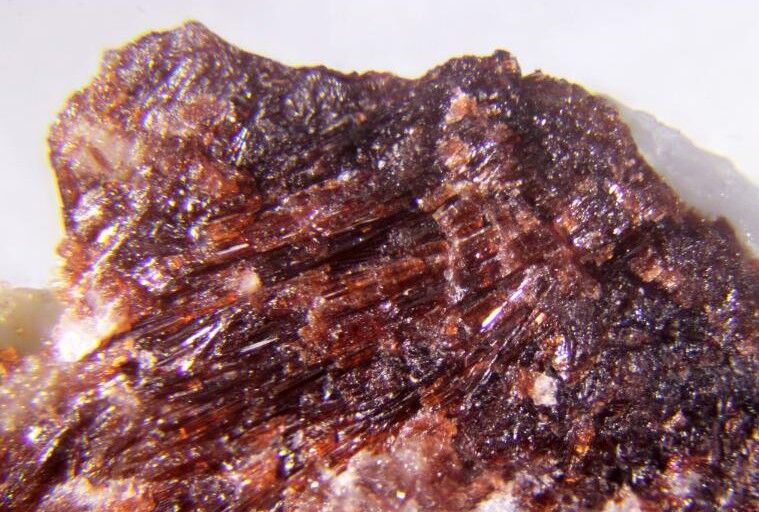 BosiiteNaFe3+3(Al4Mg2)(Si6O18)(BO3)3(OH)3OMineral—
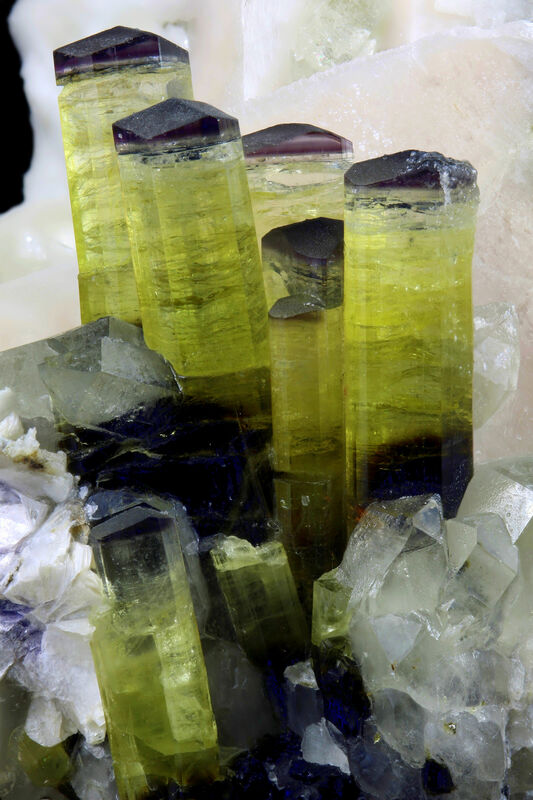 Celleriite◻(Mn2+2Al)Al6(Si6O18)(BO3)3(OH)3(OH)Mineral—
- Chromium-draviteNaMg3Cr3+6(Si6O18)(BO3)3(OH)3(OH)Mineral—
- Chromo-alumino-povondraiteNaCr3(Al4Mg2)(Si6O18)(BO3)3(OH)3OMineral—
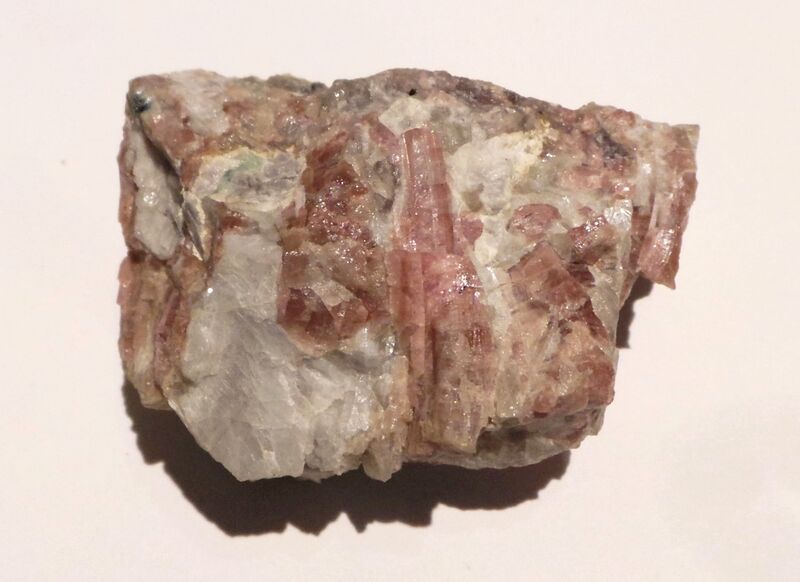 DarrellhenryiteNa(Al2Li)Al6(Si6O18)(BO3)3(OH)3OMineral—
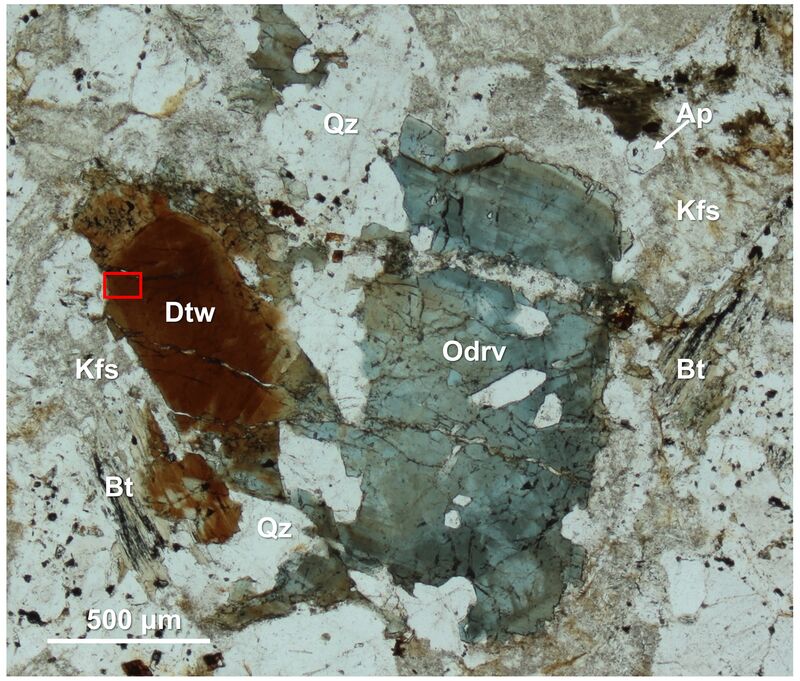 DutrowiteNa(Fe2+2.5Ti0.5)Al6(Si6O18)(BO3)3(OH)3OMineral—
 ElbaiteNa(Al1.5Li1.5)Al6(Si6O18)(BO3)3(OH)3(OH)Mineral—
- ErtliteNaAl3Al6(Si4B2O18)(BO3)3(OH)3OMineral—
Literature, links & citation
- 1941Agrell, S. O. (1941) Dravite-bearing rocks from Dinas Head, Cornwall. Mineralogical Magazine and Journal of the Mineralogical Society, 26 (174) 81-93 doi:10.1180/minmag.1941.026.174.02 DOI: 10.1180/minmag.1941.026.174.02
- 1964Barsanov, G.P., Yakovleva, M.E. (1964) Tourmalines of dravite composition. Akademiya Nauk SSSR, Mineralogicheshkii Muzei, Moscow: 15: 39-80.
- 1969Manning, P. G. (1969) An optical absorption study of the origin of colour and pleochroism in pink and brown tourmalines. The Canadian Mineralogist, 9 (5) 678-690
- 1977Dunn, Pete J. (1977) Chromium in dravite. Mineralogical Magazine, 41 (319) 408-410 doi:10.1180/minmag.1977.041.319.21 DOI: 10.1180/minmag.1977.041.319.21
- 1981Povondra, P. (1981) The crystal chemistry of tourmalines of the schorl-dravite series. Acta Univ. Carol., Geol. 3: 223-264.
Entry last updated
@misc{mineral2026,
  author    = {Mineral Index editorial board},
  title     = {Dravite — Mineral Index},
  year      = {2026},
  url       = {https://mineralindex.org/minerals/dravite-1318}
}