History
Long before elbaite was distinguished as a species, Europe knew the broader tourmaline group as a curiosity from Ceylon. From the 18th century onward, crystals carried home by Dutch traders were called the Ceylonese Magnet — heat one in an ash fire and it first attracted ash to itself, then pushed it away. The behaviour is real: it is the pyroelectric effect, the build-up of electric charge on a crystal as its temperature changes. Elbaite shares that property with every other tourmaline species.
The species itself takes its name from the small Italian island of Elba, off the Tuscan coast, where lithium-rich tourmalines had been turning up for decades. The Russian mineralogist Vladimir Vernadsky proposed the name Elbait — sodium-, lithium- and aluminium-rich tourmaline from Elba — and gave the species its modern identity. The mineral is recorded as originally discovered there in 1913.
Once elbaite was named, its colour varieties moved quickly into the gem trade under names that are still in use. Rubellite covers the red and pinkish-red stones. Indicolite is the light-blue to bluish-green variety, classically from Brazil. Verdelite is green, also a Brazilian gem-trade name. Watermelon tourmaline is the zoned crystal with a pink core and a green outer rim — the colour change visible end-to-end in a single sliced section. Each of these is elbaite at the species level; the name on the dealer's label tracks the colour, not a separate mineral.
The most consequential moment in the species' modern history happened in 1989. The Brazilian prospector Heitor Dimas Barbosa, working in the village of São José da Batalha in Paraíba state, brought to the surface a tourmaline of a blue-to-green saturation no one had seen before. Gem laboratories soon established that the colour came from copper substituting into the crystal — these were elbaite tourmalines coloured by copper, and the trade adopted the locality name Paraíba tourmaline for the type. Prices for the best Brazilian stones rose past twenty thousand US dollars per carat. In 2000, copper-bearing tourmalines were found in Nigeria; not long after, similar material emerged from Mozambique. Both African sources are now sold under the Paraíba trade name, though Brazilian stones still command a premium for the depth of their colour.
Industrial & practical applications
Elbaite's modern role is almost entirely a gemstone one. The species is the source of the most-collected tourmaline gems on the market: rubellite, indicolite, verdelite, watermelon tourmaline and the copper-bearing Paraíba type — all of them elbaite at the level of mineralogical species, separated only by colour and the trace elements that produce it. Rough crystals are faceted for jewellery or cut as cabochons; the most desirable specimens combine clean transparency, depth of colour, and crystals large enough to yield a stone of useful size.
A small share of elbaite carries acicular inclusions — needle-shaped tubes or fibres aligned along the crystal's length — that produce a cat's-eye effect when the stone is cut as a domed cabochon. Such stones are sold as tourmaline cat's-eye and trade as a specialist variety within the gem market.
Beyond cut stones, elbaite has no commodity-scale industrial use. Single crystals and small clusters circulate among collectors, museum cabinets and research collections, where they are valued for the species' colour range and the textbook examples of elemental zoning that watermelon and bicoloured crystals offer.
Where it forms, where it's found
- Geological setting
Lithium-rich granitic pegmatites, metamorphic rocks and high temperature hydrothermal veins.
- Type locality
- Rosina vein (Rosina pegmatite)
- San Piero in Campo
- Campo nell'Elba
- Livorno Province
- Tuscany
- Italy
42.7500°, 10.2117°
Varieties
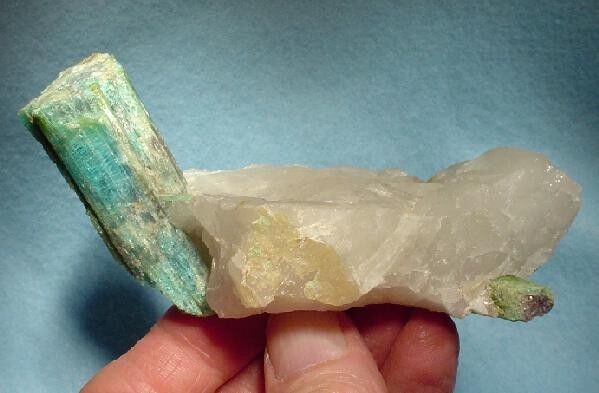
Physical
- Hardness
- 1Talc
- 2Gypsum
- 3Calcite
- 4Fluorite
- 5Apatite
- 6Orthoclase
- 7Quartz
- 8Topaz
- 9Corundum
- 10Diamond
- Lustre
- Vitreous to oily.
- Transparency
- Transparent · Translucent
- Colour
- Green · blue-green · blue · red to pink · orange · yellow · colourless
The isomorphous substitution of ions forms the different colors of tourmalines. The cations in the structure (such as Fe, Mn, Cr, etc.) exist in a wide range of isomorphous substitutions, which gives tourmaline a very rich color. There are no or very few transition metal ions in colorless tourmaline. The red hue of tourmaline is attributed to the d-d transition of octahedral Mn3+, Mn2+, or Mn2+-Mn3+ intervalence charge transfer (IVCT) in its crystal structure. The deep blue color is due to Fe2+, Fe3+, and Mn3+. The “neon” blue color of Paraíba tourmaline is attributed to Cu2+ and Mn3+. The yellow color could be associated with both the Fe2+-Ti4+ and Fe2+-Fe3+ intervalence charge transfers. Regarding the color genesis of green tourmalines, many previous experimental studies have shown that it is due to the isomorphous substitution of transition metal ions, such as Cr, V, and Fe, at the Y or Z position in its structure. It has also been shown that the green color of tourmaline is due to defects in the crystal structure of tourmaline.[[1]] The chromogenic components iron and manganese were found in the green elbaites; however, the bivariate correlation analysis indicated that the Mn content had no impact on the color, whereas the Fe content significantly affected both the lightness and the hue of green elbaites. The primary factors influencing the color of tourmaline were the absorption band at 720 nm caused by the Fe2+ d-d transitions and the 300 to 400 nm wide absorption edge extending to the visible range due to the O2−-Fe3+ charge transfer. Infrared spectroscopy indicated that the color of tourmalines was also influenced by their structure. As the degree of Y and Z octahedral distortion in the tourmaline lattice increased, the lightness of the tourmaline decreased and its color deepened.[[1]] Based on the Raman frequencies of [OH], short-range crystal occupancy assignments of metal cations were inferred for different samples. The UV-visible spectral analysis demonstrated that the symmetric broad absorption band centered at 725 nm in the blue samples results from intermetallic charge transfer between Fe2+ and Fe3+, with Fe content directly affecting the depth of the blue hue.[[2]] Elbaite enriched in Mn (17,346–20,669 μg/g) and Fe (8396–10,750 μg/g). Heat treatment enhanced transparency and induced strong pleochroism (yellowish green parallel c-axis, brown perpendicular c-axis). UV-Vis spectroscopy identified the brown color origin in the parallel c-axis direction: absorption bands at 730 nm (Fe2+ d–d transition, 5T2g → 5Eg), 540 nm (Fe2+→Fe3+ intervalence charge transfer, IVCT), and 415 nm (Fe2+→Ti4+ IVCT + possible Mn2+ contribution). Post-treatment, the 540 nm band vanished, creating a green transmission window and causing the color shift parallel the c-axis. The spectra perpendicular to the c-axis remained largely unchanged. The disappearance of the 540 nm band, attributed to the reduction of Fe3+ to Fe2+ eliminating the Fe2+–Fe3+ pair interaction required for IVCT, is the primary color change mechanism. The parallel c-axis section of the samples shows brown and yellow-green dichroism after heat treatment. A decrease in the IR intensity at 4170 cm−1 indicates a reduced Fe3+ concentration. The weakening or disappearance of the 4721 cm−1 absorption band of the infrared spectrum and the near-infrared 976 nm absorption band of the ultraviolet–visible spectrum provides diagnostic indicators for identifying heat treatment in similar brown elbaite–fluorelbaite. [[3]]
- Streak
- White
- Tenacity
- brittle
- Cleavage
- Poor/Indistinct
on (110) and (101)
- Fracture
- Irregular/Uneven · Conchoidal
- Density
- 2.9 g/cm³
Optical
- Optical type
- Uniaxial (-)
- Refractive index
- 1.615 – 1.651
- Surface relief
- Moderate
- Principal indices
- nω 1.633 – 1.651 · nε 1.615 – 1.63
- Pleochroism
- Visible
O- Pink, pale green, pale to deep blue E- Colourless, yellow, olive-green, purplish
- Luminescence
- May rarely fluoresce a weak blue-white under SWUV.
- UV response
- blue shortwave-excited luminescence excited by SW UV caused by titanate groups (TiO<sub>6</sub>)
Crystallography
- Space group
- #86
- Cell parameters
- a = 15.86(6) Å · c = 7.11(2) Å
- Z
- 3
- Morphology
Prismatic to acicular
- Twinning
Rare on (101)(401)
Chemical composition
- Impurities
- Fe
- Mn
- Cu
- Ti
- Ca
- F
Synonyms
- Elbaite (of Vernadsky)
- Lithia Tourmaline
In other languages
- French
- elbaïte
- German
- Elbait
- Spanish
- elbaíta
- Italian
- Elbaite
- Portuguese
- Elbaíta · elbaíte
- Japanese
- エルバアイト · リシア電気石 · リチア電気石
- Chinese
- 锂电气石
- Simplified Chinese
- 锂电气石
- Traditional Chinese
- 鋰電氣石
- Russian
- Эльбаит
Classification
9.CK.05
- 9SilicatesClass
- 9.CCyclosilicatesDivision
- 9.CK[Si6O18]12- 6-membered single rings, with insular complex anionsGroup
- 9.CK.05ElbaiteSpecies
61.03.01.08
- 61Cyclosilicates Six-membered RingsClass
- 61.03Six-Membered Rings with borate groupsType
- 61.03.01— unnamed intermediate level —Group
- 61.03.01.08ElbaiteSpecies
17.5.5
- 17Silicates Containing other AnionsClass
- 17.5BorosilicatesGroup
- 17.5.5ElbaiteSpecies
Group, growth & confusion
- AdachiiteCaFe2+3Al6(Si5AlO18)(BO3)3(OH)3(OH)Mineral—
- Alumino-oxy-rossmaniteAl3Al6(Si5AlO18)(BO3)3(OH)3OMineral—
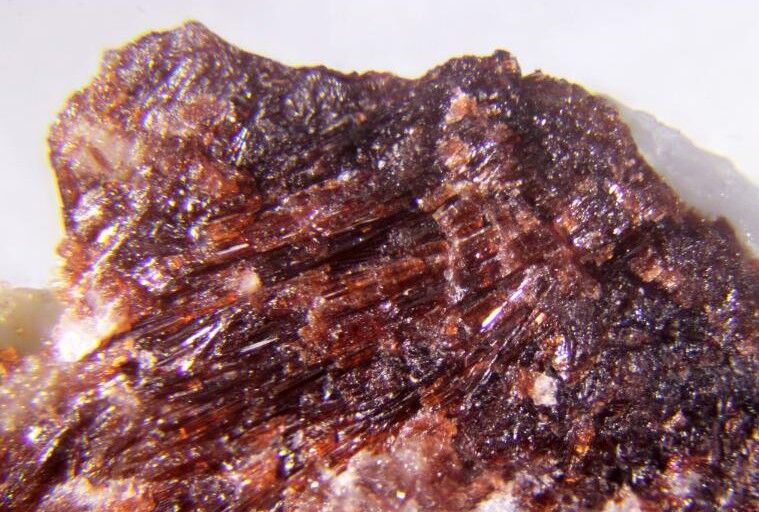 BosiiteNaFe3+3(Al4Mg2)(Si6O18)(BO3)3(OH)3OMineral—
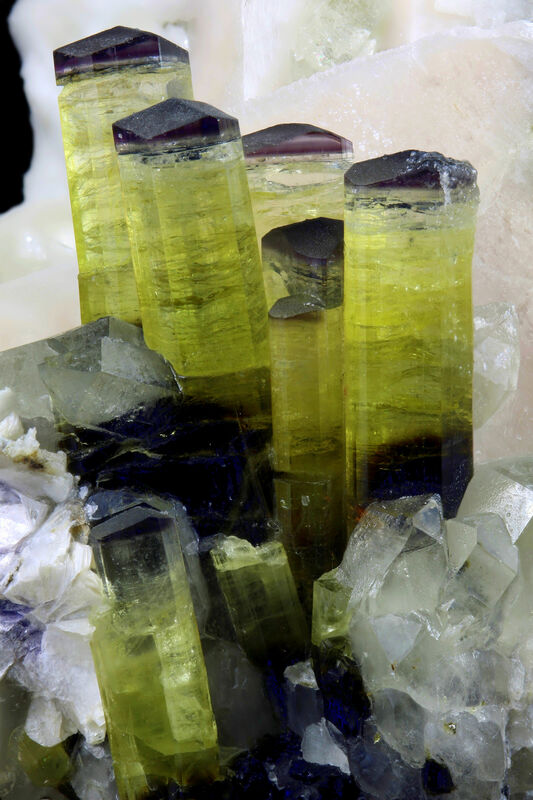 Celleriite◻(Mn2+2Al)Al6(Si6O18)(BO3)3(OH)3(OH)Mineral—
- Chromium-draviteNaMg3Cr3+6(Si6O18)(BO3)3(OH)3(OH)Mineral—
- Chromo-alumino-povondraiteNaCr3(Al4Mg2)(Si6O18)(BO3)3(OH)3OMineral—
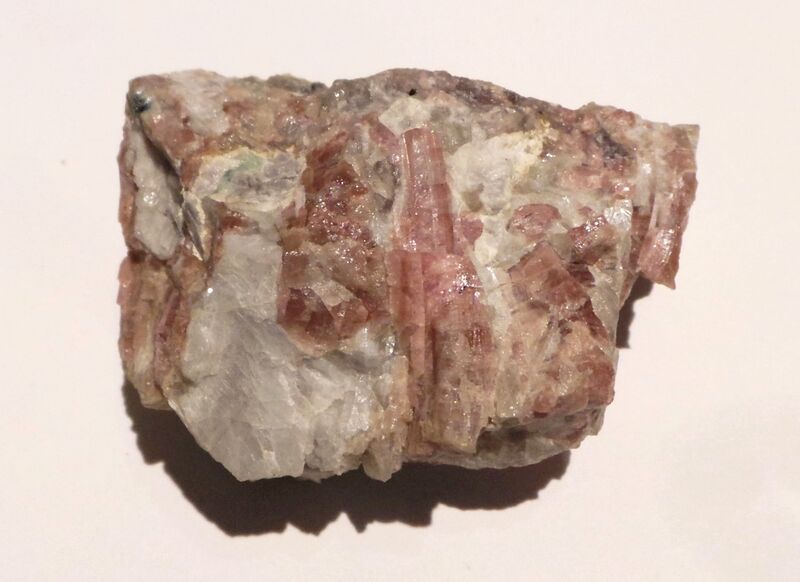 DarrellhenryiteNa(Al2Li)Al6(Si6O18)(BO3)3(OH)3OMineral—
 DraviteNaMg3Al6(Si6O18)(BO3)3(OH)3(OH)Mineral—
 DutrowiteNa(Fe2+2.5Ti0.5)Al6(Si6O18)(BO3)3(OH)3OMineral—
- ErtliteNaAl3Al6(Si4B2O18)(BO3)3(OH)3OMineral—
Literature, links & citation
- 1810Klaproth, M. H. (1810) CLXXXIII. Untersuchung des Rubellites aus Mähren. In Beiträge zur chemischen Kenntniss der Mineralkörper Vol. 5. Rottmann. p.86-90.
- 1953Bradley, J. E. S., Bradley, Olive (1953) Observations on the colouring of pink and green zoned tourmaline. Mineralogical Magazine and Journal of the Mineralogical Society, 30 (220) 26-38 doi:10.1180/minmag.1953.030.220.03 DOI: 10.1180/minmag.1953.030.220.03
- 1966Barsanov, G.P. and Yakovleva, M.E. (1966) Elbaite and certain rare varieties of tourmaline. Akademiya Nauk SSSR, Mineralogicheshkii Muzei, Moscow: 17: 3-25.
- 1969Manning, P. G. (1969) An optical absorption study of the origin of colour and pleochroism in pink and brown tourmalines. The Canadian Mineralogist, 9 (5) 678-690
- 1972Donnay, Gabrielle, Barton, R. (1972) Refinement of the crystal structure of elbaite and the mechanism of tourmaline solid solution. TMPM Tschermaks Mineralogische und Petrographische Mitteilungen, 18 (4). 273-286 doi:10.1007/bf01082837DOI: 10.1007/bf01082837
Entry last updated
@misc{mineral2026,
  author    = {Mineral Index editorial board},
  title     = {Elbaite — Mineral Index},
  year      = {2026},
  url       = {https://mineralindex.org/minerals/elbaite-1364}
}