Where it forms, where it's found
- Geological setting
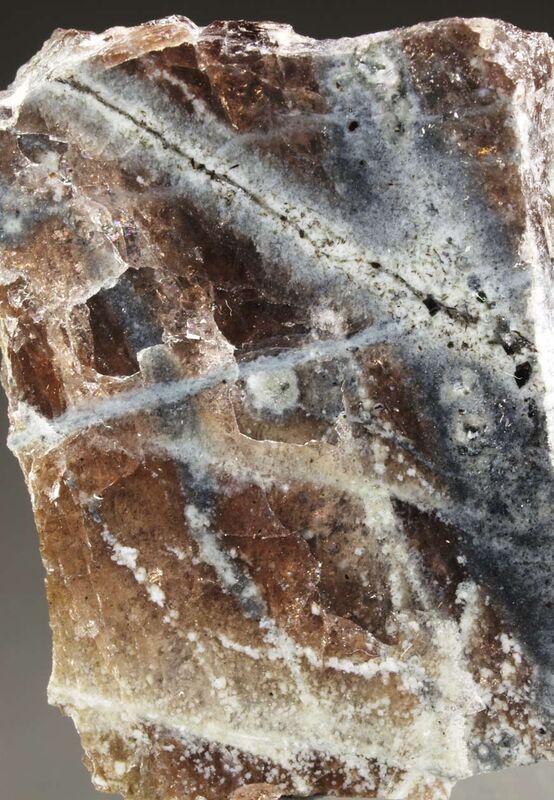
It was assumed that these rocks are a product of combustion metamorphism (pyrometamorphism), occurring under the sanidinite facies condition. High-temperature pyrometamorphic rocks are gradually altered by the late hydrothermal and weathering processes, evidenced by the presence of numerous cavities, veins, and cracks usually filled with low-temperature and secondary minerals.
- Type locality
- Ferroåkermanite type locality
- Hatrurim Basin
- Tamar Regional Council
- Beersheba Subdistrict
- Southern District
- Israel
31.1750°, 35.2897°
5recorded occurrences
Physical
Optical
- Optical type
- Uniaxial (-)
- Refractive index
- 1.643 – 1.652
- Surface relief
- Moderate
- Principal indices
- nω 1.652 · nε 1.643
- Pleochroism
- Visible
light-yellow (ω) to intense yellow (ε)
- Extinction
- parallel extinction
Δ = 0Δmax
PPLpleochroism per grain
XPLindependent extinctions · rotate the stage
PPLpleochroism only · colour blends on rotation
XPLinterference colour · extinct every 90°
Retardation90 nm
Order1st order
XPL colour
Crystallography
- Space group
- #146
- Cell parameters
- a = 7.7813(7) Å · c = 5.0114(5) Å
- Z
- 2
- Twinning
none
- Parting
- none
- Type-locality form
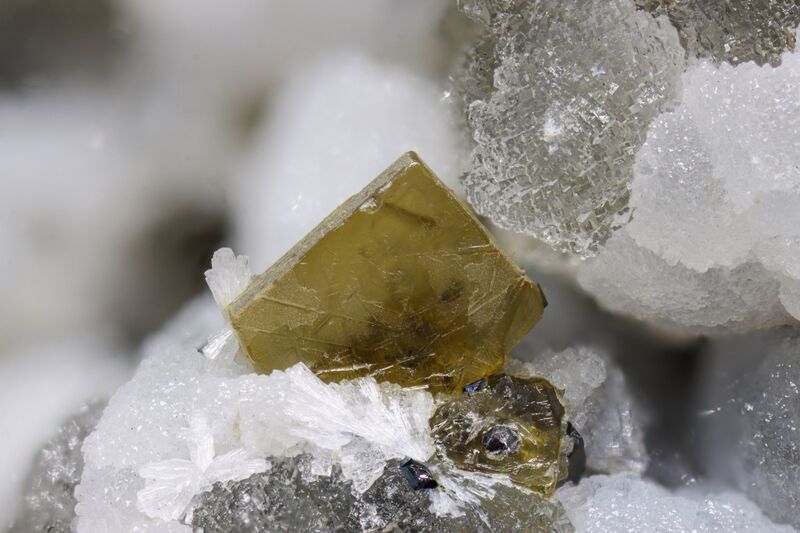
Ferroåkermanite rarely forms single subhedral light-yellow crystals up to 30-50 μm in size with a prismatic habit. The most common are irregular grains, aggregates and intergrowths
Chemical composition
Synonyms
- Fe2+-melilite
- Ferro-åkermanite
- Ferroåkermaniet
- IMA2024-080
In other languages
- German
- Ferroåkermanit · IMA 2024-080
Classification
Strunz
10th ed.9.BB.10
- 9SilicatesClass
- 9.BSorosilicatesDivision
- 9.BBSi2O7 groups, without non-tetrahedral anions; cations in tetrahedral [4] and greater coordinationGroup
- 9.BB.10FerroåkermaniteSpecies
Group, growth & confusion
Literature, links & citation
Citations
- 2025Bosi, Ferdinando; Hatert, Frédéric; Pasero, Marco; Mills, Stuart J. (2025) IMA Commission on New Minerals, Nomenclature and Classification (CNMNC) – Newsletter 84. European Journal of Mineralogy, 37 (2). 249-255 doi:10.5194/ejm-37-249-2025 DOI: 10.5194/ejm-37-249-2025
- 2025Juroszek, Rafał; Krüger, Biljana; Vapnik, Yevgeny; Galuskin, Evgeny (2025) Ferroåkermanite, Ca2FeSi2O7 – a new mineral from the reduced kirschsteinite-bearing paralava, Hatrurim Complex, Israel. Mineralogical Magazine, 90 (2). p.286-296. doi:10.1180/mgm.2025.10120DOI: 10.1180/mgm.2025.10120
Cite this entry
Entry last updated
@misc{mineral2026,
  author    = {Mineral Index editorial board},
  title     = {Ferroåkermanite — Mineral Index},
  year      = {2026},
  url       = {https://mineralindex.org/minerals/ferroakermanite-471953}
}