Where it forms, where it's found
- Geological setting
Syenite pegmatite
- Type locality
- Mount Nakkaalaaq
- Ilímaussaq complex
- Kujalleq
- Greenland
60.9667°, -45.9000°
4recorded occurrences
Safety & handling
Physical
Optical
- Optical type
- Uniaxial (+)
- Refractive index
- 1.62 – 1.634
- Surface relief
- Moderate
- Principal indices
- nω 1.620 – 1.624 · nε 1.630 – 1.634
- Pleochroism
- Non-pleochroic
Δ = 0Δmax
PPLpleochroism per grain
XPLindependent extinctions · rotate the stage
PPLpleochroism only · colour blends on rotation
XPLinterference colour · extinct every 90°
Retardation100 nm
Order1st order
XPL colour
Crystallography
- Space group
- #146
- Cell parameters
- a = 7.415(1) Å · c = 4.965(2) Å
- Unit cell volume
- 272.9 ų
- Z
- 2
- Morphology
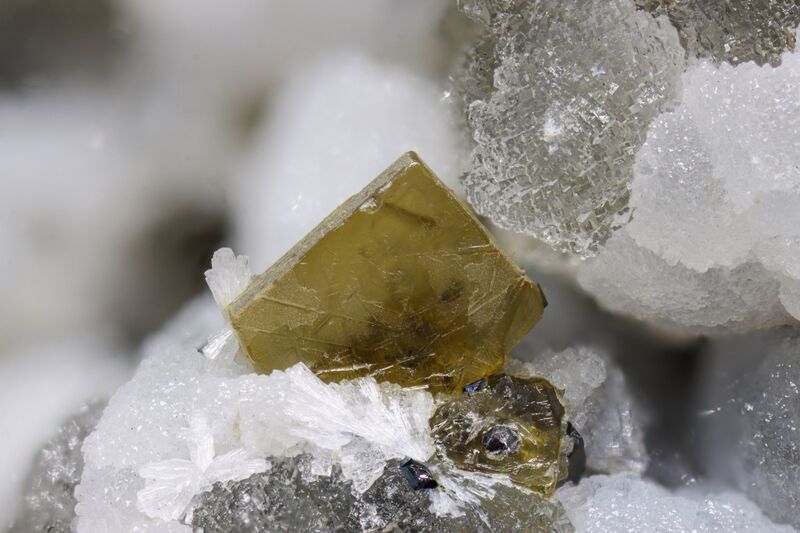
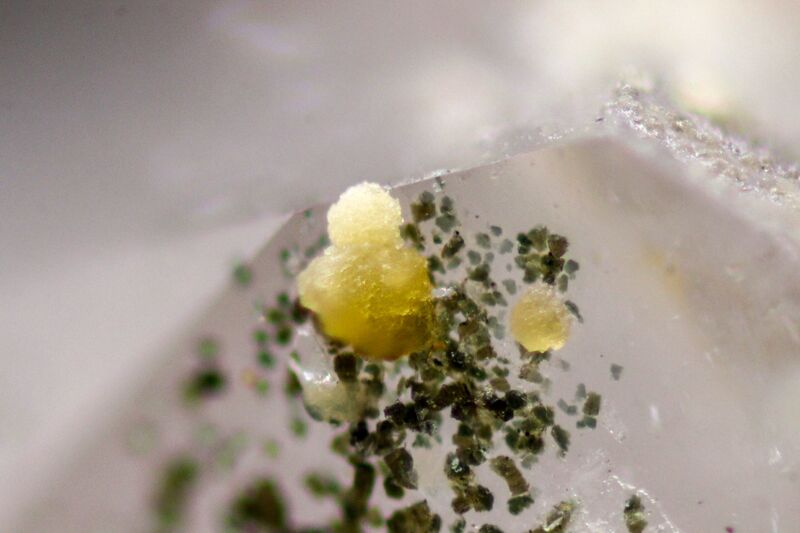
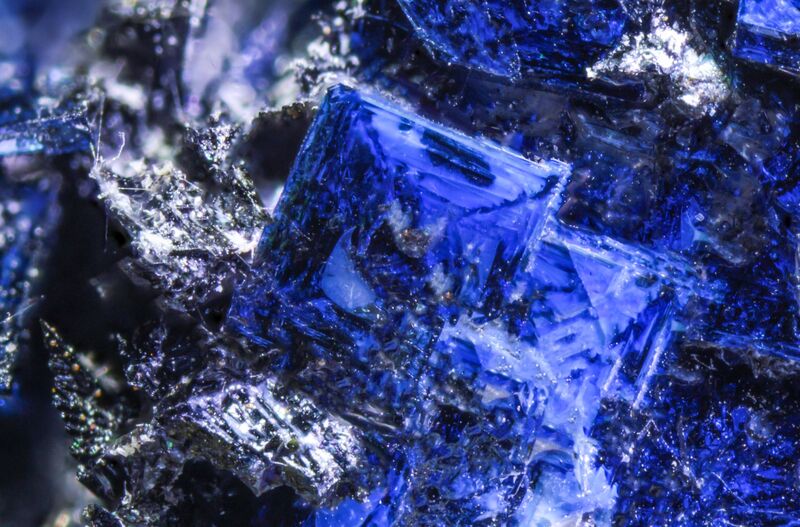
Rod-like crystals, anhedral grains and rarely as euhedral crystals, with a flattened pillow-shaped tetragonal dipyramid form. Squat dipyramids (111) or as elongate tetragonal prisms.
- Type-locality form
As squat dipyramids (30 × 50 μm) or as elongate tetragonal prisms.
Chemical composition
- Impurities
- K
- Sr
- Mg
Synonyms
- Hydroxylgugiaiet
- IMA2016-009
In other languages
- German
- Hydroxylgugiait · IMA 2016-009
Classification
Strunz
10th ed.9.BB.10
- 9SilicatesClass
- 9.BSorosilicatesDivision
- 9.BBSi2O7 groups, without non-tetrahedral anions; cations in tetrahedral [4] and greater coordinationGroup
- 9.BB.10HydroxylgugiaiteSpecies
Group, growth & confusion
Literature, links & citation
Citations
- 2013Grice, J., Kristiansen, R. (2013) Hydrogen in the Gugiaite Structure. SY1: Earth Materials, Petrological and Geochemical Processes (in Honour of Frank C. Hawthorne). Winnipeg 2013 http://www.gac.ca/wp/wp-content/uploads/2013/05/2013WinnipegGACMACAbstracts-merged.pdf
- 2016Hålenius, U., Hatert, F., Pasero, M., Mills, S. J. (2016) New minerals and nomenclature modifications approved in 2016, CNMNC Newsletter no 31. Mineralogical Magazine, 80 (4) 691-697 doi:10.1180/minmag.2016.080.083DOI: 10.1180/minmag.2016.080.083
- 2017Grice, Joel D., Kristiansen, Roy, Friis, Henrik, Rowe, Ralph, Cooper, Mark A., Poirier, Glenn G., Yang, Panseok, Weller, Mark T. (2017) Hydroxylgugiaite: A New Beryllium Silicate Mineral From the Larvik Plutonic Complex, Southern Norway and the Ilímaussaq Alkaline Complex, South Greenland; The First Member of the Melilite Group To Incorporate A Hydrogen Atom. The Canadian Mineralogist, 55 (2) 219-232 doi:10.3749/canmin.1700002DOI: 10.3749/canmin.1700002
- 2018(2018) Hydroxylgugiaite. Handbook of Mineralogy. Mineralogical Society of America
Cite this entry
Entry last updated
@misc{mineral2025,
  author    = {Mineral Index editorial board},
  title     = {Hydroxylgugiaite — Mineral Index},
  year      = {2025},
  url       = {https://mineralindex.org/minerals/hydroxylgugiaite-47040}
}