Where it forms, where it's found
- Geological setting
Skarn zones of alkaline rocks
- Type locality
- Gujia village
- Tangqiao
- Zhangjiagang Co.
- Suzhou
- Jiangsu
- China
13recorded occurrences
Safety & handling
Physical
Optical
- Optical type
- Uniaxial (+)
- Refractive index
- 1.664 – 1.672
- Surface relief
- High
- Principal indices
- nω 1.664 · nε 1.672
Δ = 0Δmax
PPLpleochroism per grain
XPLindependent extinctions · rotate the stage
PPLpleochroism only · colour blends on rotation
XPLinterference colour · extinct every 90°
Retardation80 nm
Order1st order
XPL colour
Crystallography
- Space group
- #148
- Cell parameters
- a = 7.48(2) Å · c = 5.044(3) Å
- Z
- 2
- Morphology
(001), (011), (111), (110)
- Twinning
None observed
- Type-locality form
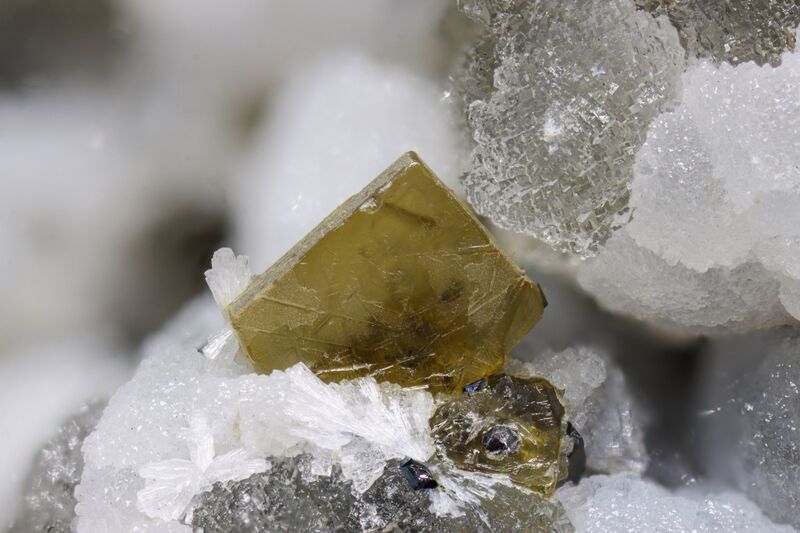
Clear tetragonal tablets, mostly 2-3 mm across and 0.3-0.5 mm thick in cavities and disseminated in melanite.
Crystal structure
Chemical composition
- Impurities
- Ti
- Zr
- Hf
- Al
- Fe
- Mn
- Mg
- Na
- K
- F
- Cl
- P
Synonyms
- Gugiaiet
- IMA1983-072
In other languages
- French
- Gugiaïte
- German
- Gugiait · IMA 1983-072
- Italian
- Gugiaite
Classification
Strunz
10th ed.9.BB.10
- 9SilicatesClass
- 9.BSorosilicatesDivision
- 9.BBSi2O7 groups, without non-tetrahedral anions; cations in tetrahedral [4] and greater coordinationGroup
- 9.BB.10GugiaiteSpecies
Dana
8th ed.55.04.02.06
- 55Sorosilicates Si2o7 Groups, Generally with No Additional AnionsClass
- 55.04Si2O7 Groups, Generally with No Additional Anions with cations in [8] and lower coordinationType
- 55.04.02Fresnoite groupGroup
- 55.04.02.06GugiaiteSpecies
CIM
—14.3.8
- 14Silicates not Containing AluminumClass
- 14.3Silicates of BeGroup
- 14.3.8GugiaiteSpecies
Group, growth & confusion
Literature, links & citation
Citations
- 1962Peng Chi-Jui, Tsao Rung-Lung, and Chou Zu-Rin (1962) Gugiaite, Ca2BeSi2O7, a new beryllium mineral and its relation to the melilite group. Scientia Sinica: 11(7): 977-988. (in English)
- 1962Peng Chi-jui, Tsao Yin-lung, Zou Zu-yin, Chang Lan-chuan, Yin Shu-shen, and Ting Kui-shou (1962) Gugiaite, Ca2BeSi2O7, a new beryllium mineral belonging to the melilite group. Acta Geologica Sinica: 42(3): 259-274. (in Chinese with English abstract)
- 1962Peng Chi-Jui, Tsao Rung-Lung, and Chou Zu-Rin (1962) Gugiaite, Ca2BeSi2O7, a new beryllium mineral and its relation to the melilite group. Scientia Sinica: 11(7): 977-988.
- 1963Fleischer, Michael (1963) New Mineral Names. American Mineralogist, 48 (1-2) 209-217
- 1982Kimata, M., Ohashi, H. (1982) The crystal structure of synthetic gugiaite, Ca2BeSi2O7. Neues Jahrbuch für Mineralogie, Abhandlungen: 143: 210-222.
Cite this entry
Entry last updated
@misc{mineral2025,
  author    = {Mineral Index editorial board},
  title     = {Gugiaite — Mineral Index},
  year      = {2025},
  url       = {https://mineralindex.org/minerals/gugiaite-1769}
}