History
For most of mining history, hydrozincite had no name of its own. It hid inside calamine — the old catch-all term for the non-sulfide zinc ores that miners dug and smelters prized. Calamine was never one mineral. It was a jumble of zinc carbonates and zinc silicates lumped together because they looked alike and yielded the same metal. Until the 18th century, this mixed ore was the only practical route to brass, made by heating copper and calamine together in what was called the cementation process.
The tangle began to unravel in 1803. The British chemist James Smithson showed that what had passed for one ore was really two distinct minerals — a zinc carbonate and a zinc silicate. Those two were later named smithsonite and hemimorphite. Hydrozincite, another zinc carbonate within the calamine family, was still waiting for its own description.
That came in 1853. The German mineralogist Gustav Adolph Kenngott described the mineral from an occurrence at Bad Bleiberg in Carinthia, Austria. He named it for its make-up — water of hydration bound together with zinc. The same year, Kenngott also gave hemimorphite its modern name, helping close the long confusion that calamine had created.
Collectors and miners knew hydrozincite by plainer names too. Its habit of forming pale crusts on weathering zinc ores earned it the nickname zinc bloom, and it has also gone by marionite.
Industrial & practical applications
Hydrozincite is a minor ore of zinc. It is never the metal's main source — that role belongs to sphalerite, the zinc sulfide that supplies almost all mined zinc. Where hydrozincite does count is in the weathered upper parts of zinc deposits, the oxidised caps that sit above the sulfide ore. There it forms alongside other non-sulfide zinc minerals and adds to what can be recovered, rather than standing on its own.
Its most reliable use is as a marker in the field and the cabinet. Under ultraviolet light, hydrozincite glows pale blue to lilac. Geologists read that glow as a sign of zinc in a rock, and collectors prize the same fluorescence in display specimens.
A newer, more unexpected role is environmental. The Rio Naracauli is a stream in Sardinia draining old zinc workings. There, hydrozincite precipitates through a process driven by living microbes — a microalga and a cyanobacterium. The mineral locks up roughly 1.2 kilograms of zinc per day, removing close to 90 percent of the metal carried by the water. That capacity has prompted researchers to propose this biomineralization as a way to clean zinc out of mine drainage where the water is near neutral in acidity.
Where it forms, where it's found
- Geological setting
Oxidized zones of zinc mineral deposits, particularly those with sphalerite.
- Type locality
- Bad Bleiberg
- Villach-Land District
- Carinthia
- Austria
46.6167°, 13.6833°
Physical
- Hardness
- 1Talc
- 2Gypsum
- 3Calcite
- 4Fluorite
- 5Apatite
- 6Orthoclase
- 7Quartz
- 8Topaz
- 9Corundum
- 10Diamond
- Transparency
- Transparent · Translucent
- Colour
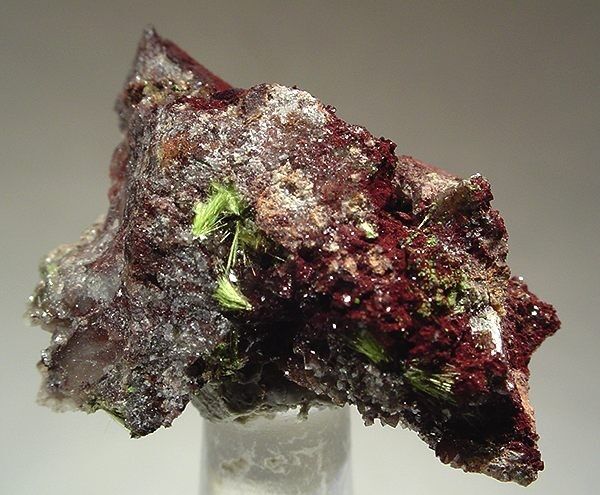
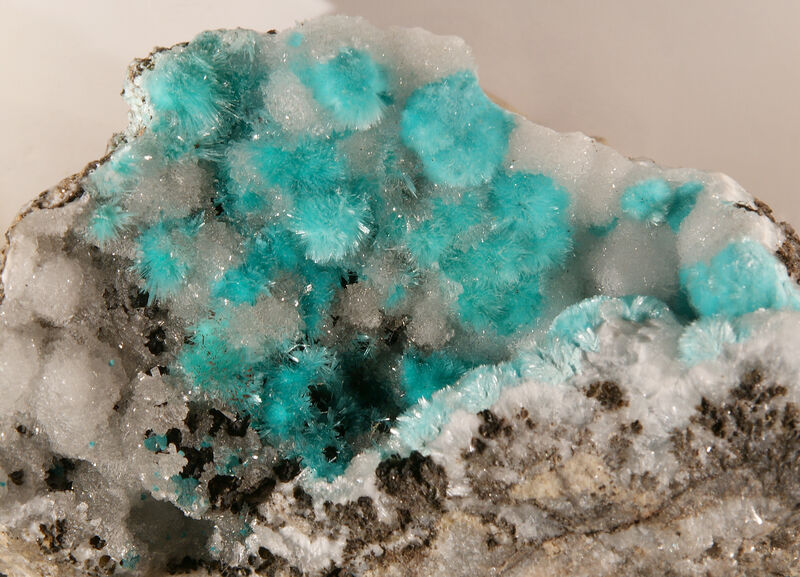
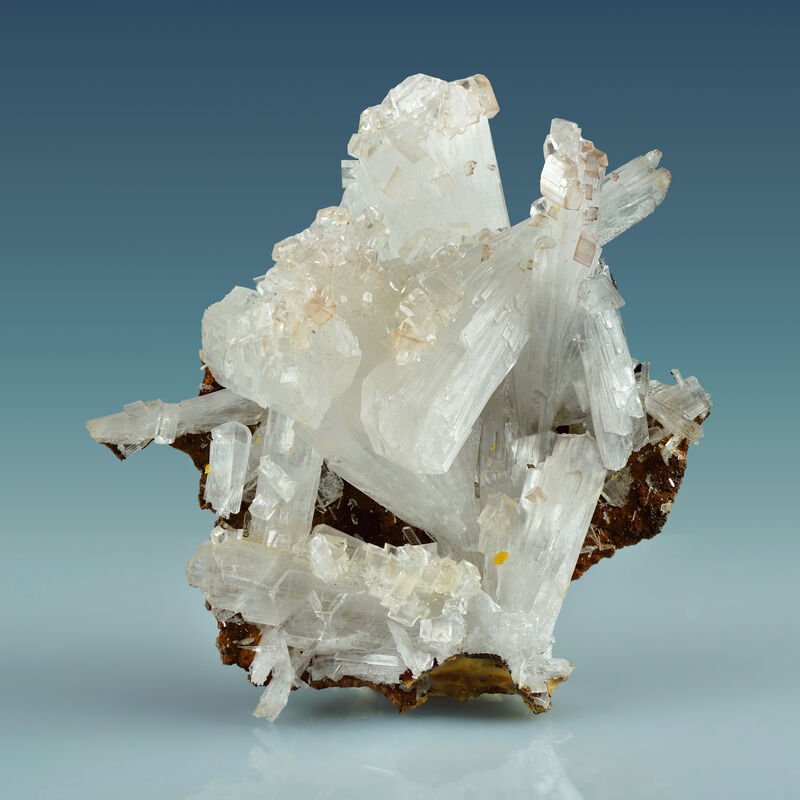
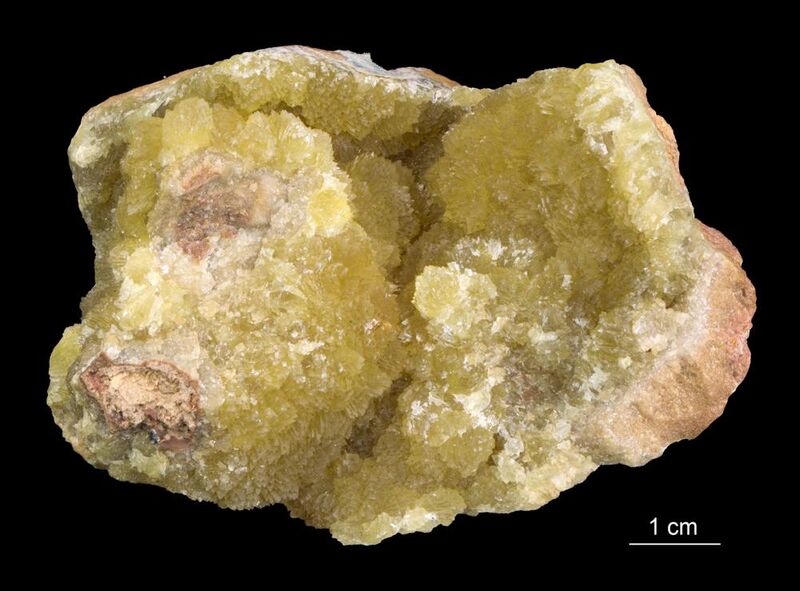
- White to grey · stained pale pink · or pale yellow or brown · colourless in transmitted light.
- Streak
- White
- Tenacity
- very brittle
- Cleavage
- Perfect
On (100).
- Fracture
- Irregular/Uneven
- Density
- 3.5 g/cm³
Optical
- Optical type
- Biaxial (-) · 2V measured = 40° · 2V calc = 40°
- Refractive index
- 1.63 – 1.75
- Surface relief
- High
- Principal indices
- nα 1.63 · nβ 1.642 · nγ 1.75
- Dispersion
- relatively strong
- UV response
- Light blue (SW UV). May fluoresce weak gray, white, or pale yellow in mid-wave and long wave. Probably does not phosphorece except due to mixture with other species. blue shortwave-excited luminescence excited by SW UV caused by titanate groups (TiO<sub>6</sub>)
Crystallography
- Space group
- C1 2/m 1
- Cell parameters
- a = 13.58 Å · b = 6.28 Å · c = 5.41 Å
- Cell angles
- β = 95.51 °
- Ratio a:b:c
- 1 : 0.462 : 0.398
- Z
- 2
- Morphology
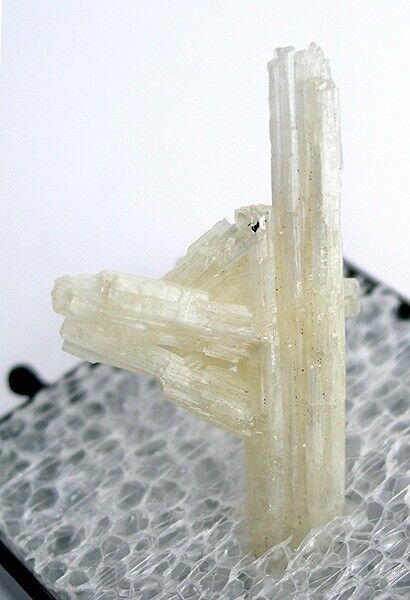
Crystals usually very small to microscopic, lath-like or bladed, flattened on (100) and elongated [001], often tapering to a sharp point. Typically found as massive aggregates of either powdery material, earthy and porous, to compact material, with fibrous radial structure, may be reniform. Dense agate-like masses, stalactic, and pisolitic.
- Twinning
Intimate twinning has been observed, but the morphology has not been reported.
Chemical composition
- Impurities
- Fe
- Cu
Synonyms
- Cegamit
- Cegamite
- Earthy Calamine
- Hydro-carbonate of zinc
- Idrozincit
- Marionit
- Marionite
- Zinc Bloom
- Zinconine
- Zinconise
- Zinkblüte
- Zinkblüthe
In other languages
- French
- hydrozincite · Zinconise
- German
- Hydrozinkit · Zinkblüte
- Spanish
- Flor de cinc · hidrocincita
- Italian
- Fiore di zinco · idrozincite
- Japanese
- 水亜鉛土
- Chinese
- 水锌矿
- Russian
- гидроцинкит
- Arabic
- هيدروزنسيت · هيدروزنكيت
Classification
5.BA.15
- 5CarbonatesClass
- 5.BCarbonates with additional anions, without H2ODivision
- 5.BAWith Cu, Co, Ni, Zn, Mg, MnGroup
- 5.BA.15HydrozinciteSpecies
16a.04.01.01
- 16aAnhydrous Carbonates Containing Hydroxyl or HalogenClass
- 16a.04(AB)5(XO3)2ZqType
- 16a.04.01— unnamed intermediate level —Group
- 16a.04.01.01HydrozinciteSpecies
11.6.2
- 11CarbonatesClass
- 11.6Carbonates of Zn and CdGroup
- 11.6.2HydrozinciteSpecies
Group, growth & confusion
Literature, links & citation
- 1803Smithson, J. (1803) A chemical analysis of some calamines. Royal Society of London, Philosophical Transactions: 12-28. (as Calamine)
- 1808Karsten, D.L.G. (1808) Mineralogische Tabellen, Berlin, second edition: 70, 99 (as Zinkblüthe).
- 1832Beudant, François-Sulpice (1832) Traité élémentaire de minéralogie. Deuxiéme Edition [Elementary Treatise on Mineralogy. Second Edition] (2nd ed.) Vol. 2 - Tome II [Volume II]. Chez Verdière.
- 1853Kenngott, G.A. (1853) Ubersichte der Resultate mineralogischer Forschungen, for the years 1850-51, Vienna (as Hydrozinkit).
- 1858Elderhorst (1858) Geological Report of Arkansas: 153. (as Marionite).
Entry last updated
@misc{mineral2026,
  author    = {Mineral Index editorial board},
  title     = {Hydrozincite — Mineral Index},
  year      = {2026},
  url       = {https://mineralindex.org/minerals/hydrozincite-1993}
}