History
The name smithsonite honours James Smithson — the English chemist whose bequest founded the Smithsonian Institution in Washington, DC. The connection is direct: Smithson was the mineralogist who, in the early 1800s, first picked apart what calamine really was.
For centuries, calamine meant a confused mixture. Georgius Agricola used the Latin form lapis calaminaris in 1546. The Swedish chemist Johan Gottschalk Wallerius shortened it to calamine in 1747, applying it to the zinc carbonate. In 1780, his countryman Torbern Bergmann analysed several calamine ores and found they were not one mineral but a mix of zinc carbonates and silicates.
In 1803, Smithson took the work further. His systematic investigation showed that ores sold as calamine contained two distinct species — one a carbonate, the other a silicate. The silicate kept the old commercial name for a while; today it is called hemimorphite. The carbonate needed a new name.
François Sulpice Beudant supplied it. In 1832, the French mineralogist renamed the carbonate smithsonite in honour of Smithson, who had died three years earlier.
Through the nineteenth century, smithsonite was the principal ore of zinc. Smelters worked it directly, roasting the carbonate to drive off carbon dioxide and reduce the oxide that remained. From the 1880s onward, it was displaced by sphalerite — the zinc sulfide — once a new ore-dressing technique made sulfide minerals easier to concentrate.
Industrial & practical applications
Smithsonite is still classed as an ore of zinc, but it is no longer the chief source. The dominant zinc ore today is sphalerite — the sulfide. Smithsonite contributes only where oxide-type zinc deposits are worked directly, mostly through non-sulfide operations and the rare older mine that still produces.
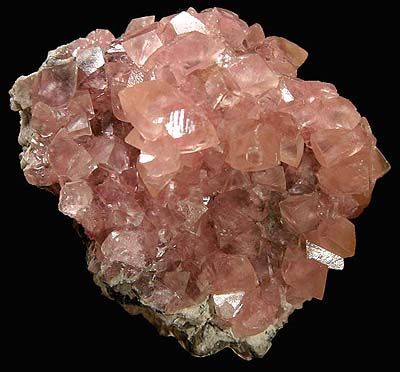
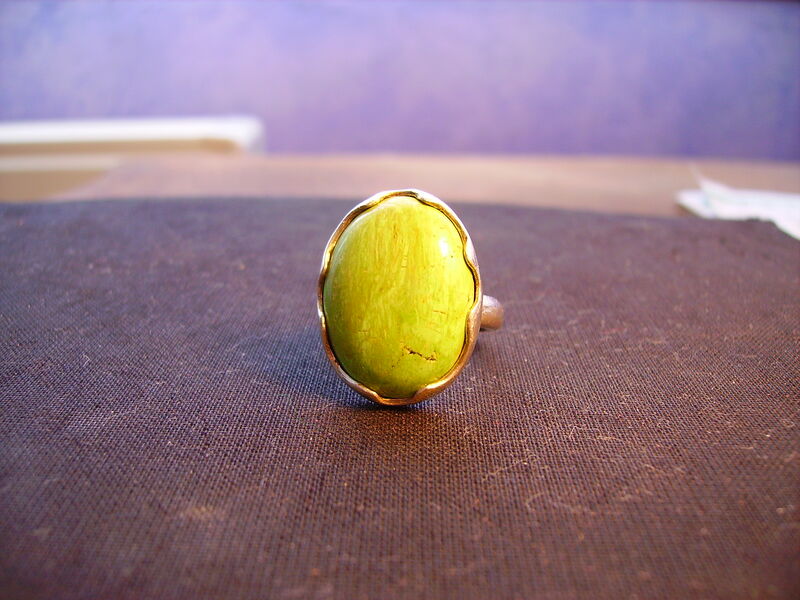
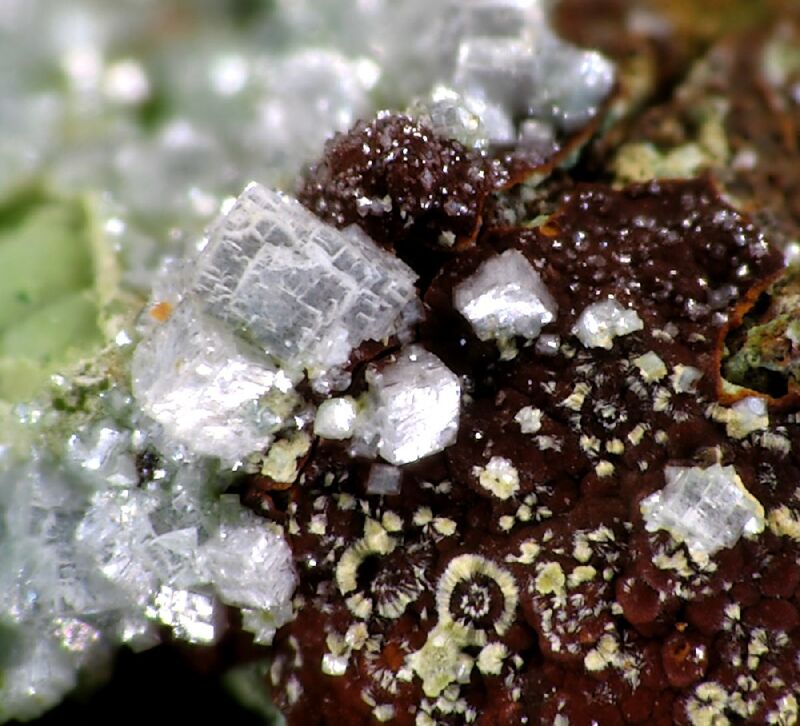
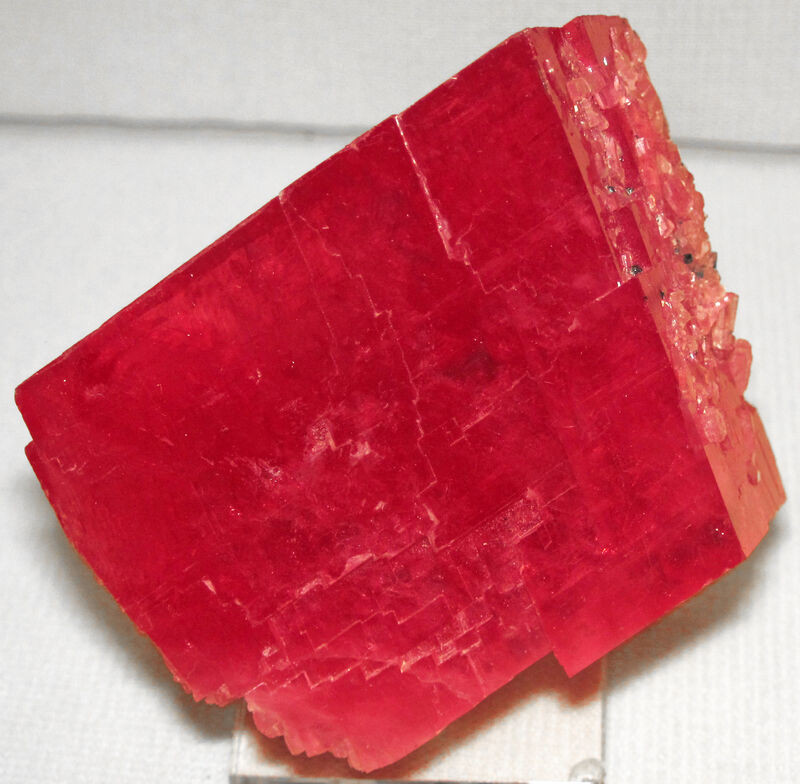
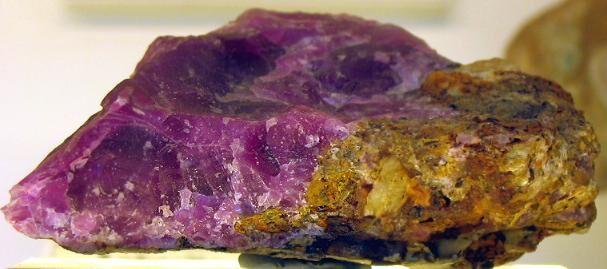
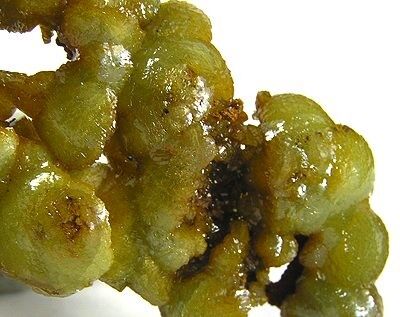
Most modern demand for smithsonite is from collectors and museums. The mineral forms striking botryoidal masses — rounded, grape-like crusts — in a range of colours that few other species match. The apple-green variety, called cuprian smithsonite, takes its colour from copper held in the crystal. Pink crystals are cobaltoan smithsonite, coloured by trace cobalt. A bright yellow variety, known to miners as turkey fat ore, gets its tint from inclusions of greenockite — a cadmium sulfide — within the smithsonite. Notable specimen localities include the Kelly Mine in New Mexico, in the United States; Tsumeb in Namibia; the Ojuela Mine at Mapimí, in Durango, Mexico; and the Lavrion District in Greece.
Where it forms, where it's found
- Geological setting
Oxidised zones of zinc ore deposits.
Varieties
Physical
- Hardness
- 1Talc
- 2Gypsum
- 3Calcite
- 4Fluorite
- 5Apatite
- 6Orthoclase
- 7Quartz
- 8Topaz
- 9Corundum
- 10Diamond
- Lustre
- Vitreous to Pearly
- Transparency
- Translucent
- Colour
- White · grey · yellow · green to apple-green · blue · pink · purple · bluish grey · and brown · colourless or faintly tinted in transmitted light.
Trace elements can be the direct cause of colour. Iron and manganese are enriched in orange-yellow smithsonites. The Cd2+ ion itself is not the cause of colour; only the presence of greenockite inclusions is related to “turkey fat” yellow in smithsonite. Manganese substitution of zinc is limited and changes the colour of smithsonite to pink. Only blue and cyan (blue-green) smithsonite samples contain weak Raman peaks at around 1200 cm−1 and Cu2+ concentrations higher than the detection limit of the test. The blue and cyan (blue-green) colours are both due to the (CO3)− radicals, nano-sized inclusions formed by Cu2+ ions, and aurichalcite inclusions (or aurichalcite–hemimorphite layers). As for the cyan smithsonite, the aurichalcite–hemimorphite layers are the major factor affecting colour. Ding et al (2023)
- Streak
- White
- Tenacity
- brittle
- Cleavage
- Very Good
On (101).
- Fracture
- Irregular/Uneven · Sub-Conchoidal
- Density
- 4.42 g/cm³
Optical
- Optical type
- Uniaxial (-)
- Refractive index
- 1.619 – 1.85
- Surface relief
- High
- Principal indices
- nω 1.842 – 1.85 · nε 1.619 – 1.623
- UV response
- May fluoresce pale green or pale blue.
Crystallography
- Space group
- #98
- Cell parameters
- a = 4.6526(7) Å · c = 15.0257(22) Å
- Morphology
Crystals rhombohedral (101); less commonly (022). Crystal faces usually curved and rough or composite; rarely scalenohedral. Botryoidal, reniform, or stalactic; incrustations; coarsely granular to compact massive; earthy, friable.
- Twinning
None observed.
- Translation gliding
- Translation gliding with T(0001), t(100).
- Epitaxy
Smithsonite upon calcite with parallel axes. Oriented pseudomorphs of ZnO are formed by thermal dissociation. Otavite oriented growths on Smithsonite (Tsumeb).
- Comment
Cell parameters are similar to those of magnesite.
Chemical composition
- Impurities
- Fe
- Co
- Cu
- Mn
- Ca
- Cd
- Mg
- In
Synonyms
- Aztec Stone
- Azurite (of ?)
- Bonamite
- Cadmium-bearing Smithsonite
- Cadmiumzinkspat
- Capnit
- Carbonate of Zinc
- Cobaltian Smithsonite
- Cuprian Smithsonite
- Kapnit
- Kohlengalmei
- Smithsonite (of Beudant)
- Szaskaite
- Zinc carbonaté
- Zinc Spar
- Zincspath
- Zincum acido aëro mineralisatum
- Zinkischer Carbonspat
- Zinkspath
In other languages
- French
- 14476-25-6 · 3486-35-9 · bonamite · cadmiosmithsonite · cobaltosmithsonite · cuprosmithsonite · herrerite · monheimite · smithsonite · zinc carbonaté · ZnCO3
- German
- Capnit · Edelgalmei · Edler Galmei · Galmei · Kapnit · Kohlengalmei · Smithsonit · Zinkspat
- Spanish
- esmitsonita · espato de cinc · espato de zinc · smithsonita
- Italian
- Smithsonite
- Portuguese
- smithsonita · Smithsonite
- Japanese
- スミソナイト · 菱亜鉛鉱
- Chinese
- 菱锌矿
- Simplified Chinese
- 菱锌矿
- Traditional Chinese
- 菱鋅礦
- Russian
- Бонамит · Монхеймит · Смитсонит · Смифсонит · Херрерит · Цинковый шпат
- Arabic
- السميثونايت · سميثسونيت
Classification
5.AB.05
- 5CarbonatesClass
- 5.ACarbonates without additional anions, without H2ODivision
- 5.ABAlkali-earth (and other M2+) carbonatesGroup
- 5.AB.05SmithsoniteSpecies
14.01.01.06
- 14Anhydrous Normal CarbonatesClass
- 14.01A(XO3)Type
- 14.01.01Calcite Group (Trigonal: R-3c)Group
- 14.01.01.06SmithsoniteSpecies
11.6.1
- 11CarbonatesClass
- 11.6Carbonates of Zn and CdGroup
- 11.6.1SmithsoniteSpecies
Group, growth & confusion
 AdamiteZn2(AsO4)(OH)Mineral—
 Agardite-(La)LaCu2+6(AsO4)3(OH)6 · 3H2OMineral—
 AnglesitePb(SO4)Mineral—
 AragoniteCa(CO3)Mineral—
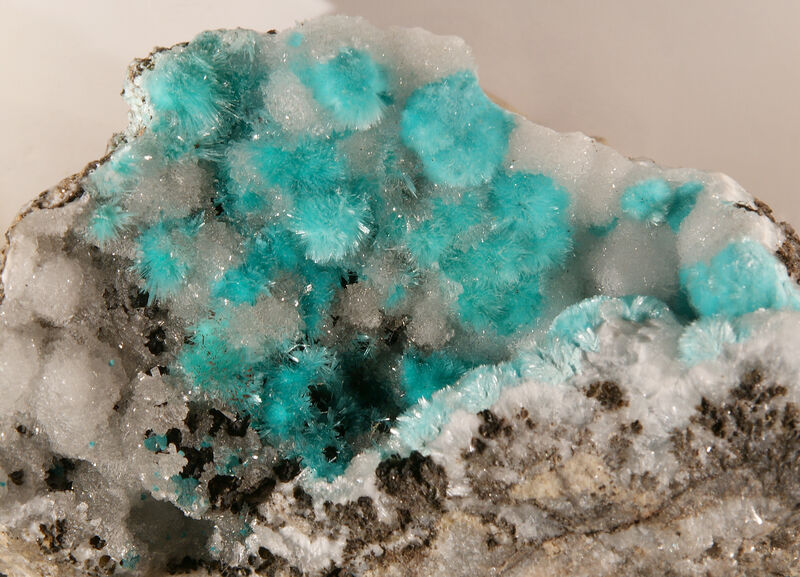 Aurichalcite(Zn,Cu)5(CO3)2(OH)6Mineral—
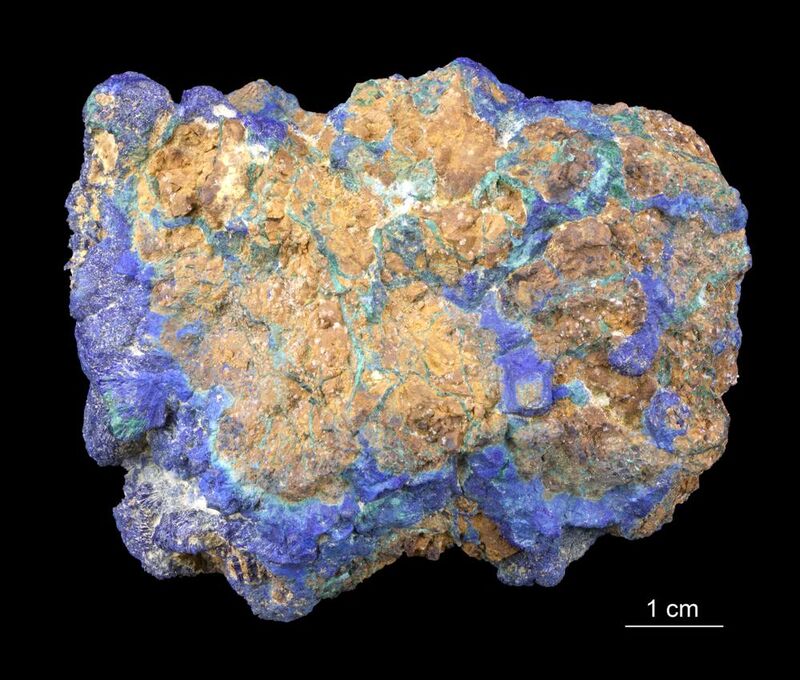 AzuriteCu3(CO3)2(OH)2Mineral—
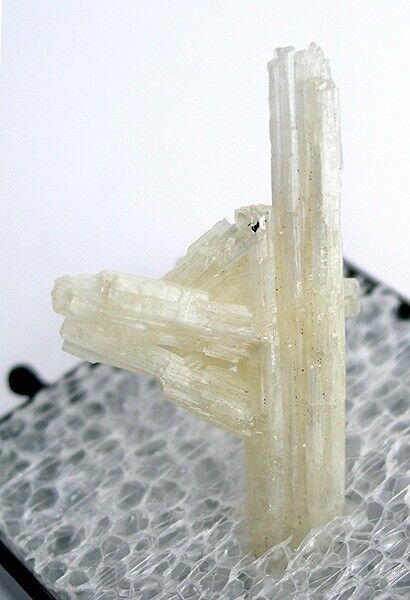 CerussitePb(CO3)Mineral—
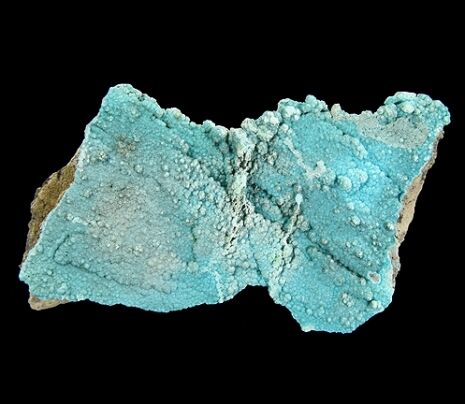 Glaucocerinite(Zn1-xAlx)(SO4)x/2(OH)2 · nH2O (x < 0.5, n > 3x/2)Mineral—
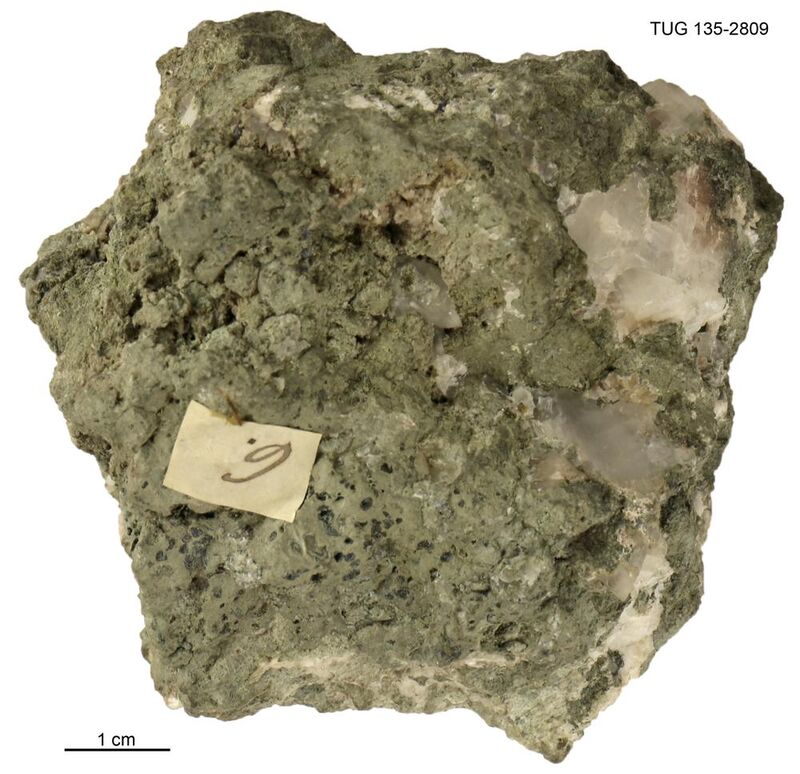 GreenockiteCdSMineral—
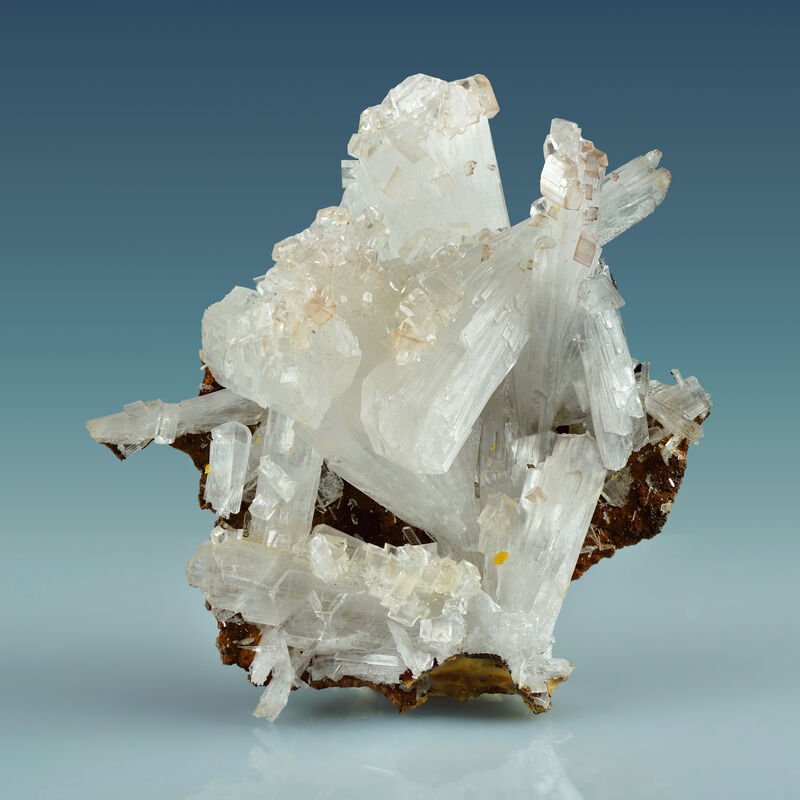 HemimorphiteZn4(Si2O7)(OH)2 · H2OMineral—
Literature, links & citation
- 1780Bergmann, T. (1780) Opuscula of Tobernus Bergmann: 209.
- 1783Bergman, Torbern (1783) Sciagraphia Regni Mineralis Secundum Principia Proxima Digesti [Sketch of the Mineral Kingdom According to the Proximate Principles of Digestion]. Apud Johannem Murray, Londini. 165pp.
- 1827Brongniart, A. (1827) 47 (as Zinc carbonaté).
- 1832Beudant, François-Sulpice (1832) Traité élémentaire de minéralogie. Deuxiéme Edition [Elementary Treatise on Mineralogy. Second Edition] (2nd ed.) Vol. 2 - Tome II [Volume II]. Chez Verdière.
- 1837Dana, James D. (1837) A System of Mineralogy (1st ed.)
Entry last updated
@misc{mineral2026,
  author    = {Mineral Index editorial board},
  title     = {Smithsonite — Mineral Index},
  year      = {2026},
  url       = {https://mineralindex.org/minerals/smithsonite-3688}
}