Where it forms, where it's found
- Type locality
- Yadovitaya fumarole
- Second scoria cone
- Northern Breakthrough (North Breach)
- Great Fissure eruption (Main Fracture)
- Tolbachik Volcanic field
- Milkovsky District
- Kamchatka Krai
- Russia
55.8333°, 160.3333°
2recorded occurrences
Physical
Optical
- Optical type
- Biaxial (+) · 2V measured = 55°
- Refractive index
- 1.63 – 1.714
- Surface relief
- High
- Principal indices
- nα 1.630 · nβ 1.650 · nγ 1.714
Δ = 0Δmax
PPLpleochroism per grain
XPLindependent extinctions · rotate the stage
PPLpleochroism only · colour blends on rotation
XPLinterference colour · extinct every 90°
Retardation840 nm
Order2nd order
XPL colour
Crystallography
- Space group
- C2/m
- Cell parameters
- a = 8.935(2) Å · b = 6.252(2) Å · c = 7.602(2) Å
- Cell angles
- β = 117.318(5) °
- Ratio a:b:c
- 1 : 0.700 : 0.851
- Unit cell volume
- 377.3 ų
- Z
- 2
- Morphology
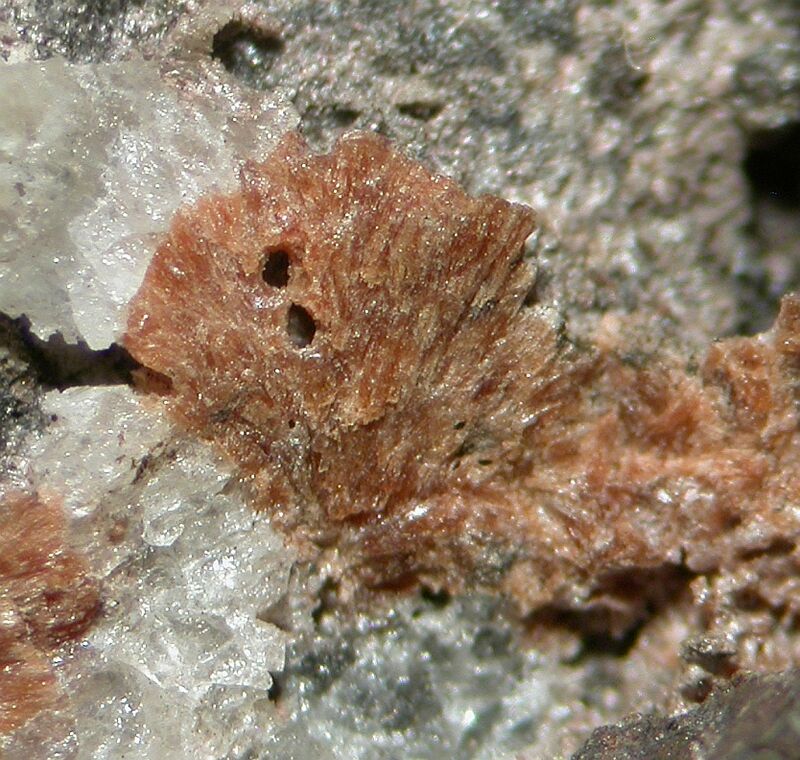
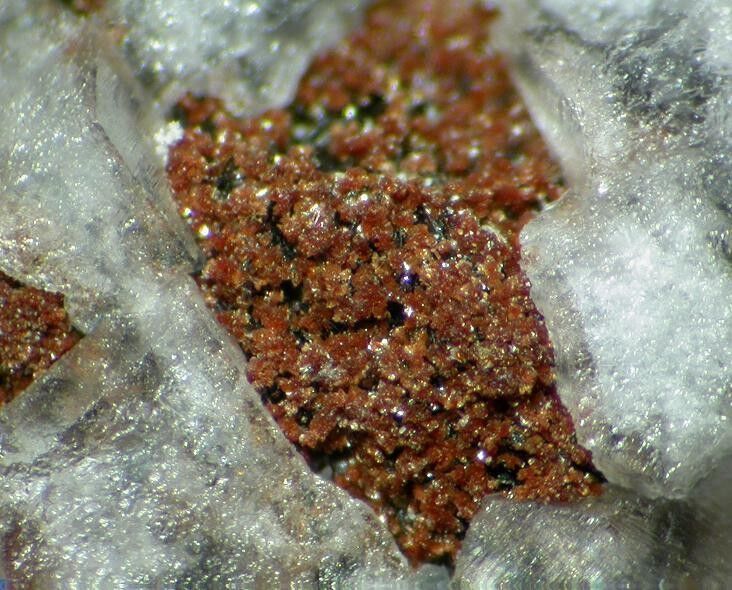
Crust; Pseudo-rhombohedral crystals; as finegrained pseudomorphs after anhydrous KCu-sulphates.
- Type-locality form
Asd polymineralic crusts (up to several dozens cm2 in area and up to 0.5 cm thick. Forms fine-grained pseudomorphs after anhydrous KCu-sulphates, mainly euchlorine, fedotovite or piypite, usually with their relics.
Crystal structure
Chemical composition
Synonyms
- IMA2013-037
- Kaliochalciet
In other languages
- German
- IMA 2013-037 · Kaliochalcit
- Italian
- kaliochalcite
Classification
Strunz
10th ed.7.DF.10
- 7SulfatesClass
- 7.DSulfates (selenates, etc.) with additional anions, with H2ODivision
- 7.DFWith large and medium-sized cationsGroup
- 7.DF.10KaliochalciteSpecies
Group, growth & confusion
- AlumolukrahniteCaCu2+Al(AsO4)2(OH)(H2O)Mineral—
 CabalzariteCaMg2(AsO4)2 · 2H2OMineral—
 CobaltlotharmeyeriteCaCo2(AsO4)2 · 2H2OMineral—
- CobalttsumcoritePbCo2(AsO4)2 · 2H2OMineral—
 FerrilotharmeyeriteCaZnFe3+(AsO4)2(OH) · H2OMineral—
 GartrellitePbCuFe3+(AsO4)2(OH) · H2OMineral—
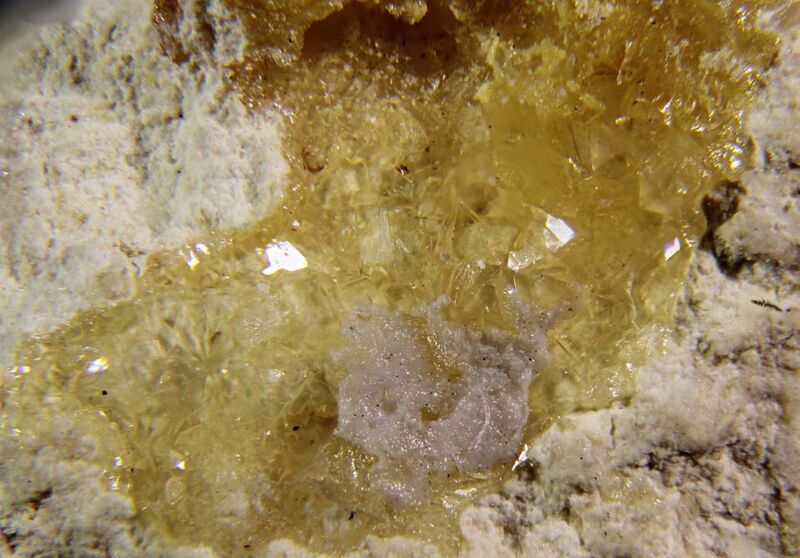 HelmutwinkleritePbZn2(AsO4)2 · 2H2OMineral—
- KrettnichitePbMn3+2(VO4)2(OH)2Mineral—
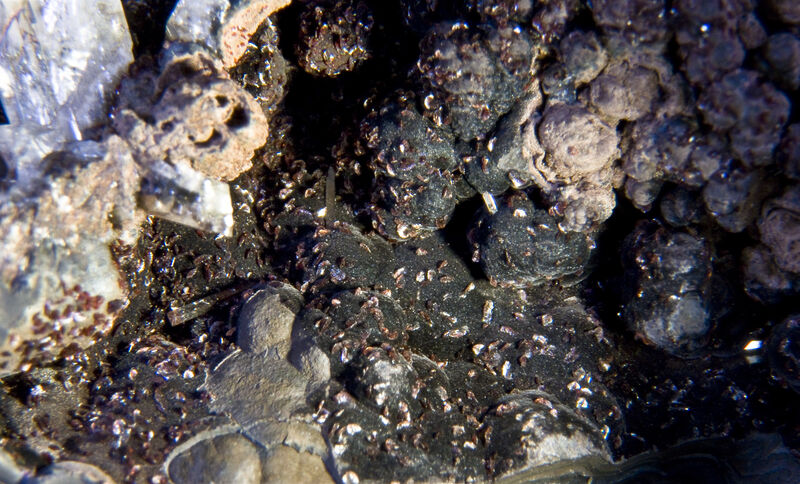 LotharmeyeriteCaZn2(AsO4)2 · 2H2OMineral—
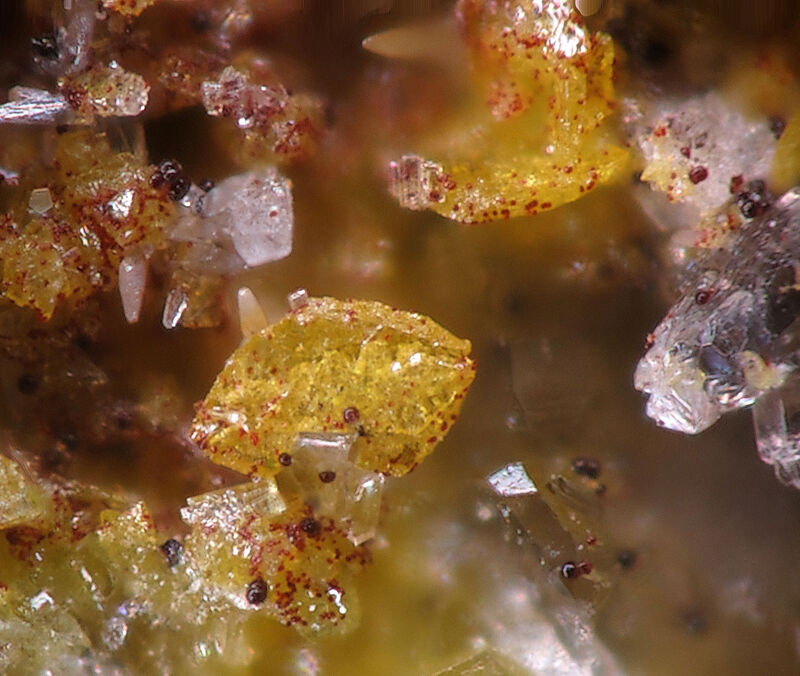 LukrahniteCaCuFe3+(AsO4)2(OH,H2O)2Mineral—
Literature, links & citation
Citations
- 2013Williams, P. A., Hatert, F., Pasero, M., Mills, S. J. (2013) New minerals and nomenclature modifications approved in 2013. CNMNC Newsletter No.17. Mineralogical Magazine, 77 (7) 2997-3005 doi:10.1180/minmag.2013.077.7.09DOI: 10.1180/minmag.2013.077.7.09
- 2014Pekov, Igor V., Siidra, Oleg I., Chukanov, Nikita V., Yapaskurt, Vasiliy O., Belakovskiy, Dmitry I., Murashko, Mikhail N., Sidorov, Evgeny G. (2014) Kaliochalcite, KCu2(SO4)2[(OH)(H2O)], a new tsumcorite-group mineral from the Tolbachik volcano, Kamchatka, Russia. European Journal of Mineralogy, 26 (4) 597-604 doi:10.1127/0935-1221/2014/0026-2394 DOI: 10.1127/0935-1221/2014/0026-2394
- 2016(2016) Kaliochalcite. Handbook of Mineralogy. Mineralogical Society of America
Cite this entry
Entry last updated
@misc{mineral2025,
  author    = {Mineral Index editorial board},
  title     = {Kaliochalcite — Mineral Index},
  year      = {2025},
  url       = {https://mineralindex.org/minerals/kaliochalcite-43901}
}